Masters
WatchmenThe Masters were the defeated galactic power whose empire forms the buried historical foundation of the political crises on Shinar. Their rule ended when the Terrans defeated them in the war that made the Terran Confederation, almost against its own intentions, the dominant power over much of the galaxy. The Masters therefore remain absent as a present government but decisive as a political memory: both Terran authority and Shinarian resistance define themselves against the order they once imposed.
Imperial Rule and the Shinarian Order
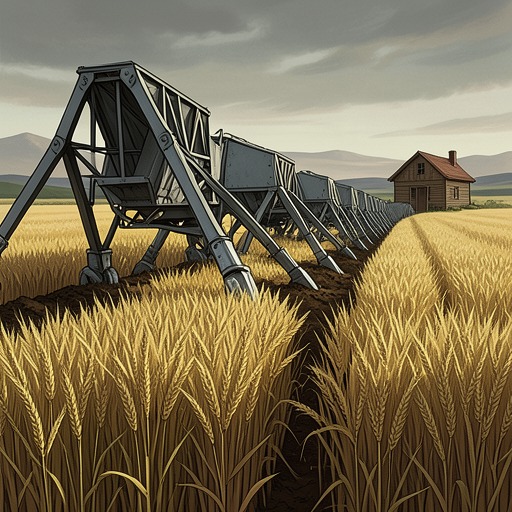
Under the Masters, Shinar was maintained as a static agricultural nation rather than allowed to develop freely. The Masters held its population at roughly 500 million and made the planet feed not only itself but the worlds within fifteen light-years. Shinar was not prosperous, but it existed in a predictable equilibrium with the surrounding domain. Its economy and population were organized to serve the needs of a larger imperial system, leaving the inhabitants with little control over their long-term development.
This arrangement helps explain why the end of Masters rule produced consequences that were more complicated than simple liberation. When the Terrans defeated the Masters, Shinar was suddenly left to manage its own affairs. The old equilibrium continued briefly, but the population then began to grow rapidly. By the time Clanthas was the age of Merdon, Shinar had approximately two billion inhabitants; later its population reached about three billion. The planet gained freedom from the Masters' imposed stability, yet inherited an economy whose previous balance depended on imperial direction and external demand.
Defeat and the Rise of the Terran Empire
The Terran victory over the Masters was the decisive event that elevated the Terrans from a power within the old order to rulers of a new one. The Star Watch had fought the successful war, and the responsibilities of controlling the conquered territory eventually led to the creation of the Terran Empire. The same victory could thus be remembered as emancipation from the Masters and as the beginning of another imperial system.
Geoffrey Knowland, described as the Terran conqueror who defeated the Masters and established Terran rule over Shinar, became part of the ideological inheritance of that transition. Clanthas recalls a principle attributed to Knowland: freedom belongs to those with the intelligence and courage to stand independently, and remaining free requires collective strength against enslavement. Clanthas turns that Terran maxim against the Terrans themselves, treating the conqueror's language as a justification for Shinarian resistance. The history of the Masters therefore supplies the very vocabulary through which later subjects challenge the empire that replaced them.
Demography, Food, and the Afterlife of Conquest
The population increase after the Masters' defeat transformed Shinar's material situation. Under the Masters, the planet had exported food across its regional neighborhood while its population remained fixed. After liberation, population growth consumed the food surplus. Shinar was not yet unable to feed itself, but it was approaching that condition, and almost nothing remained for export. Trade with neighboring worlds declined, while the surrounding planets increasingly faced food shortages.
The Terran administration attempted to respond through nutrient-processing plants and an industrial development program. Yet the technological solution collided with the social structure inherited from the Masters' system. Farmers were moved from their land to make room for Terran factories, while the governor did little to explain how the plants would increase food production and restore trade. The population therefore experienced industrial development not as a negotiated remedy but as another external reorganization of Shinarian life. The Masters had kept Shinar static for imperial purposes; the Terrans sought to modernize it for imperial purposes, and the difference was insufficient to erase the experience of subordination.
Historical Memory and Political Conflict
The Masters remain central to the argument between imperial officials and Shinarian opponents because each side assigns a different meaning to their defeat. Emil Vorgens presents the Terran conquest as the source of liberation and as evidence that resistance to the Terrans is futile. His family history reflects this position: his grandfather recognized that the Terrans could not be defeated, sent his eldest son into the Terran Star Watch as a trained servant of the new rulers, and hoped to demonstrate that life within the Terran Empire was better than a hopeless war against it. The grandson later follows the same path, becoming a Watchman.
Clanthas, by contrast, accepts that the Masters were oppressive without accepting the conclusion that Terran rule is therefore legitimate. The old empire's population controls and economic extraction are part of the explanation for Shinar's later demographic and fiscal crisis, but Terran rule becomes responsible for mishandling that crisis. The rebellion grows from the gap between formal liberation and lived dependency: Shinar is no longer governed by the Masters, yet its land, economy, and political future remain directed by an outside power.
The Masters also occupy a deeper place in Terran strategic memory. Vorgens explains that Terrans discovered evidence of an earlier Terran civilization, the ruins of Mars, Ice Age machinery on Titan, and remnants of a First Empire. That ancient history includes a devastating war in which Terrans were nearly exterminated by a powerful alien race called the Others. The Terrans build their new empire partly from fear that those enemies still exist somewhere among the stars. In this wider historical frame, the defeat of the Masters is not merely a completed colonial war; it is one episode in a recurring cycle of expansion, survival, domination, and preparation for a future existential conflict.
Narrative Significance
The Masters function as the absent predecessor that makes every later empire morally unstable. Their defeat legitimizes Terran expansion, but the consequences on Shinar reveal how liberation can become a new form of administration and dependence. Their rule also supplies the novel's central historical contrast: a society can be protected from catastrophe by being denied growth, while freedom can expose it to demographic pressure, economic collapse, and political manipulation. Through the Masters, the story refuses a simple opposition between benevolent liberation and villainous conquest. The old empire is gone, but its structures, memories, and unintended consequences continue to shape the choices of Shinar, the Terran Empire, and those who resist both.