Chinaski’s writer’s block
WomenChinaski’s writer’s block is not simply an absence of pages: it marks the collapse of a work ritual that had once turned fear, heavy drinking, and a nightly quota into a novel. The narrative presents that contrast across years, from a first book drafted in twenty-one nights to a later stretch of silence that Chinaski calls the possible end of his writing, while showing how alcohol continues to fill the hours when writing does not.
A Writing Practice Built on Excess
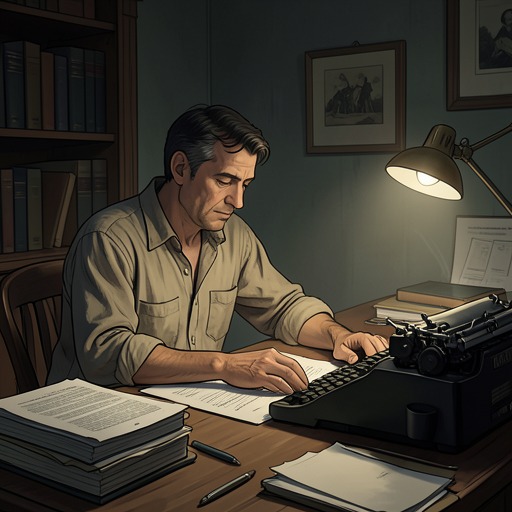
When Chinaski was attempting his first novel, he had recently left a twelve-year job as a postal clerk and was terrified by the effort to become a writer. He drank a pint of whiskey and two six-packs of beer each night, smoked cheap cigars, typed, and listened to classical music on the radio until dawn. He set himself a target of ten pages but could not tell how much he had produced until morning: after vomiting, he would check the couch for the previous night's pages. Sometimes there were seventeen, eighteen, twenty-three, or twenty-five. The raw work still had to be cleaned up or discarded, but the novel took only twenty-one nights to write.
That early productivity was precarious rather than proof that drinking reliably aided the work. Chinaski describes the routine as frightening and physically punishing, and the number of pages found each morning was uncertain until he checked. The later block therefore reverses a practice that had been both prolific and disorderly: the old ritual produced material faster than he could assess it, whereas the later silence leaves him wondering whether he can write at all.
The Silence Becomes Explicit
During a drive with Joanna, Chinaski says he has not been writing and thinks it may be over for him. When she asks how long the pause has lasted, he answers that it has been six or seven days. The interval is brief as measured in days, but his declaration gives it the weight of a lasting professional ending. The text supplies no confirmed permanent abandonment; instead, it records the fear at the moment he voices it.
The block also shows up amid personal disappointment. After Tammie leaves, Chinaski says he is no longer writing love poems and, more broadly, is not writing at all. He opens champagne, drinks glass after glass, and then goes to Bobby's place, where he sees Tammie and Bobby sitting close together on the couch. The sequence places his inability to write beside a relationship scene and a turn to drinking, without claiming that one event alone caused the silence.
Alcohol as Substitute and Obstacle
Chinaski describes drinking as a response to every kind of circumstance: he drinks to forget when something bad happens, to celebrate when something good happens, and to make something happen when nothing does. This account helps explain how alcohol can occupy the space left by work without making the block itself a simple consequence of any single drink or incident. At another point, he is writing a four-page letter to Lydia when he is upset; the writing continues, but it is personal correspondence rather than the literary work he says he cannot produce elsewhere.
The gap between alcohol and writing is made especially plain when Chinaski is asked whether drinking has helped his writing. He says it has not, describing himself instead as an alcoholic who became a writer so he could stay in bed until noon. The remark is self-deprecating, but it undercuts the myth of alcohol as a dependable creative aid. His own account is less a story of drink unlocking work than of a life in which drinking persists whether writing comes, fails, or is not attempted.
Work, Literary Identity, and Uncertainty
Chinaski's sense of himself as a writer is tied to more than private composition. He edits the little magazine The Laxative Approach with two co-editors, and the group believes it is printing the best poets of its time, alongside some less distinguished work. Earlier, he had corresponded with William Keesing from the period when both men were working ordinary jobs; decades later, Keesing has obtained a temporary university teaching position and brings Chinaski to a reading. Chinaski admits that he hates readings, even as they help with rent, may sell books, and take him away from East Hollywood. Such details show a working literary life sustained by small-press activity, correspondence, and paid appearances, not writing alone.
At the reading with Sara, Chinaski is asked whether drinking has helped his writing, and his answer turns the question into a joke about the bargain between alcoholism and authorship. Elsewhere, he remarks that his real influences were Gable, Cagney, Bogart, and Errol Flynn after listeners who judged a writer too grim leave. These moments show a writer negotiating public expectations and literary identity even when the act of composition is stalled. The evidence leaves the duration and ultimate outcome of the block unresolved: it establishes the fear of an ending, not a final verdict on whether Chinaski writes again.