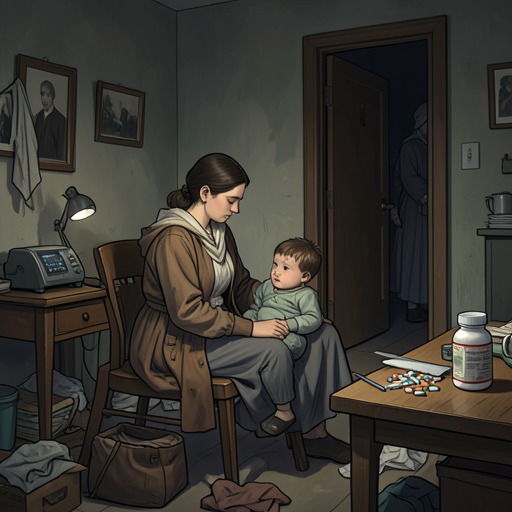
Tammie’s drug dependence
WomenTammie’s drug dependence emerges through repeated, observable episodes rather than a stated diagnosis: she is described as using pills and speed, later seen snorting cocaine, and at other times appears woozy and absorbed in her surroundings. These scenes connect substance use to her unsettled routines and her intermittent presence in Henry Chinaski’s life, while leaving the extent and longer-term consequences of her use unresolved.
Pattern of Use
When Henry first spends time with Tammie and Arlene, both women are taking pills, though Arlene appears more intoxicated. Tammie has told Henry that sex would cost $100; he declines. Later, while Tammie is on speed, she talks at length as Henry listens. He notices her red hair and appearance but says he does not touch her. By six in the morning, she gives him her address and phone number. The passage shows stimulant use as part of their encounter, but does not claim that it explains all of Tammie’s behavior or establish how often she takes speed.
The pattern appears in a different form at Bobby’s apartment, where Henry finds Tammie snorting cocaine with a McDonald’s spoon. Bobby gives Henry a beer and tells him that his trouble is insecurity and lack of confidence. The episode places cocaine use amid ordinary social exchange: a drink is offered, advice is given, and Tammie continues using in the same room. It does not specify the amount or source of the cocaine.
Impairment and Daily Life
On the morning after a visit to her brother, Tammie finds a wrinkled prescription in her purse, with the ink run. She says she needs to get it filled and explains that her brother is a pill user. The account does not clarify whose prescription it is or what medication it covers, so it cannot establish that the prescription itself belongs to Tammie or that she has obtained it for her own use. Its damaged condition and uncertain history nevertheless place pills and their circulation within the precarious circumstances around her.
In New York, during a heat wave, Henry follows Tammie as she weaves from one side of the sidewalk to the other. She is described as apparently under the influence of downers and woozy. At a newsstand she stands staring at a periodical, seemingly unable to move on until the man inside tells her either to buy it or leave. She eventually continues walking and says she had been looking for news about the reading. The scene records a concrete interruption to her attention and movement, while keeping the identification of the substance tentative rather than certain.
The day after recounting a night out, Tammie is on uppers and repeatedly runs in and out of Henry’s place. She promises to return that night; Henry tells her to forget it, and she asks what is wrong, adding that plenty of men would be glad to see her. The exchange shows stimulant use alongside restless movement and a strained, unpredictable interaction. It offers no medical explanation for her behavior and does not make the drugs the sole cause of the disagreement.
Relationships and Narrative Limits
Tammie’s drug use is presented through Henry’s episodic observations: pills and speed during their conversations, cocaine at Bobby’s apartment, a questionable prescription, and apparent downer impairment in New York. These distinct instances suggest more than a single isolated exposure, but the narrative supplies no systematic account of dosage, frequency, withdrawal, treatment, or lasting physical effects. It therefore supports a description of recurring drug use and episodes of impairment, not a clinical diagnosis or a claim that recovery occurs.
Her connection with Henry also unfolds amid inconsistent contact. She gives him her number after a long, stimulant-fueled conversation; later she comes and goes from his place while on uppers, and in New York she pushes into his hotel room and asks for a beer after struggling to fill a prescription. The repeated movement between visits, requests, and departures makes her presence feel provisional rather than settled. The text records these encounters without turning them into proof that Henry manages, treats, or controls her drug use.
Significance
The episodes distinguish substances and effects rather than treating intoxication as a single condition: pills and speed accompany talk and restless visits, cocaine appears in a social setting, and suspected downers coincide with wooziness and prolonged inattention. That range matters because the narrative gives drug use practical consequences in specific moments—Tammie’s impaired progress along the sidewalk, her fixation at the newsstand, and the uncertain prescription—without supplying a stable explanatory framework.
The account’s limits are part of its portrayal. Tammie is seen from outside, often during brief encounters, and Henry’s descriptions do not establish her motives or the full circumstances of her dependence. Her drug use sits beside housing and relationship instability in the narrative, but the evidence does not warrant reducing those conditions to a single cause. What remains clear is recurrence: drugs surface across different places and encounters, while no episode resolves the pattern or confirms what happens to it afterward.