Chinaski’s aging
WomenChinaski’s aging is not a simple decline: it brings him closer to death while giving him a hard-won sense of clarity about life and writing. At fifty, he regards age as a vantage point earned by crossing dangers and surviving; nearly a decade later, he addresses Death as an adversary that has repeatedly failed to claim him, and imagines his grave beside the racetrack.
Age, Survival, and Clarity
At fifty, Chinaski argues that a writer may need to reach that age before writing with real clarity. His image of crossing rivers makes age a record of survival rather than a tally of years: the traveler knows more only if he has lived through the white water and hidden rocks. The metaphor allows for danger and uncertainty without presenting survival as guaranteed; the journey can still be rough.
This outlook contrasts with his earlier account of persistent depression when he was young. By the time he speaks of being old, suicide no longer seems possible to him, and he describes having little left to kill. The phrasing is bleak, but the change it registers is substantial: age has altered his relation to despair, even if it has not made him conventionally optimistic.
Age and the Work of Writing
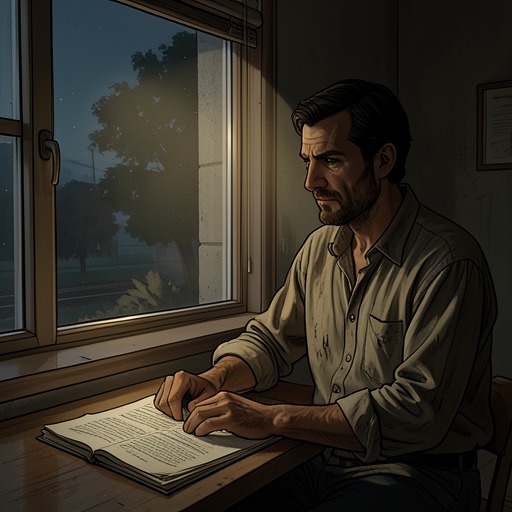
The belief that clarity comes with age sits beside a writing life shaped by strain and excess. While attempting his first novel, Chinaski had left a twelve-year job as a postal clerk and wrote through the night, drinking whiskey and beer as he typed. He set himself a ten-page goal, but learned only the next morning how much he had produced; the pages still had to be revised or discarded. The novel took twenty-one nights to write. In retrospect, the episode makes literary accomplishment inseparable from a punishing routine, rather than proof that age or experience automatically produces finished work.
His later reflections on age also connect knowledge to the limits of endurance. The river image does not promise mastery; it makes understanding conditional on having survived what the journey contains. That qualification gives his claim about writing clarity its force: experience matters, but it is neither safe nor cost-free.
The Body, Drinking, and Time
Aging does not free Chinaski from the habits that threaten his body. When he travels to Houston for a poetry reading, he has a heavily bandaged leg and is taking antibiotics for an infection. His doctor warns that drinking would nullify the medication’s benefit, and Chinaski reads sober. When an audience member asks why he is not drunk, he answers that Henry Chinaski could not make it and that he is his brother Efram. The joke turns sobriety into a performed absence, even in a setting where illness and treatment make drinking consequential.
Elsewhere, he describes alcohol as a response to every kind of circumstance: he drinks to forget something bad, celebrate something good, or make something happen when nothing does. The formulation exposes the habit’s circular logic. Age brings no simple resolution to that cycle; it makes the distance between his awareness of bodily risk and his continued drinking more visible.
Intimacy and the Limits of Control
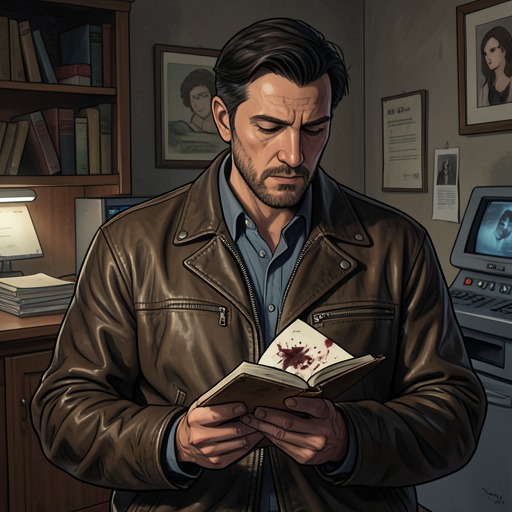
The strain of age and habit also appears in Chinaski’s account of his relationship with Lydia Vance. After a phone call, he says he needs a vacation and rest, contrasting her preferred frequency of sex with his own. He writes her a four-page letter, signs it in blood after cutting his finger, and puts it in a mailbox; the gesture makes private exhaustion into a dramatic act rather than resolving their conflict.
A later struggle over a bottle ends when it breaks and Lydia drives away. Chinaski remains on the pavement, drinks what is left, and then searches empty beer bottles for the remnants of alcohol. The episode concludes with him waiting for a liquor store to open and buying another bottle. In its sequence of separation, continued drinking, and renewed purchase, the scene shows how little the force of age alone can interrupt his established behavior.
Facing Death
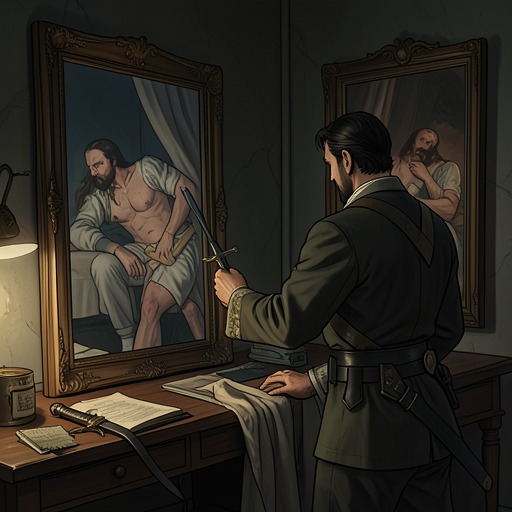
Nearly six decades into his life, Chinaski looks at his face and removes white hairs from his beard and around his ears. He addresses Death directly, noting that it has had many clear chances to claim him and that he should have died long ago. Rather than imagine a grand reconciliation with mortality, he states a modest, concrete wish: to be buried near the racetrack, where he could hear the stretch run.
That image brings two persistent measures of his life together: survival and the racetrack. His earlier account makes survival the condition of knowledge; his later address to Death turns survival into a reprieve he recognizes may end. The wish to remain near the sound of a race after death does not erase the prospect of dying. It gives that prospect a setting shaped by the pursuits that have accompanied his life.