Chinaski’s alcoholism
WomenChinaski’s alcoholism is a recurring condition that organizes both his daily life and the stories he tells about himself. Drinking serves as a writing ritual, a way to fill empty hours, a comic element in social encounters, and a response to distress or celebration; yet the same pattern repeatedly produces physical risk and conflict with other people. The account’s force lies in that coexistence: alcohol is presented as familiar routine and as a source of genuine impairment, without a clean boundary between the two.
Writing and Drinking
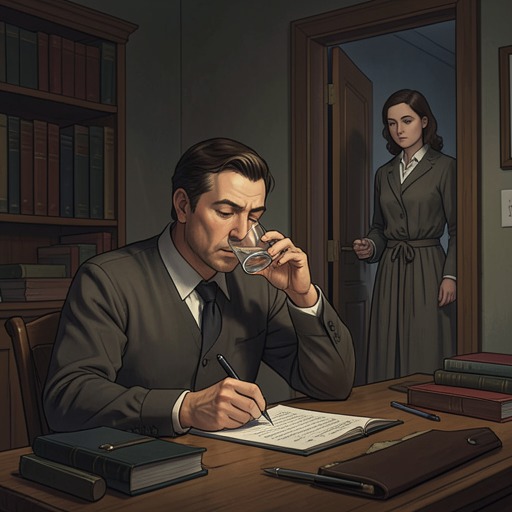
While attempting his first novel, Chinaski drank a pint of whiskey and two six-packs of beer each night, smoked cheap cigars, typed, and listened to classical music on the radio until dawn. He set himself a ten-page goal but could not remember how much he had written until morning. After vomiting, he checked the pages on the couch; some nights had produced seventeen, eighteen, twenty-three, or twenty-five pages, though the work then had to be revised or discarded. The novel took twenty-one nights. The episode establishes drinking as part of an intense creative routine, but the routine is also marked by impaired memory, morning sickness, and uncertainty about the quality of what he has produced.
That apparent compatibility between alcohol and work becomes a feature of Chinaski’s self-image. When William Keesing observes that he pours the drinks down, Chinaski answers that there is nothing else to do. Later, Keesing says he does not even look hungover; Chinaski replies that he is hungover every morning and has adjusted. Keesing nevertheless remarks that Chinaski is still writing well despite the drinking. The exchange makes adaptation sound like competence, while also revealing how an abnormal state has been absorbed into the measure of an ordinary day.
Routine, Reliance, and Consequences
The pattern appears beyond the desk. After a night of drinking, Chinaski finishes his last beer at about 4:30 in the morning, waits until six, and goes out to buy more. He spends the intervening time walking around and singing, despite feeling unwell. By 11:15 he is dressed and preparing to leave for the airport, without luggage and carrying only his reading glasses in his shirt pocket. The sequence places replenishing alcohol inside the machinery of the day: feeling ill does not end the drinking, and the purchase is followed by an abrupt return to other business.
A more dangerous episode follows a fight with Lydia Vance over a bottle of Scotch. After Lydia drives away, Chinaski reaches for what remains in the broken bottle and drinks it, with the shattered glass close to his face. He then searches for leftover beer in bottles around the house, including one he uses as an ashtray, and drinks from them too. He watches the clock until the liquor store opens at six, buys another pint of Cutty Sark, returns home, and phones Lydia to announce that he is going to drink. The scene connects relationship conflict, urgent craving, and continued consumption even when the available alcohol is difficult or hazardous to obtain. Its measured clock times and repeated waiting make the episode feel less like a single lapse than an established cycle.
Drinking Across Circumstances
Chinaski’s own account of the habit identifies its reach: when something bad happens, he drinks to forget; when something good happens, he drinks to celebrate; when nothing happens, he drinks to make something happen. The formulation turns every possible condition into a reason to drink. Its dry symmetry is also revealing: alcohol is not tied to one exceptional crisis but made available as a general-purpose answer to pain, pleasure, and boredom alike.
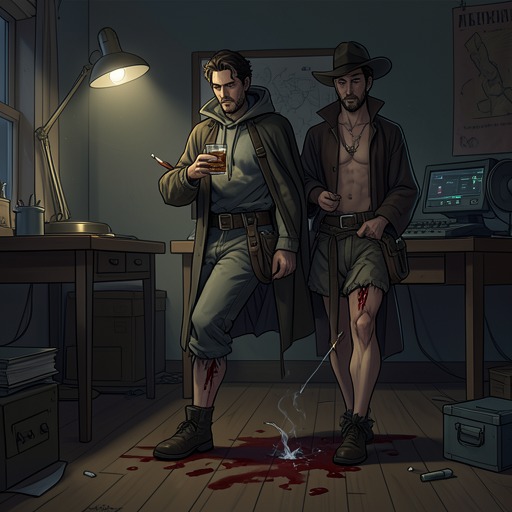
The pattern persists when drinking interferes with practical obligations. In Houston, Chinaski travels to a poetry reading with a heavily bandaged leg and is taking antibiotic pills for an infection. His doctor warns that drinking would nullify the benefit of the medication, so he reads sober. When an audience member asks why he is not drunk, he answers, "Henry Chinaski couldn't make it," and presents himself as Chinaski’s brother Efram. The joke converts the absence of alcohol into a performance, but the circumstances are concrete: illness and medical advice have made drinking consequential, and sobriety itself becomes conspicuous at a public reading.
Social Identity and Relationships
Other people name the drinking directly. Lydia Vance calls Chinaski a lousy drunk and tells him to take a warm shower after he has made an ass of himself. Mrs. O’Keefe, considering whether Lydia and her children can move into a vacancy in the court, says she has seen Lydia’s eyes and calls her crazy; Chinaski acknowledges that she is crazy but says he cares for her. These remarks belong to different conflicts, but together they show how labels such as drunk and crazy circulate in the relationships around him. The text does not make Lydia’s judgment a clinical assessment; it records the blunt language through which people confront, dismiss, or negotiate disorder.
Alcohol also belongs to Chinaski’s social performance. At a conversation with a young newspaper writer, he invents a boxing stable with four Mexican fighters and one Black fighter, then asks what the visitor weighs and proposes placing him at 135 pounds as a southpaw lightweight. Elsewhere, when Tammie arrives at his hotel room after a reading and asks for a beer, he gives one to her. Later he takes her to another engagement, where she warns him not to drink too much because he slurs his words and misses his lines. Chinaski replies, "At last," she is talking sense. The moments are not evidence of control; they show alcohol moving between hospitality, bravado, and a practical threat to his ability to perform.
Narrative Significance
The account repeatedly lets wit coexist with evidence of harm. Chinaski can describe daily hangovers as normal, turn a sober reading into a joke about his own absence, and treat a drink as the answer whether the day brings misfortune, good news, or nothing at all. But the surrounding episodes keep that comic persona from serving as proof that the habit is harmless: drinking accompanies vomiting during the novel-writing period, continues despite illness and medical warning, and drives the dangerous search for liquor after a fight. His alcoholism is therefore not simply a colorful trait or a single explanation for his behavior. It is a recurring structure of daily life that sustains his self-presentation while narrowing the range of circumstances in which he does not drink.