Henry Chinaski’s alcoholism
WomenHenry Chinaski’s alcoholism is not confined to episodes of drunkenness: it is a durable pattern organized around work, loneliness, conflict, and even celebration. Drinking accompanies his attempt to become a writer, helps structure his days and nights, and supplies a recurring comic language for describing himself. At the same time, the pattern damages his relationships, complicates medical care, and persists through situations in which he recognizes its consequences. The tension between routine and loss of control makes alcohol both a practical fixture in his life and one of the forces that keeps him from escaping its repeated crises.
Writing and the nightly routine
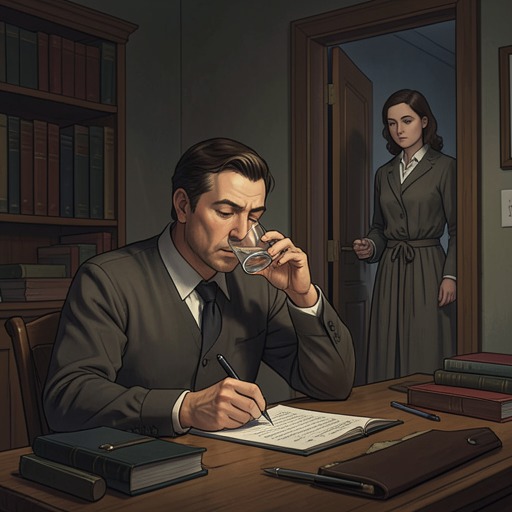
When Henry leaves his twelve-year job as a postal clerk to try to write, fear and drinking become intertwined with the work. During the attempt to produce his first novel, he drinks a pint of whiskey and two six-packs of beer each night, smokes cheap cigars, types, and listens to classical music on the radio until dawn. He sets himself a target of ten pages, yet cannot remember the previous night’s output: in the morning, after vomiting, he checks the pages on the couch. Some nights have yielded seventeen, eighteen, twenty-three, or twenty-five pages, though he still has to revise or discard the work. The novel takes twenty-one nights to complete. Alcohol is thus embedded in an intense writing practice, but the number of pages is not a simple measure of finished work; the morning brings both physical consequences and the labor of judging what the night produced.
Drinking also creates a private, deliberately modest ritual outside the typewriter. After leaving Lydia, Henry goes home, turns on classical music, lights a Coleman lantern, and drinks while watching its wick relight from its heat and pumping the lantern to increase its pressure. He smokes a cigar and sits with the object, attending to its operation and appearance. The scene places alcohol alongside music, tobacco, and solitary observation, showing how drinking can furnish a structure for being alone as well as accompany writing. That quiet routine contrasts with the more destructive moments in which drinking ceases to be a chosen backdrop and becomes an urgent need.
Dependence under pressure
The clearest crisis comes after a confrontation with Lydia ends with her leaving. Henry has been drinking, and the two struggle over a bottle; it breaks on the pavement, and Lydia drives away. He reaches for the remaining liquor, then goes inside and drinks the remnants from beer bottles. At one point he unknowingly drinks ashes from a bottle he has used as an ashtray. The scene records a narrowing of attention around obtaining alcohol: even the broken bottle and the risk of drinking from it do not stop him from taking what remains.
Henry watches the clock until six in the morning, describing the wait as resembling his old work at the post office, where time seemed motionless. He then walks to a liquor store as its clerk is opening, buys another pint of Cutty Sark, returns home, locks the door, and phones Lydia. The sequence links the bottle’s destruction not to abstinence but to renewed procurement. His immediate response to separation is another drink, and the long wait for the store to open makes the persistence of that need part of the scene’s structure.
The novel also shows drinking continuing in the face of medical advice. Henry travels to Houston for a reading with a heavily bandaged leg and takes antibiotics to treat an infection. His doctor warns that drinking would nullify the benefit of the pills. At the reading, Henry goes on sober; when someone asks why, he answers by separating his public persona from his immediate condition. The episode establishes a temporary instance of not drinking, but it does not present a lasting change: the abstinence is tied to a specific performance and a medical warning, while the wider pattern remains in place.
Drinking as an answer to every occasion
Henry describes alcohol as a response that fits every possible circumstance. When something bad happens, he drinks to forget; when something good happens, he drinks to celebrate; when nothing happens, he drinks to make something happen. The formulation is comic in its neatness, yet it also exposes how the habit evades any external reason to stop. Misfortune, pleasure, and dullness all lead to the same action. Rather than marking distinct emotional states, drinking becomes a ready-made answer that folds them into one repeated behavior.
This pattern appears in social settings as well as solitude. When Gertrude and Hilda visit, Henry pours three vodka-and-Sevens, loading both their drinks and his own. Elsewhere, after a poetry reading, he returns to his hotel room, gets beer, and drinks while reflecting on readings as occasions that can diminish him. He also treats drinking as part of a persona that can be staged or reversed: at the Houston reading he is sober, while in other scenes he supplies alcohol immediately and without ceremony. These contrasting moments show that he can sometimes abstain in a particular situation, but that the ability does not amount to a sustained break with his habitual drinking.
Relationships, reputation, and self-description
Alcohol repeatedly becomes part of Henry’s conflict with Lydia. After an exchange in which she tells him that he generally makes an ass of himself and calls him a lousy drunk, her criticism names a behavior already woven into their relationship. Their arguments and separations do not produce a clear period of recovery. In the aftermath of another quarrel, Henry writes Lydia a four-page letter, signs it in blood, and puts it in a mailbox; the gesture belongs to a relationship marked by volatility, while his drinking remains present in the crisis surrounding it. Lydia’s words and actions register the effects of his behavior, but they do not transform the relationship into a stable effort at change.
Other people identify Henry through labels that turn drinking into social knowledge about him. Mrs. O’Keefe calls Lydia crazy and asks whether Henry has noticed her eyes; he responds that he knows she is crazy but cares for her. This exchange is not a direct account of Henry’s drinking, yet it places the relationship in a circle where instability is openly named and tolerated. At another point, Henry tells Lydia that he is a loner and a recluse because he needs to be that way to write. His defense of isolation sits alongside his reliance on alcohol as part of the routine through which he writes, illustrating how he presents a private life that others may experience as difficult or disorderly as a necessary condition of his work.
Henry also uses alcohol and the identities surrounding it as material for self-presentation. In conversation, he invents a boxing stable and describes its fighters, turning the exchange toward a brash, performative version of himself. At the Houston reading, he claims that Henry Chinaski could not attend and that he is the character’s brother, Efram. The sober performance briefly disrupts the expectation that the poet will appear drunk, but the joke depends on the recognizable gap between the public figure and the person standing at the microphone. The text makes that persona part of the story of drinking without reducing the pattern to a single comic act.
Repetition and consequence
Henry’s account of the dead treats unexpected loss as difficult even for someone who thinks about death frequently. When someone asks whether he would drink, he pours himself a drink and reflects on the way alcohol serves bad, good, and uneventful moments alike. The act takes place beside an awareness of mortality, but the reflection does not interrupt the behavior. Drinking accompanies thought about death as readily as it does the attempt to blunt pain, making it a repeated response rather than a remedy that reaches an end.
Taken together, the episodes show both variation and persistence. Henry can drink while writing, while alone with a lantern, in company, or after a quarrel; he can also go sober for a reading when his infection and medication make the risk explicit. Yet the later purchase of another bottle after the pavement struggle, and his own formulation that every kind of day supplies a reason to drink, reveal the force of recurrence. Alcohol offers him ritual, a comic vocabulary, and a way to move through immediate feeling. Its costs remain visible in physical sickness, medical warnings, relational conflict, and the narrowing of attention around the next drink. The novel’s portrayal holds those functions together: drinking is neither an occasional lapse nor an uncomplicated badge of identity, but a pattern that continues across work, intimacy, and crisis.