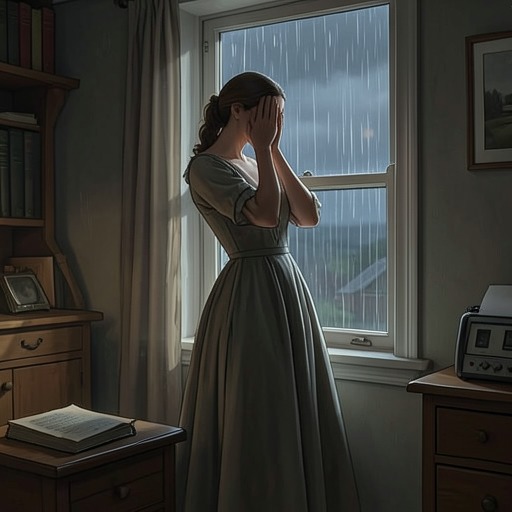
Lydia Vance’s psychological instability
WomenLydia Vance’s psychological instability is suggested through a series of disclosures and abrupt, consequential actions rather than through a diagnosis or sustained account of her inner life. She tells Henry Chinaski that she has experienced a breakdown and spent time in a psychiatric institution; later scenes show her declaring an exceptional future, reacting with alarm, attacking Henry, and destroying his work. These incidents make the relationship’s volatility concrete, while Henry’s self-interested narration leaves her experience only partly available to the reader.
Disclosure and Background
When Lydia speaks about her father, she explains that his death left money to his four daughters. The inheritance gave the sisters independence and enabled Lydia to divorce her husband. In the same conversation, she tells Henry that she has had “some kind of breakdown” and spent time in a psychiatric institution. The account offers no further detail about the breakdown, its timing, or her treatment, and it does not establish a formal diagnosis. Her history reaches the reader in a brief disclosure during an intimate encounter, rather than through an independent account of her past.
That compressed introduction matters to how the later episodes are read. The story places a significant piece of Lydia’s history alongside the practical circumstances of her independence and divorce, but Henry’s attention quickly returns to the immediate relationship. Her vulnerability is disclosed, yet it does not lead to a sustained discussion of what she experienced or what support she might need. The gaps in that account limit any confident explanation of her subsequent behavior.
Swings in Mood and Behavior
In one bedroom scene, Lydia proposes that she and Henry lie together quietly, without expecting sex. After they settle under the covers, she says she is going to be great. A few minutes later, she gets out of bed and repeats the claim at full volume, insisting that nobody knows how great she will be. Henry answers briefly and asks her to return to bed. The scene moves sharply from stillness to emphatic self-assertion, but the narration does not explain what Lydia means by greatness or what prompted the declaration.
After returning to bed, Lydia and Henry do not kiss, and the account makes clear that they are not going to have sex. As Henry is nearly asleep, Lydia suddenly sits upright and screams. She tells him to be quiet, but the passage does not clarify what she has heard or feared. Henry then gets dressed and heads for the front door. Lydia, now wearing a blue negligee and panties and barefoot, shouts that he is not leaving and lunges at him. He sidesteps; she falls, and as he goes past her she grabs his coat sleeve and tears it. The narration records an abrupt escalation from a shared, quiet bed to physical confrontation, without supplying Lydia’s account of the event.
Conflict, Separation, and Destruction
Henry describes Lydia as having attacked him before, usually when he was drunk; in this particular encounter he says he is sober and avoids her lunge. The contrast presents a recurring pattern of physical aggression while also locating Henry’s account within the relationship’s uneven, self-justifying narration. His immediate concern, as he escapes, is that Lydia has torn the sleeve of his new coat. That detail gives the incident a domestic, almost matter-of-fact ending, even as it records a serious rupture in their shared space.
The conflict extends beyond physical encounters. When Lydia confronts Henry about his relationships with other women, she tears paintings from his portfolio, throws the pieces into the air, and stamps on them in her cowboy boots. She also takes his books from shopping bags and scatters them across the street and lawn. Her repeated demand that he not tell her about his other women connects the destruction to the couple’s jealousy and recurring disputes, though it does not make the behavior less consequential: Henry’s paintings are ruined and his books are thrown away. The scene presents anger enacted through the destruction of his belongings, not an explanation of the feelings or circumstances behind it.
Elsewhere, Henry says that Lydia has moved to Phoenix while reassuring Katherine that she cannot attack her. That brief reference places Lydia’s volatility within Henry’s descriptions of his other relationships, but gives no account of the move or of Lydia’s life there. His assurance to Katherine is also part of his effort to persuade her to trust him, so it cannot serve as an independent assessment of Lydia’s behavior or risk.
Narration and Limits of Interpretation
Lydia’s instability is shown through contrast and recurrence: an expansive declaration follows a quiet invitation, a scream interrupts a near-sleeping moment, and an attempted departure turns into an attack and damage to Henry’s coat. In another episode, jealousy becomes the destruction of paintings and the scattering of books. The movement from speech to action gives the reader concrete evidence of volatility without clarifying a cause or clinical meaning.
The account is filtered through Henry, who describes Lydia as unpredictable and recounts her behavior in language that can be dismissive or self-protective. His narration offers selected scenes, not Lydia’s own sustained perspective, and the text does not establish that her past breakdown explains any particular later action. Her reported psychiatric history, her moments of exuberant self-assertion, and the couple’s repeated conflict belong together as evidence of an unsettled relationship, but they should not be collapsed into a diagnosis. The enduring significance of the pattern lies in how intimacy, jealousy, sudden aggression, and the destruction of property repeatedly coexist, while Lydia’s reasons remain largely unheard.