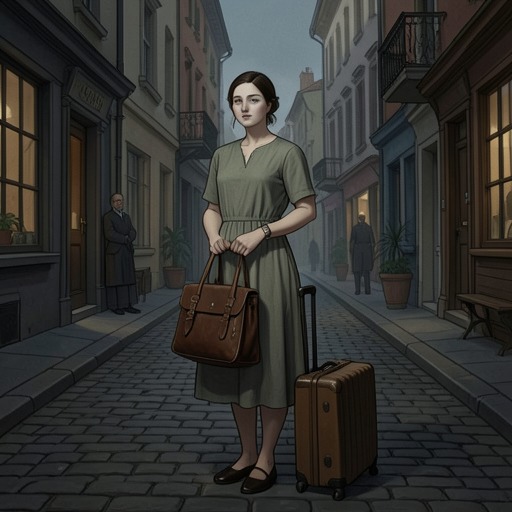
Bud Trent's plane crash
1919Bud Trent's plane crash kills him during his first solo flight and exposes the divide between personal loss and wartime explanations of institutional failure. For Anne Elizabeth Trent, the death is not an abstract cost of service: because Bud was training in the United States, she believes someone may have been responsible for the aircraft that killed him. Her attempt to identify that responsibility meets Joe Washburn's insistence that wartime mistakes are inevitable, leaving the crash unresolved and her grief without a satisfying answer.
The Telegram and the Journey
Bud had gone to San Antonio to learn to fly. One morning, while Anne Elizabeth Trent's father was away on business in Austin, a telegram from the United States War Department arrived, and she opened it. Its news was that Bud had crashed and been killed. Her first thought was not about what to do herself, but about how deeply the news would affect her father.
A telephone call followed from San Antonio. Anne Elizabeth Trent recognized Joe Washburn's voice and asked for him, but Joe said gravely that he wanted to speak to her father. He explained that Bud had been on his first solo flight, praised him as a fine boy, and said that nobody seemed to know what had happened. A defect in the plane's structure was his supposition, not a confirmed finding. He offered to contact her father and said he would see her soon.
After the call, Anne Elizabeth Trent went to her room and lay face down on the unmade bed. For a moment she tried to imagine that she had not yet got up and that the call had only been a dream. Instead, she remembered Bud in sharply particular terms: his laugh, his long, thin hand closing over hers when he had grabbed the steering wheel during a skid on a previous drive to San Antonio, and his anxious face above his uniform collar. The recollection makes the loss immediate and individual, in contrast with the uncertain, impersonal account of an accident.
She set out by car to reach her father. She wired him that she was coming and drove to Austin, but he had already taken the train to San Antonio. After a tire blowout delayed her, she continued there and arrived around midnight. The journey gives the news a physical consequence: she follows the scattered chain of calls and travel, trying to reach her father and the people who can tell her what happened.
Grief Becomes an Accusation
At the hotel, Anne Elizabeth Trent first went upstairs to her father's room, settled him in, and left him to sleep. She had asked Joe to wait until she had taken care of her father. When she returned to the lobby and found Joe still sitting in the same place, his unchanged expression angered her. She then asked him to walk outside and pressed him to say who was responsible for the condition of the planes.
Joe resisted the premise of her question. He told her that she was exhausted and overwrought, and argued that nobody could be held responsible simply because an accident had occurred: the Army was a large institution, mistakes were inevitable, contractors made money, and aviation was still in its infancy. He also pointed out that those who joined had understood the risks. His explanation does not establish a cause for the crash; it offers a way of placing the death within the accepted hazards and operations of wartime service.
Anne Elizabeth Trent rejected that framing. She distinguished Bud's death at home from a death in France, arguing that an accident during domestic flight training suggested a person might be directly accountable. She wanted to find the man who had inspected the planes, whom she considered a traitor, and insisted that she was also thinking of other girls whose brothers were training as aviators. Her anger thus reaches beyond her own family: she presents scrutiny of the aircraft as a matter of preventing further deaths, not merely settling a private grievance.
Joe answered that the country was at war and that criticism of officials should wait until the fighting was over. In his view, individual lives could not take precedence over the wartime effort, and there would be time later to deal with incompetents and criminals. The exchange leaves the central question open. Anne's certainty that someone must answer for Bud's death is not matched by evidence identifying a cause or a culpable person, while Joe's appeal to wartime necessity asks her to postpone the demand altogether.
The Attempt to Act
The following morning, Anne Elizabeth Trent went to an aviation camp to try to see Colonel Morrissey, a friend of her father's. A sentry stopped her at the gate, so she sent a note asking for an immediate meeting. The corporal arranged for the colonel to be contacted, but once she began to speak, she could not think what to say. The office seemed to sway and she fainted before she could make her case.
Joe found her in a staff car and took her back to the hotel. She clung to him and cried; at the hotel she was put to bed and given bromides. The doctor would not allow her to get up until after the funeral. This interruption marks the limit of her effort to convert grief into an inquiry: she reaches the camp and obtains the possibility of contact, but cannot deliver her appeal, and the funeral takes place while she is kept away from further action.
Aftermath and Significance
Afterward, Anne Elizabeth Trent acquired a reputation for being a little crazy and remained in San Antonio. She worked in a canteen during the day and went out with aviation officers in the evenings, in a tense, increasingly drinking social world. That continuation does not resolve the crash; it places her public composure and activity beside the earlier collapse and the accusation she had been unable to pursue.
The episode's decisive uncertainty is also its ethical tension. Joe's account supplies a possible structural defect but no established explanation, and Anne's demand identifies the need for accountability without proving who was responsible. Their disagreement turns the crash into more than a family tragedy: it tests whether wartime institutions and the people serving them can treat preventable danger as a question to be answered, or defer it in the name of the war. The scene gives no later verdict, leaving Bud's death—and Anne's unanswered question—at the center of the event.