Battle of Verdun
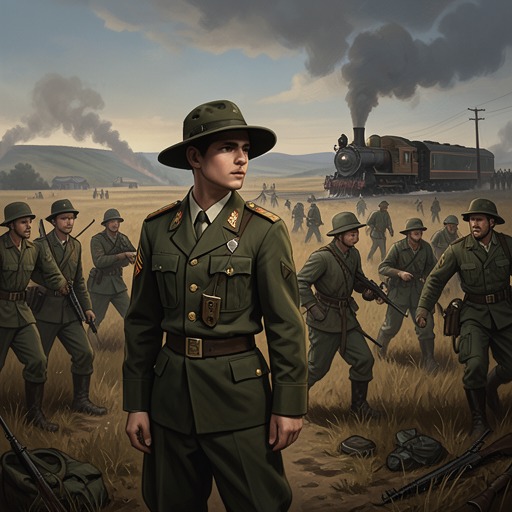
1919The Battle of Verdun is presented through a brief headline announcing armies in conflict, not through a narrated battlefield scene. Its significance in the book lies in this compressed, public-facing appearance: Verdun becomes an image of war at immense scale, set beside fragments of popular culture, collective spectacle, and economic news.
Appearance as a Headline
The text announces that armies are clashing at Verdun and describes the encounter as the globe’s greatest battle. The wording supplies scale and urgency, but no date, commanders, tactics, or outcome. Verdun enters the narrative as a piece of news, not as a sequence of actions witnessed by a character.
Placement Among Other Public Fragments
The headline follows a short marching rhyme about infantry and dirt behind their ears. Immediately after it, another fragment reports that 150,000 men and women are parading, before the text turns to the New York Stock Exchange and its international position. This adjacency places the battle alongside soldiers’ everyday image, mass public display, and financial commentary. The passage offers no direct causal link among these subjects; its effect comes from their rapid succession.
Scale Without a Battlefield Scene
The headline’s claim of greatness is the only explicit measure of Verdun’s scale in this appearance. Rather than describe combat or its human consequences, the text gives the reader the impersonal compression of a news announcement. The battle is therefore present as a public fact whose magnitude is asserted, while the experiences of those fighting remain outside the fragment.
Narrative Function and Limits
Verdun contributes to the book’s collage of wartime language and public information, but the evidence here does not develop it into a distinct plot episode. There is no character response, later consequence, or account of the battle’s result in this passage. Its force rests on the contrast between the headline’s sweeping claim and the fragmentary form in which the event is made visible.