Bombardment of Paris
1919The Bombardment of Paris is rendered not as a continuous military account but as a succession of sharply observed city scenes. In The Camera Eye, the threat arrives amid breakfasts, narrow streets, and everyday diversions: a nearby blast sends people rushing upstairs, while a later shell falls into the Seine River during a fishing contest. The contrast makes bombardment part of the city’s lived environment, interrupting ordinary routines without wholly replacing them.
Setting and Everyday Life
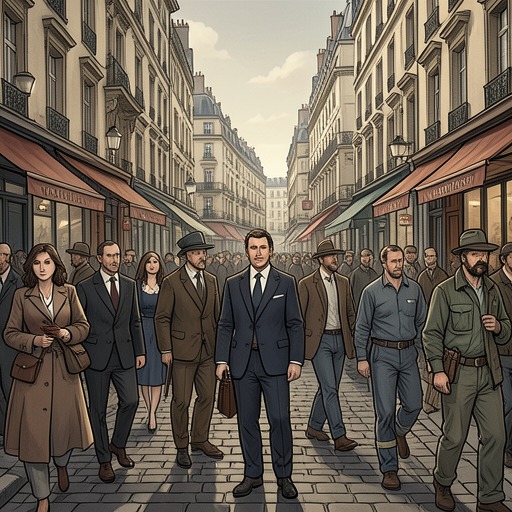
The account first places the reader in the Latin Quarter, among old, close-set slate-grey houses and steep, narrow streets. Across from the little creamery where the group ate breakfast, two cats with aquamarine eyes watched from a laundry window. The surrounding streets held small bars, restaurants, print shops, and old prints; the passage’s close attention to meals, shopfronts, and animals establishes a dense, inhabited Paris rather than an empty battlefield.
That intimacy sharpens the contrast with the large, newer quarters near the Arc de Triomphe, which the Camera Eye describes as deserted. The narrative turns instead toward the older districts associated with the Carmagnole, the Faubourg St Antoine, and the Commune. Their presence gives the city’s response a historical and political texture, while the scene itself stays with what people see and do in the streets rather than explaining the bombardment’s military course.
Blasts and Immediate Responses
One report of Bertha’s firing reaches the group as a snapping sound, no louder than a firecracker, near the hotel where Oscar Wilde died. They run upstairs to see whether the house is on fire. The danger initially appears as a possible domestic accident, and the old woman whose lard is burning is irritated by their alarm. The brief episode sets off the ordinary reflex to investigate a fire, then abruptly reduces the visitors’ concern to a false alarm.
Elsewhere, the bombardment strikes the Seine River during a fishing contest. People in small, bright-green skiffs are gathered among older fishermen; the concussion stuns minnows, which are then scooped up in nets. The shell’s fall does not end the scene with a report of destruction or casualties. Instead, the account fixes on the water, the boats, the fishermen, and the fish made vulnerable by the shock. The violence is unmistakable, but the fragment records its effects through a local interruption in an ongoing activity.
Narrative Form and Significance
The Bombardment of Paris is filtered through The Camera Eye, a mode that gives the event the immediacy of remembered sensation rather than the shape of a conventional battle narrative. Sounds, streets, animals, food, and the fishermen’s nets share the foreground with the falling shell. This scale offers no broad chronology, military explanation, or casualty count; it shows how danger enters the textures of daily life and is apprehended in scattered moments.
That fragmentary method belongs to the book’s wider montage, in which the Newsreels interrupt character narratives with headlines, news fragments, advertisements, and song lyrics. Here, however, the Camera Eye’s attention rests on singular sights and responses: a rush upstairs, a woman’s annoyance, deserted new quarters, and minnows stunned in the river. The juxtaposition neither makes the city’s routine safe nor depicts it as wholly extinguished. It leaves the bombardment present as a threat woven into the ordinary life continuing beneath it.