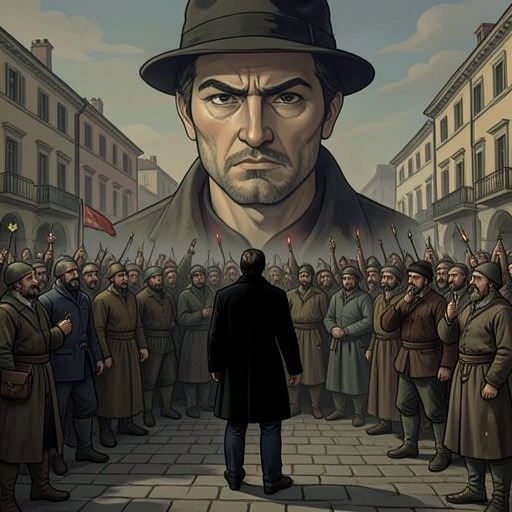
Death of Joe Hill
1919The execution of Joe Hill in November 1915 is presented not as an isolated death but as a turning point in the story of working-class organizing: the laborer and songwriter is killed by the state, yet his final message directs the living toward collective action. The account links his organizing work in Utah to his conviction for murder, the failure of efforts to obtain a new trial, and the posthumous circulation of his songs and image.
Organizing and Conviction
At Bingham, Utah, Joe Hill organized workers for the Utah Construction Company into One Big Union. Their campaign secured a new wage scale, shorter hours, and better food. The concrete gains matter: the organizing is shown not merely as a declaration of political belief but as a challenge to the conditions under which workers lived and labored. The narrative’s blunt list of improved wages, hours, and meals gives the movement material stakes.
That victory is followed by a murder prosecution. The account says that Mormons came to believe Hill had shot a grocer named Morrison, and that the verdict of guilty was sustained by the Utah Supreme Court. Its repeated invocation of the angel Moroni as the force moving both the community and the court gives this passage a sharply ironic, accusatory tone. The language does not provide the details of the shooting or the trial; instead, it emphasizes the conviction and the power that made it stand.
The Swedish consul and Woodrow Wilson tried to secure a new trial for Hill, but their efforts failed. The appeal for a retrial therefore becomes a final institutional counterpoint to the sentence: intervention reached the case, but it did not reverse the verdict. The narrative moves directly from that failed effort to Hill’s year in jail, where he continued making songs.
Execution and Final Message
In November 1915, Hill was taken into the jail yard in Salt Lake City and stood against a wall. The scene is spare and deliberate: the account gives the place, the prison yard, and the firing squad’s guns, concentrating attention on the condemned man’s composure and the words he sent beyond the prison. He looked into the gun muzzles and gave the word to fire.
His last message, “Don’t mourn for me organize,” turns the expected language of private grief toward a public task. Addressed to the working stiffs of the Industrial Workers of the World, it refuses to make remembrance an endpoint. The command is brief, but it reorganizes the meaning of the execution: the death can be used to call workers together rather than to leave them only with mourning. In the account, Hill’s songs and political work make that appeal continuous with the organizing that preceded his arrest.
Funeral and Afterlife
After the execution, Hill’s body was dressed in a black suit, stiff collar, and bow tie, then shipped to Chicago for a large funeral. The transformation from prisoner to carefully dressed dead man is marked through specific details of clothing and transport. A photograph preserved his “handsome stony mask staring into the future,” an image that makes the posthumous portrait seem at once fixed and directed beyond the moment of death.
On the first of May, his ashes were scattered to the wind. The account gives no further description of the ceremony or those who took part. Its brevity makes the scattering a final release from the prison yard and the funeral’s formal arrangements, while leaving the act’s collective meaning to the movement that continues to invoke him.
That continuing presence appears elsewhere in the book through the songs attributed to Hill: hoboes and workers sing them in cookshacks, flophouses, camps, and jails across the West. The account describes those jailhouse voices as forming “the structure of the new society within the shell of the old.” Hill’s execution thus enters a wider pattern in which imprisonment does not silence labor organizing; songs and shared political language carry it into places where workers remain confined.
Significance in the Narrative
Hill’s death joins material labor demands, political prosecution, and a continuing culture of worker solidarity. The account first measures organizing by its practical results at Bingham, then sets those gains against a murder conviction and an execution that outside intervention could not prevent. His last message supplies the hinge between those events and their later remembrance: mourning is redirected toward organization.
The funeral photograph and the scattering of the ashes give his death two different afterlives. The photograph fixes his face in an enduring public image; the ashes disperse, while the songs attributed to him continue to be sung collectively. Rather than resolving the story with the execution, the narrative follows its repercussions into workers’ shared spaces, where Hill’s name and songs become part of an ongoing struggle over labor, solidarity, and who will shape the society to come.