Centralia Massacre
1919The Centralia Massacre is presented as an eruption of violence in a timber town where workers’ demands for collective rights collided with employer-backed anti-radical campaigns. Its significance lies not only in the armed attack on a union hall and the lynching of logger Wesley Everest, but also in the story’s exposure of how patriotic language and official authority could be used to conceal violence against labor organizers.
Background and Labor Conflict
The account places Centralia, Washington, within a Pacific Northwest timber industry dominated by powerful owners and mill operators. Lumberjacks, loggers, shingleweavers, and sawmill workers are described as a subordinated workforce. The Industrial Workers of the World brought industrial democracy into the logging camps, arguing that the forests should belong to the people and that workers should receive real wages rather than company scrip. Its organizers also called for an eight-hour day, clean bunkhouses, wholesome food, and somewhere to dry clothes soaked by work in snow and freezing weather. These demands make the conflict material as well as political: workers sought control over the conditions of daily labor, while employers treated organizing as a threat to their authority.
The postwar political climate sharpened that confrontation. The narrative contrasts the workers, branded as reds, with timber owners and mill operators who claimed the mantle of patriotism. During the war, lumber prices had risen from $16 to $116 per thousand feet; in some cases, the government paid as much as $1,200 per thousand feet for spruce. Against that backdrop of profitable wartime production, owners set out to drive radicals from the camps while presenting the defense of free American institutions as justification for their campaign.
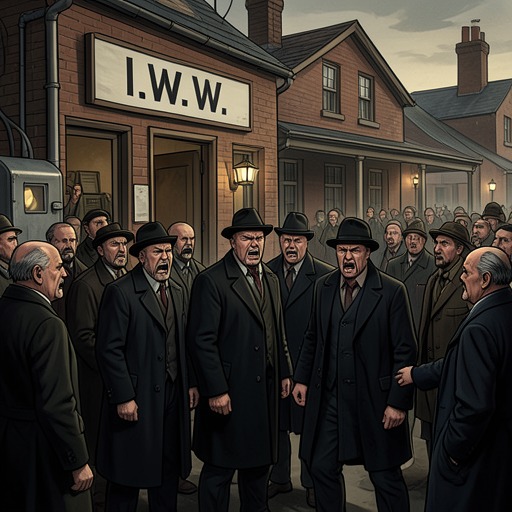
Employers organized through the Employers Association and the Legion of Loyal Loggers. They made it worthwhile for groups of ex-soldiers to raid Industrial Workers of the World halls, assault organizers, and burn literature deemed subversive. The repression was not merely a threat: on Memorial Day in 1918, American Legion members from Centralia, joined by a group from the Chamber of Commerce, wrecked the union hall, beat people inside, jailed some, and forced others across the county line in a truck. They burned papers and pamphlets and auctioned the hall’s fittings for the Red Cross. The account notes the bitter afterlife of that raid: the union desk still stood in the Chamber of Commerce.
The loggers hired another hall, and their union continued to grow. In the months before Armistice Day in 1919, rumors spread that the hall would be raided again, this time for good. Business leaders chose Warren O. Grimm, an officer who had served with the American force in Siberia, to lead the Citizens Protective League’s “100% forces.” The account’s emphasis on his appointment connects local anti-union mobilization to the period’s broader fear of Bolshevism. The first act attributed to the self-described defenders of order was to seize a blind newsdealer, beat him, and leave him in a ditch across the county line.
The loggers sought legal advice and concluded that they had the right to defend themselves and their hall if it was attacked. Wesley Everest, a returned soldier and logger whose sharpshooting in the army had earned him a medal, became central to the looming confrontation. At a union meeting on the Sunday before the parade, members discussed the possibility of a lynching. Everest, who was not much of a talker, walked the aisle in his olive-drab coat over his overalls, distributing pamphlets. When the men said they would not tolerate another raid, he stopped, rolled a cigarette from brown paper, and smiled quietly. The scene foreshadows his later role while keeping the focus on the union’s expectation that violence might come again.
The Armistice Day Attack
Armistice Day arrived raw and cold, with mist rolling in from Puget Sound and dripping from the spruces and storefronts. Warren O. Grimm commanded the Centralia section of the parade, whose ex-soldiers marched in uniform. As the procession first passed the union hall without stopping, the loggers inside began to feel relief. On its return, however, the parade halted in front of the hall. A whistle sounded, someone urged the marchers forward, and three men crashed through the doorway. A rifle shot was followed by rifle fire from the hills behind town and from the rear of the hall.
Grimm and another ex-soldier were hit. The parade broke apart, but armed men regrouped and rushed the hall. Inside, they found several unarmed men hiding in an old icebox and a uniformed boy at the head of the stairs, his arms raised over his head. The attack turned the union hall, already a target of an earlier raid, into the scene of an armed confrontation between the marchers and the loggers who had anticipated another assault.
Wesley Everest’s Flight and Lynching
When the armed men rushed the union hall, Wesley Everest emptied the magazine of his rifle, dropped it, and fled toward the woods. He forced a path through the crowd behind the hall with a blue automatic, climbed a fence, and doubled through an alley and a back street as the mob pursued him. The men had brought ropes intending to lynch Britt Smith, the union secretary; by drawing them away, Everest prevented them from killing Smith at the hall. He stopped once or twice to fire scattered shots, then reached the river and waded in until the water came to his waist. Everest turned to face the approaching crowd, his hat gone and his hair wet with water and sweat. He called out, “Stand back,” and said he would submit to arrest if there were police among them. When the mob kept advancing, he fired four times from the hip. His gun jammed; he worked the trigger, took aim, and shot the foremost pursuer, Dale Hubbard, dead. Hubbard was another ex-soldier and the nephew of one of Centralia’s prominent lumbermen. Everest threw away the empty weapon and fought with his fists until the crowd overwhelmed him. A man struck out his teeth with a shotgun butt, and someone put a rope around his neck. A woman pushed through the crowd and pulled it away. Everest taunted them that they lacked the courage to hang a man in daylight. The attackers took Everest to jail and threw him onto the floor of a cell while the other loggers were interrogated. That night the city lights went out. A mob broke through the jail’s outer door, and a guard presented Everest to them. Before they took him away, he stood and whispered to the men in the other cells, “Tell the boys I did my best.” They drove him in a limousine to the Chehalis River bridge. While he lay stunned in the car, a Centralia businessman mutilated him with a razor; Everest screamed in pain and pleaded with his captors to shoot him rather than make him suffer. They hanged him from the bridge in the headlights. The violence continued in its official retelling. At the inquest, the coroner treated the death as a joke and reported that Everest had escaped, gone to the bridge, and hanged himself, adding that he had climbed back up when his first rope was too short, made a longer one, hanged himself again, and shot himself full of holes. The narrative sets this grotesque account against the mob’s actual abduction and killing of a prisoner. Everest’s mutilated remains were forced into a packing box and buried; the account says that no one knows where his body was laid. Six other loggers captured in the aftermath were buried instead in the Walla Walla Penitentiary.
The Union’s Persistence and the Story’s Judgment
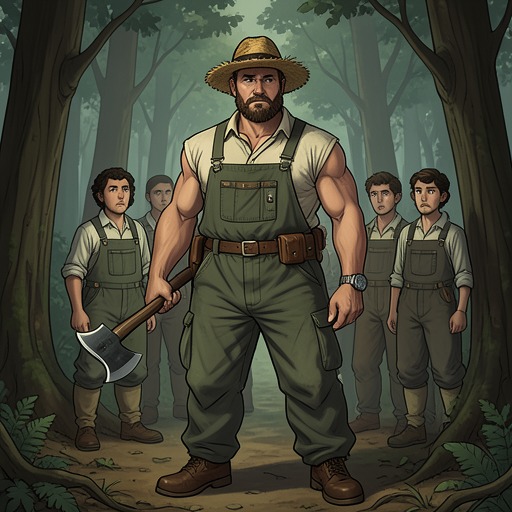
The attack is framed within a campaign that had already failed to extinguish the union: after the 1918 destruction of its hall, the loggers rented another, and the organization kept growing. The recurring refrain, “Not a thing in this world Paul Bunyan’s ascared of,” gives that persistence the scale of a working-class legend. Its defiance is sharpened by the distance between the lumber interests’ claim to defend American institutions and the violence used against workers seeking a hall, a union, and a voice.
The episode’s final judgment rests on the contrast between public claims of patriotism and what happened to an unarmed labor movement’s meeting place, its organizers, and its dead. In the story, the massacre is not an isolated clash detached from working conditions: it is the culmination of organized resistance to industrial democracy, followed by an official account that turns a lynching into a supposed suicide. The legend’s stubborn refrain therefore sounds less like a promise of safety than a refusal to let intimidation have the last word.