Treaty of Versailles and postwar peace negotiations
1919The Treaty of Versailles and the postwar peace negotiations are presented not as a clean passage from war to peace but as a struggle over who would control the postwar order. As diplomats bargained over borders and national destinies, corporate and financial power continued to shape events; meanwhile, the book’s interwoven accounts show violence and unresolved loss persisting beyond the armistice.
Bargaining over territory and relief
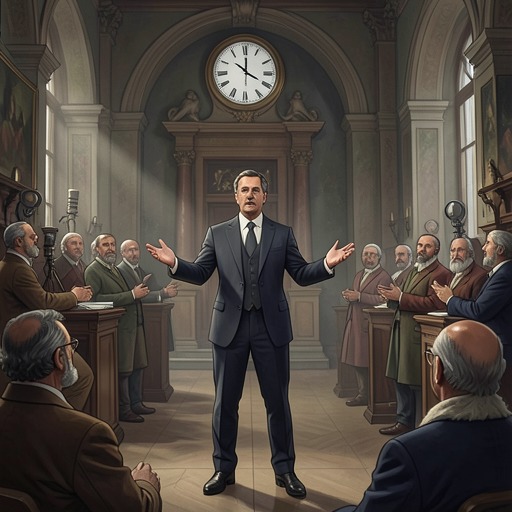
In Paris, the negotiations are rendered as haggling over what the narrative calls the price of blood: toy flags, river boundaries on relief maps, and the historical destiny of peoples. Behind this public bargaining, powerful business interests quietly secured access to raw materials. The contrast makes the peace conference appear to distribute more than territory: it also negotiated the conditions under which wealth and influence would be exercised after the fighting.
A related scene at the Café de la Paix brings the stakes into a conversation about oil and mandates. An engineer from Standard Oil argues that British interests are gaining ground in the Near East and that the United States risks losing primacy in world oil production. The discussion moves among Baku, Mohommarah, and Mosul, and disputes who should control Baku: the engineer invokes the Turkish and Armenian population while considering whether French or Russian control would be preferable to British control. The talk also turns to Armenia and the prospect of feeding its starving people. These competing claims expose the distance between self-determination as a principle and the strategic calculations attached to territory and resources.
Finance and the reach of corporate power
The negotiations take place within a financial order already shaped by wartime lending. By 1917, the Allies had borrowed $1.9 billion through the House of Morgan. The book links that scale of credit to the language of democracy and the flag, setting the public justification for American involvement beside the influence of private finance. By the end of the Peace Conference, the phrase J. P. Morgan suggests is associated with a power of seventy-four billion dollars. In this account, peace is not separate from financial power: the credit that helped sustain the war also shadows the making of the postwar settlement.
The book’s other views of trade and transport give this economic structure a material counterpart. Joe Williams’s voyage aboard the Callao leaves the ship waiting outside Roseau while limes are prepared for loading. A local man describes the United Fruit monopoly’s power to dictate prices and let limes rot on the wharf if growers refuse them. Elsewhere, Joe’s passage through the Mediterranean follows lines of wartime shipping: camouflaged freighters, transports, colliers, and hospital ships move along the coast under naval scrutiny. These episodes are not conference proceedings, but their placement alongside the negotiations broadens the picture of a world in which commodities, shipping, and control of markets remain consequential after political leaders turn to peace.
Peace alongside continuing violence
The gap between diplomatic settlement and lived security also appears in the book’s postwar labor narrative. Wesley Everest, a veteran and former army sharpshooter, returns to logging after his discharge. Later, during the violence surrounding the loggers, he is taken from jail by a mob and hanged from a bridge over the Chehalis River. The episode is not presented as an outcome decided at Versailles; its significance here lies in the sharp contrast it creates with the language of a peace negotiated among governments. The end of fighting between states does not end violence at home.
The loss of Randolph Bourne offers a different measure of what the new peace failed to include. He does not live to see the Treaty of Versailles or the political normalcy that follows. Six weeks after the armistice, he dies while planning an essay on the foundations of future radicalism in America. His unfinished subject points toward political conflicts that the conference’s settlement could not resolve, even as the negotiations claimed to shape a new era.
The unidentified dead and public remembrance
The book closes its treatment of the war’s aftermath with the national transfer and burial of an unidentified member of the American Expeditionary Forces at Arlington National Cemetery. The official resolution describes the body as that of an American whose identity has not been established. In the narrative, the selected pine box is one among many in a makeshift morgue at Châlons-sur-Marne; the problem of identification is tangible in the scattered remains and military clothing, but the ceremony will make one unknown dead soldier stand for the nation’s losses.
The public observance is marked by silence, tears, songs, prayer, muffled drums, and soft music rather than applause. The president’s speech presents the tribute as impersonal, while the pageant around the body gathers officials, diplomats, military leaders, and spectators into a solemn national scene. Decorations are pinned where the soldier’s chest would have been, including American and foreign honors; Woodrow Wilson brings poppies. The ceremony grants the unidentified dead a collective identity, but the book’s movement between official commemoration, individual lives, and continuing violence keeps that transformation unsettled. Against the promise of peace, the unnamed soldier remains both a national symbol and a reminder of losses that cannot be fully recovered or explained.