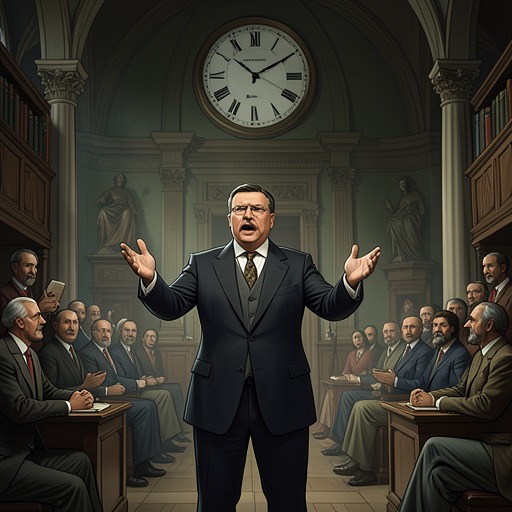
Battle of San Juan Hill
1919The Battle of San Juan Hill is rendered as a turning point in Theodore Roosevelt’s public legend: an apparently decisive charge that the narrative immediately undercuts with details of confusion, redundancy, and political reward. Its account sets the celebrated image of courage against the fact that the hill had already been taken from the other side.
Background and Public Image
After the Maine blew up, Theodore Roosevelt resigned to lead the Rough Riders and became a lieutenant colonel. The battle was presented to the American public as a test of courage and just cause, with stories of bullets singing and Roosevelt charging up the hill. The novel shows how the telling of the action helped make the colonel a public hero.
The Charge
In the account of the fighting, Roosevelt charged up San Juan Hill without his men, then had to go back and fetch them. The passage also recounts him shooting a fleeing Spaniard. These details give the charge its vivid, ragged character: its celebrated bravery is not separated from the disorder of the advance or from the violence inflicted on a retreating enemy.
Outcome and Significance
The narrative punctures the heroic version by noting that regular troops had already reached the hill from the other side, so there had been no need to take it at all. Santiago de Cuba surrendered and the campaign was successful, but the battle’s practical necessity is cast into doubt. Roosevelt, meanwhile, emerged from the charge not merely with a military reputation but on his way to the governorship of New York State. The contrast makes San Juan Hill a story about how public acclaim can grow out of an action whose military meaning is less clean than its legend.