United States entry into World War I
1919The United States entry into World War I marks a transition from the country’s uneasy distance from the conflict to direct participation, but the novel presents that transition through its effects across different lives and institutions. A writer who had already witnessed war as an ambulance driver enlisted with the American Expeditionary Forces; sailors debated the meaning of neutrality as submarine danger reached commercial routes; and the aftermath joined international finance and official remembrance to the lives of ordinary people.
From Ambulance Service to Army
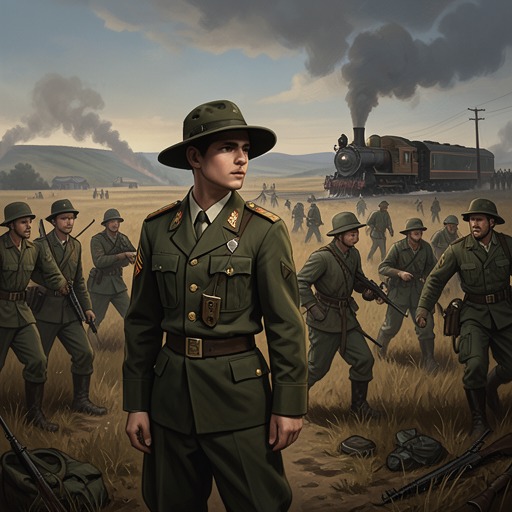
Before the United States entered the conflict, John Dos Passos had volunteered in 1916 to drive for the Norton-Harjes Ambulance Service. He served in France and Italy, then enlisted in the American Expeditionary Forces after the United States joined the war. The sequence matters: his military experience did not begin with the national decision to enter. Ambulance work had already brought him close to the war’s human costs, and his later enlistment extended that experience into the armed forces. The novel’s account links this service to his subsequent portrayal of soldiers as victims of modern warfare.
The distinction between witnessing war and serving in an army is therefore not a clean division between civilian and combatant. The entry into the conflict changed the terms of Dos Passos’s participation, while the experience he had gained beforehand shaped how he understood the soldiers who bore the war’s consequences.
Neutrality and the Merchant Routes
The pressures surrounding entry are also visible aboard Joe Williams’s ship. While German submarines were reported off the English coast, the vessel’s crew complained that it was unarmed and traveling without a convoy. The British sailors blamed Joe for the United States remaining outside the war; he argued that the country had no business entering it. Their dispute makes neutrality a lived conflict among shipmates, not simply a policy debated at a distance. The ship’s exposure to raiders gives that argument immediate stakes, even before the novel’s account turns to American military enlistment.
A later voyage along the coast of Spain and France shows the wartime shipping system in motion. Camouflaged freighters traveled in one direction, while transports, colliers, and hospital ships passed in the other; vessels carried lifepreservers on deck, and destroyers stopped ships to inspect their papers. The scene does not reduce the war to a front line. It shows commercial and military traffic sharing dangerous waters, with sailors and merchant vessels drawn into the conflict’s logistics whether or not they determine its policies.
Finance, Oil, and the Meaning of Intervention
The novel places American participation beside the power of finance. By 1917, the Allies had borrowed $1.9 billion through the House of Morgan. The account sets that figure against the public language of democracy and the flag, drawing attention to the financial relationships accompanying the country’s overseas commitment. By the end of the Peace Conference, the phrase “J. P. Morgan suggests” had acquired influence over a power of $74 billion. The contrast makes the war’s political ideals inseparable, in the novel’s presentation, from the institutions able to lend and direct enormous sums.
In Paris after the war, a Standard Oil engineer’s discussion with J. Ward Moorehouse and others turns the same problem toward oil and postwar influence. He warned that British companies, including Anglo-Persian and Royal Dutch, were outpacing American interests in the Near East, and argued that the United States risked losing its primacy in world oil production. The conversation ranged over Baku, Mohommarah, Mosul, and the proposed mandate over Armenia. When the question of Baku was raised, the speakers invoked self-determination while weighing which outside power might control the region. This is not presented as a direct explanation of why the United States entered the war; it shows how the language and power relations of the conflict continued into disputes over resources and the postwar settlement.
Return and National Remembrance
The consequences of the war also return through its former soldiers. Wesley Everest came home from overseas, received his discharge, and went back to logging. His return links military service to the labor and political conflicts that persisted in civilian life; the war had ended for him as a soldier, but it had not removed him from the risks of the world he returned to.
The final commemoration of an unidentified American war dead makes the gap between individual lives and national ceremony especially stark. A congressional resolution authorized the return of a body whose identity had not been established, for burial in the memorial amphitheater at Arlington National Cemetery. At the ceremony, silence, tears, songs, prayer, muffled drums, and soft music carried the official tribute. President Harding described the dead man in impersonal terms, while the novel’s narration insists on the unknowability behind the public symbol: no name could connect the remains to one recoverable life. Decorations from several nations, a wreath, and a small gift of wampum accumulated around the body, and Woodrow Wilson brought poppies. The honors made the dead soldier a representative of the nation even as the text keeps his identity unresolved.