1912 Republican National Convention split
1919The 1912 Republican National Convention split is presented as both a political rupture and a moment of intense, ultimately disappointed hope. Theodore Roosevelt, campaigning as a progressive and champion of the Square Deal and the Plain People, broke with William Howard Taft’s party machinery and formed the Progressive Party. In the Chicago Colosseum, delegates who imagined themselves restoring democratic government sang a hymn through tears. For the diplomat Paxton Hibben, that sound seemed to gather the claims of people far beyond the convention hall; later, however, the promise of social justice associated with the movement had dwindled, and Roosevelt’s insurgency looked to him like another version of the politics it had opposed.
Political Break and Progressive Campaign
The account frames the split as Theodore Roosevelt’s last political fight. He came forward for the Republican nomination as a progressive, identified with the Square Deal and with a crusade for the Plain People. When Taft’s forces overwhelmed the challenge, Roosevelt and his supporters bolted from the party and established the Progressive Party at the Chicago Colosseum. The narrative’s image of a Bull Moose escaping from beneath a steamroller makes the break vivid: this was not simply a change of candidate but an open contest over who could claim the party’s name, its voters, and its promise of reform.
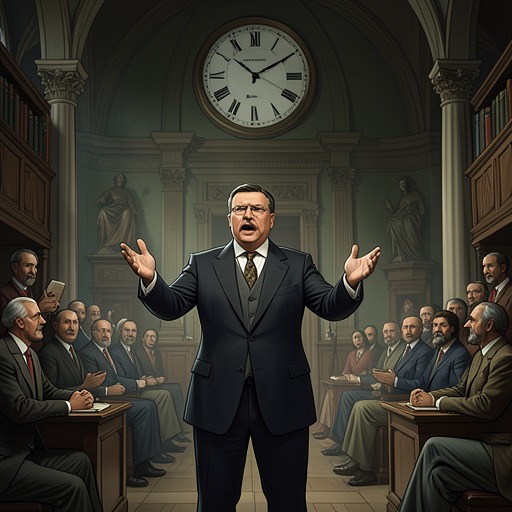
The convention scene places political conflict beside collective feeling. Delegates who believed they were about to restore democratic government sang Onward Christian Soldiers with tears in their eyes. The fractured presentation of the hymn’s words gives the moment a public, almost physical sound: a crowd trying to hold together its conviction as the party itself divided. The convention’s idealism is real in the scene, but the narrative also signals the gap between its moral language and the limits of electoral politics. The delegates’ sense of purpose cannot settle who controls the party or guarantee that the movement will secure the social changes it promises.
Paxton Hibben at Chicago
The convention also becomes a turning point in Paxton Hibben’s political allegiance. He resigned from the Diplomatic Service in 1912 and returned home to campaign for Theodore Roosevelt. He reached Chicago in time to hear the delegates singing in the Colosseum. His response extends the convention beyond its immediate partisan struggle: within the packed voices and cheers, he hears the Russian Marseillaise, the silence of Mexican peons, Colombian Indians waiting for a deliverer, and the measured cadences of the Declaration of Independence.
That imaginative widening is central to what the episode means to Hibben. He does not hear the hymn as merely a celebration of a candidate. It carries, for a moment, the political hopes of people in different countries and circumstances, joined to the American language of independence. Yet the passage makes clear that this is his perception of the convention, not proof that the Progressive campaign represented all those constituencies or could deliver their liberation. The contrast between the crowd’s expansive sound and the specific limits of a party contest is already present inside his idealistic response.
Disillusionment and the Campaign’s Limits
Hibben’s belief does not survive unchanged. After the convention, the talk of social justice peters out in his judgment. Roosevelt becomes a windbag like the others, and the Bull Moose seems to him stuffed with the same sawdust as the Republican Party. The reversal is sharper because Hibben had left diplomatic service to campaign for Roosevelt and had heard the convention as an echo of international demands for justice. The split that first appeared to offer a new political vehicle comes to look like a change of label without a sufficient change in substance.
Hibben nevertheless continued into progressive politics: he ran for Congress in Indiana. By then, however, the European war had already diverted public attention from social justice. The episode thus connects the convention’s promises to a wider change in what could command political attention. Its failure is not described solely as an argument lost inside the Republican Party; the reform cause also loses ground as war occupies the public mind.
Roosevelt’s Decline and the Event’s Aftermath
The convention is followed by a campaign marked by signs of Roosevelt’s physical and political vulnerability. The narrative wonders whether the River of Doubt had been too much for a man of his age and observes that things no longer seemed so bully. During the triangular campaign, he lost his voice. In Duluth, a maniac shot him in the chest; the thick bundle of manuscript he had been carrying for a speech saved his life. Roosevelt delivered the speech with the bullet still in him, to frightened applause and with ordinary people praying for his recovery, but the old spell had somehow broken.
The Democrats swept in, and the First World War soon drowned out the righteous voice of the Happy Warrior. Roosevelt wanted to lead a division, but Woodrow Wilson refused him, treating this as no amateur’s war; the narrative suggests that regular officers may also have remembered the round robin at Santiago. Roosevelt could instead write magazine articles against the Germans and send his sons to war. Quentin was killed. These later events do not erase the convention’s emotional force, but they place its reformist confidence beside electoral defeat, diminished influence, and the human cost of war. The split remains significant as the moment when a promise of political renewal briefly filled a convention hall—and as an early point in the story of how that promise lost its hold.