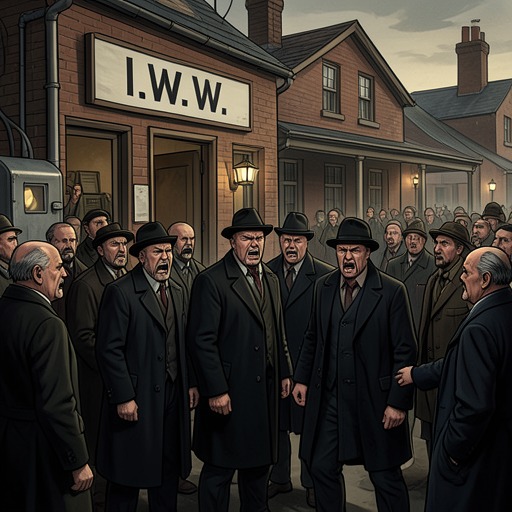
Citizens Protective League
1919The Citizens Protective League is the business-backed organization through which Centralia’s defenders of 100-percent Americanism mobilize against the I.W.W. and its loggers’ union. Its significance in the narrative lies in the way civic authority, patriotic credentials, and rumors of an impending raid converge in the run-up to the violence on Armistice Day, 1919.
Formation and Purpose
Before Armistice Day, rumors spread through Centralia that the union hall would be raided. The town’s business men chose Warren O. Grimm to lead the 100-percent forces in the Citizens Protective League. Grimm’s prior service as an officer with the American force in Siberia was treated as a qualification to speak with authority on labor and Bolshevism; the account presents that credential as part of the league’s claim to defend the community from radicalism.
The tension had a recent local history. On Memorial Day in 1918, American Legion members, joined by a group from the Chamber of Commerce, had wrecked the I.W.W. hall and driven union members out of town. The loggers later hired another hall, and the union continued to grow. In this setting, the rumors of a new raid made the league’s show of patriotic authority part of an ongoing struggle over whether workers could maintain their organization and meeting place.
Escalation in Centralia
The account portrays the anti-union campaign as acting before the feared raid on the hall: the first people described as acting in the name of the patriotic cause seized a blind newsdealer, beat him, and left him across the county line. The loggers, meanwhile, sought legal advice and concluded they had a right to defend the hall and themselves if it were attacked. Their preparations and the league’s mobilization therefore developed in an atmosphere where each side anticipated confrontation.
On Armistice Day, Grimm commanded the Centralia section of the parade, which included ex-soldiers in uniform. When the procession first passed the union hall without stopping, the loggers inside were relieved. On its return, however, the parade halted in front of the hall. A whistle and a call to advance were followed by men running toward the building and gunfire from inside and from the hills. Grimm and another ex-soldier were struck. The narrative connects the parade’s movement toward the hall with the league’s mobilized patriotic forces, while showing how quickly the public procession became an armed confrontation.
The League and the Union Hall
After the gunfire, the parade broke apart, but armed men regrouped and rushed the hall. They found several unarmed men hiding in an icebox and a uniformed boy at the top of the stairs. Wesley Everest escaped toward the woods, drawing the pursuing crowd away from Britt Smith, the I.W.W. secretary, whom the mob had intended to lynch. His flight prevented Smith from being lynched at the hall, even as the pursuit continued toward the river.
The league’s place in this episode is defined by the contrast between its language of patriotic protection and the threat of collective violence surrounding the union. It appears not as an abstract civic association but as the organization whose business sponsors selected Grimm to lead the 100-percent forces amid explicit raid rumors. The episode ends with the hall under attack and the conflict extending beyond it; the account does not establish the league’s subsequent course or a resolution of the confrontation.