United States Shipping Board
1919The United States Shipping Board is presented through the ships and employment channels associated with wartime merchant shipping, rather than through a full account of its administration. Its presence is concrete: vessels crossed the Atlantic in convoy, and a recruiting office offered Joe Williams a possible route into officer training. These encounters connect the Board to the risks of wartime sea transport and to the paperwork and gatekeeping that shaped access to maritime work.
Ships in the Wartime Convoy
During Joe Williams’s voyage across the Atlantic with Glen Hardwick, the convoy included a new wooden vessel associated with the United States Shipping Board. The boat leaked so badly that it had to be abandoned and scuttled before the convoy completed its crossing. The narrative attributes the vessel’s poor construction to someone making money, but does not identify who was responsible or describe the Board’s role in building or commissioning it. The episode nevertheless places a Board vessel among the improvised, vulnerable craft carrying wartime traffic, in contrast with the naval command and escort surrounding the convoy.
The crossing made the hazards of this maritime system visible in daily operation. Ships followed zigzag courses in the submarine zone, while false alarms, depth bombs, and gunfire at misidentified objects kept crews on edge. The Board vessel’s failure belongs to that larger setting of crowded, exposed transport: its loss is one particular instance, not a claim that all Board ships were defective.
Employment and Officer Training
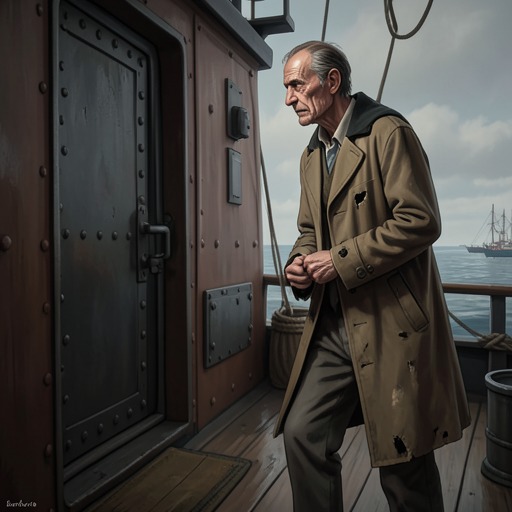
The United States Shipping Board also appears as a possible source of work. After returning to New York, Joe stayed with Mrs. Olsen, who lent him money to tide him over until he could find employment on a Shipping Board boat. The next morning, after repairing shelves and clearing out her pantry, he went to the Board’s recruiting office to put his name down for officer school.
The intake interview did not recognize his practical experience at sea as sufficient to secure immediate consideration. The clerk, who had never been to sea, asked Joe questions he considered foolish and told him to return the following week to learn what action would be taken on his application. Joe grew angry and left without waiting for a decision. The episode establishes an application and a postponement, not an acceptance or a completed training course.
Narrative Significance
The Board’s limited but distinct appearances link institutional recruitment to the material conditions of shipping. Its vessels carry crews through a dangerous convoy, while its office decides whether an experienced sailor can pursue an officer’s training. In Joe’s case, the gap between time spent at sea and the recruiting clerk’s deferred response turns an employment possibility into another blocked route ashore. The novel offers no broader account of the Board’s structure or policies; its significance here emerges from these concrete points of contact between wartime transport, precarious work, and bureaucratic selection.