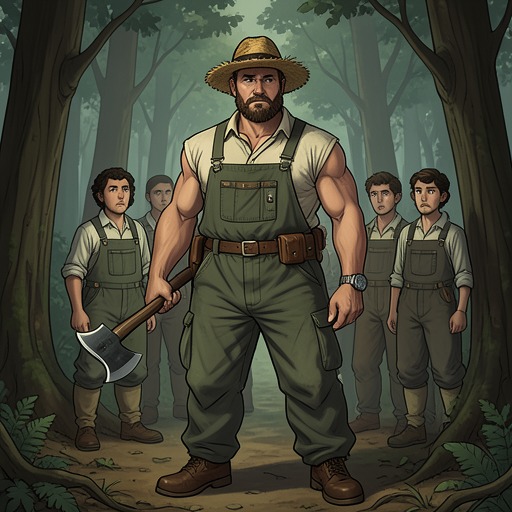
Legion of Loyal Loggers
1919The Legion of Loyal Loggers was one of the organizations timber interests formed to oppose the I.W.W. in the Pacific Northwest. In the novel’s account, it belongs to a campaign that answered demands for better conditions and industrial democracy with organized pressure against union organizers and their meeting places.
Formation and Political Setting
The organization appears in the aftermath of wartime lumber profits and amid the intensifying conflict over who would control the timber industry. Timber owners and sawmill and shingle interests presented themselves as patriots who had helped win the war; the narrative contrasts that claim with lumber prices rising from $16 to $116 per thousand feet, and some government purchases of spruce reaching $1,200 per thousand. In this setting, the owners formed both the Legion of Loyal Loggers and the Employers Association as they set out to remove radicals from logging camps.
The organization’s formation is placed within a broader confrontation with the I.W.W. The union’s organizers advocated industrial democracy and demands that included payment in real money rather than company scrip, decent places for workers to dry wet clothes, an eight-hour day, clean bunkhouses, and wholesome food. The novel frames this program against the timber owners’ effort to preserve their control of the camps and labels the conflict as a contest over the meaning of patriotism and American institutions.
Methods and Anti-Union Campaign
The account associates the Legion and Employers Association with a campaign that made it worthwhile for groups of ex-soldiers to raid I.W.W. halls, attack organizers, and burn literature deemed subversive. These actions extended opposition beyond the workplace: the campaign sought to disrupt the union’s ability to meet, circulate its ideas, and organize lumber workers.
The novel presents the campaign as coercive rather than as a neutral defense of public order. Its stated language of patriotism and the preservation of free institutions sits beside the described violence against union members and the destruction of their papers. That contrast makes the Legion part of the book’s depiction of how employers and their allies mobilized national loyalty against labor organizing.
Centralia and the Union’s Persistence
A related episode occurs on Memorial Day in 1918 in Centralia, Washington, when members of the American Legion, led by a group from the Chamber of Commerce, wrecked an I.W.W. hall. They beat people found inside, jailed some, and put others in a truck and left them beyond the county line; papers and pamphlets were burned, while the hall’s fittings were auctioned for the Red Cross. The narrative does not identify these participants as the Legion of Loyal Loggers, and the episode should not be mistaken for proof that the two organizations were identical. It does, however, place the conflict between anti-radical forces and the I.W.W. in the same wider context of organized pressure.
The campaign did not end the union’s activity. After the Centralia hall was destroyed, loggers hired a new hall and the union continued to grow. The novel sets that persistence against the recurring image of Paul Bunyan, recast as a figure who joins the lumberjacks’ local and is unafraid of what lies ahead. In this framing, the Legion of Loyal Loggers represents an organized effort to suppress labor militancy, while the continuing union points to the limits of that effort.