Progressive Party
1919The Progressive Party was formed in 1912 after Theodore Roosevelt broke with the Republican Party and its William Howard Taft-led organization. It gathered reform-minded supporters around the Square Deal and a claim to champion ordinary people, but its appearance in the narrative is also marked by a swift collapse of hope: the party’s language of social justice would soon seem to Paxton Hibben no more substantial than the politics it opposed.
Formation and Political Appeal
The party took shape during Theodore Roosevelt’s campaign for the Republican presidential nomination. The narrative describes William Howard Taft’s political machine as a steamroller and Roosevelt’s supporters as breaking away from it to form a new party. Their stated purpose was righteousness and reform; Roosevelt stood as a progressive and advocate of the Square Deal, while the movement presented itself as a champion of the Plain People. These claims distinguished the new organization from the Republican establishment, even as its origins remained a revolt within that party’s political world.
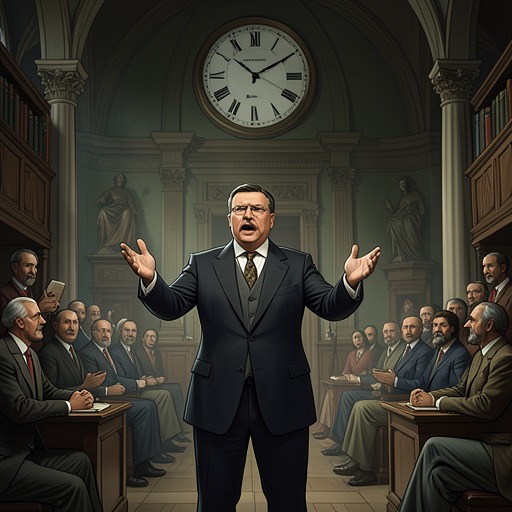
The convention at Chicago’s Colosseum gave the break a dramatic public form. Delegates who believed they were there to restore democratic government sang a hymn amid cheers and tears. The scene captures the movement at its most emotionally charged: party formation was not merely a procedural split, but an occasion in which supporters invested a political campaign with the hope of national renewal.
Paxton Hibben and the Convention’s Promise
Paxton Hibben resigned from the Diplomatic Service in 1912 and returned home to campaign for Theodore Roosevelt. He reached Chicago in time for the convention, where the packed voices and cheering carried meanings far beyond the hall. He heard, in the convention hymn, echoes of the Russian Marseillaise, the silence of Mexican peasants, Colombian Indians awaiting a deliverer, and the cadences of the Declaration of Independence. The scene presents the Progressive Party’s appeal through one supporter’s expansive imagination: its democratic promise seemed capable of speaking to struggles well beyond the immediate contest over the presidency.
That promise did not hold for him. In the narrative’s sharp reversal, talk of social justice dwindles, and Hibben comes to regard Theodore Roosevelt as a windbag and the Bull Moose movement as made of the same sawdust as the Republican Party. The political break had offered a new vehicle and a powerful convention spectacle, but in Hibben’s judgment it had not escaped the hollowness of established party politics.
Waning Attention to Reform
Hibben later ran for Congress in Indiana as a progressive. By then, the European war had already diverted public attention from social justice. The chronology places his campaign after the 1912 convention but does not describe it as a formal campaign by the Progressive Party, nor does it provide an election result. What it does establish is the narrowing political space for the reform cause: the issue that had helped animate the party’s founding was losing prominence as war occupied the public mind.
The narrative’s account of the Progressive Party is therefore concentrated on its emergence and its symbolic failure rather than on its organization, membership, or later institutional history. Its central contrast is between the convention’s almost religious confidence in democratic renewal and Hibben’s subsequent recognition of familiar political emptiness. The party matters as both a real break with the Republican establishment and a test of whether progressive language could sustain the social-justice hopes placed upon it.