Employers Association
1919The Employers Association was a coalition of timber owners, sawmill operators, and shingle manufacturers formed to suppress the Industrial Workers of the World (I.W.W.) in the Pacific Northwest. Its significance lies in the novel’s contrast between the owners’ patriotic defense of business and the coercive measures used against workers organizing for industrial democracy, better pay, and safer living conditions.
Formation and Economic Setting
The association emerged amid the wartime expansion of the timber industry. The narrative notes that lumber rose from $16 to $116 per thousand feet during the war, while some government purchases of spruce reached $1,200 per thousand. Timber owners and the sawmill and shingle operators are presented as beneficiaries of that boom, even as they claimed the patriotic credit of having won the war.
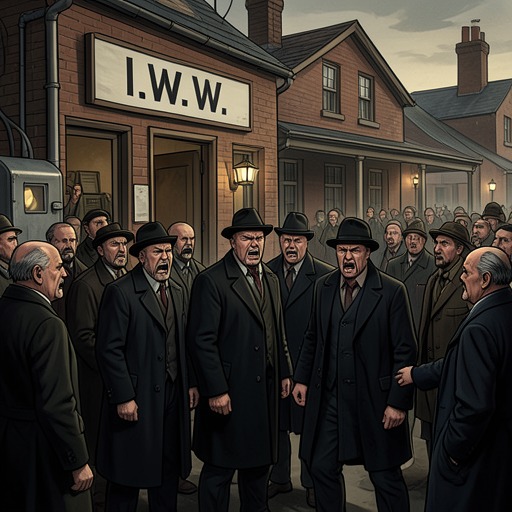
Their formation of the Employers Association was part of an effort to drive radicals out of the logging camps. The association was paired with the Legion of Loyal Loggers, joining employers’ organization to a body of ex-soldiers prepared to act against the union movement. The text identifies this alliance by its campaign and targets, rather than by internal officers or formal procedures.
Aims and Methods
The association and the Legion made it worthwhile for groups of ex-soldiers to raid Industrial Workers of the World halls, lynch and beat organizers, and burn literature deemed subversive. The account places these acts within a defense of the timber owners’ authority: appeals to preserving free American institutions accompanied violence against workers’ organizing and political speech.
The organization’s role is therefore shown through the means it helped mobilize, not through a conventional account of meetings or policy. Its response to labor activism joined employer interests to patriotic rhetoric and coercion, making anti-union force appear as a defense of the country’s institutions.
Conflict with Lumber Workers
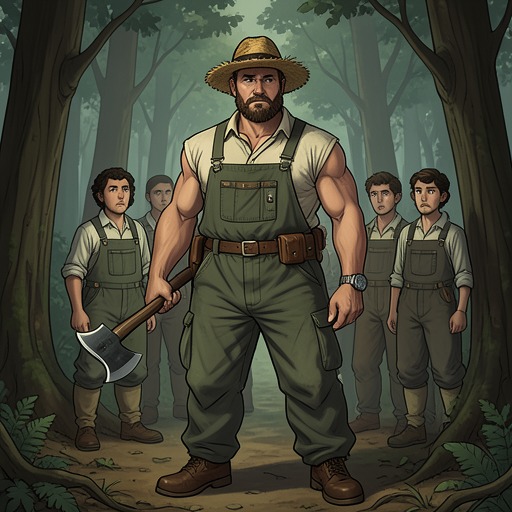
The campaign confronted a labor movement seeking industrial democracy for loggers, lumberjacks, shingleweavers, and sawmill workers. The I.W.W. organizers’ program, as described in the novel, called for the forests to belong to the people, payment in real money rather than company scrip, decent places to dry wet clothes, an eight-hour day, clean bunkhouses, and wholesome food. These demands make clear what was at stake in the conflict: not only union recognition, but workers’ control over the conditions of work and daily life.
The owners’ alliance worked against that program through intimidation and the destruction of organizing spaces and materials. The conflict is presented as a struggle between workers seeking to improve conditions in the camps and an industry determined to keep its authority intact, with the Employers Association among the institutions coordinating the anti-union response.
Repression and Its Limits
An episode dated Memorial Day 1918 shows the violence of this broader campaign. Members of the American Legion, led by a group from the Chamber of Commerce, wrecked an I.W.W. hall in Centralia, beat those inside, jailed some, and drove others across the county line in a truck. They burned papers and pamphlets and auctioned the hall’s fittings for the Red Cross. The passage does not attribute this particular raid to the Employers Association; it presents it as an instance of the anti-radical repression alongside the association’s formation and activity.
The attack did not end the workers’ organizing. Lumber workers hired a new hall, and the union continued to grow. That outcome gives the Employers Association’s campaign its central contradiction: employers and their allies could destroy a meeting place and punish organizers, but the narrative does not portray those acts as extinguishing the movement.