Council of Four
1919The Council of Four is the novel’s name for the restricted diplomatic circle that takes over the making of peace from a larger, more public assembly. Its significance lies in that contraction: the body entrusted with shaping the postwar settlement becomes smaller as the negotiations proceed, while Woodrow Wilson’s attempt to advance his declared democratic aims ends in a treaty he must defend at home. The Council is presented less as a stable institution than as a changing arrangement of access and influence, culminating in the Treaty of Versailles.
From the Council of Ten to the Council of Four
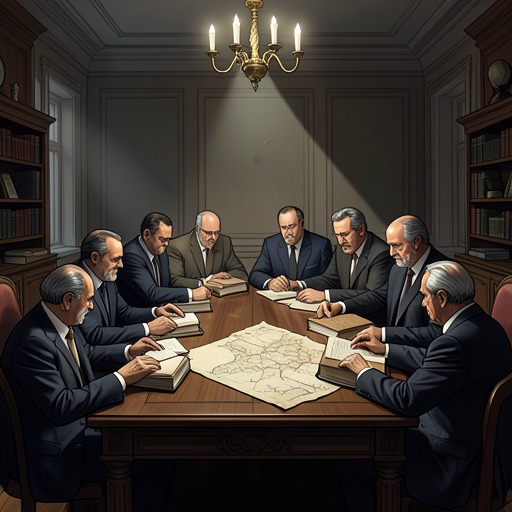
The peace-making sequence first places the Council of Ten in the Gobelin Room, among the paintings of Rubens’s History of Marie de Medici, where its members begin to dictate the peace. The setting gives the negotiations a formal, ceremonial aspect, but the narration immediately marks a practical problem: the Council of Ten is too public a place to make peace in. The stated answer is to form the Council of Four. The change is therefore not presented as a fresh public mandate or a broadening of participation, but as a response to the exposure of the larger body.
The name then becomes unstable almost as soon as it is introduced. Orlando goes home in a huff, and the narration counts the remaining negotiators down to three. It identifies Georges Clemenceau and David Lloyd George among those left. This shift from four to three makes the Council’s title describe its point of origin rather than the number present in every consequential stage. The passage emphasizes the bargaining circle’s changing membership, not a fixed roster or formal operating rules.
Wilson’s entry and the negotiations
The sequence links the Council’s formation to Woodrow Wilson’s decision to remain in Europe. On April 7, he orders the George Washington held at Brest with steam up, ready to take the American delegation home; he does not leave. On April 19, Clemenceau and Lloyd George bring him into what the narration calls their Council of Four. The dates frame his participation as a turn in the negotiations: departure is prepared, but the president stays and enters a smaller, more intimate decision-making group.
The description makes the imbalance in that encounter part of its meaning. Clemenceau and Lloyd George are characterized as the sharper negotiators, and the Council as their cosy three-card game. That image presents Wilson not as an unchallenged director of the settlement but as a participant drawn into a compact contest in which the other two are portrayed as adept at bargaining. The evidence does not specify every proposal or exchange within the Council; it does establish the political shape of the episode, with Wilson remaining at the table and the peace taking form through this reduced group.
Treaty and consequence
By June 28, the Treaty of Versailles is ready. The account connects the document’s completion directly to the Council’s negotiations, then shifts attention from the European conference to Wilson’s return home. He must explain the settlement to politicians who have been gathering against him in the Senate and House, to a public he is expected to sober, and to the God of his father. The passage thus presents the treaty not as a resolution that ends political conflict, but as the beginning of a struggle over how the peace was made and what it achieved.
The closing contrast is between Wilson’s earlier promise to make the world safe for democracy and the compromised outcome he must now account for. The Council’s work produces a finished treaty, but the narrative does not treat completion as proof that Wilson fulfilled his aims. Instead, the gap between ideal and settlement becomes the consequence attached to his membership: he stays when the ship is waiting, negotiates with Clemenceau and Lloyd George, and returns to explain how far the result falls short of the democratic promise associated with his mission.
Narrative significance
The Council’s changing scale gives the peace conference a compressed dramatic form. A ten-member body is deemed too public; a four-person council is established; Orlando’s departure leaves three. The successive reductions make institutional power appear concentrated in a narrow circle, while the Treaty of Versailles supplies the concrete endpoint of its deliberations. The passage’s emphasis is not on procedural detail but on who remains in the room, who is described as controlling the encounter, and what Wilson must answer for afterward.
In that structure, the Council of Four embodies the difference between making peace and realizing an ideal of peace. Its formation allows negotiations to proceed in a less public setting, and its work yields a treaty by June 28. Yet the concluding return to Wilson’s political and moral explanations refuses to equate a completed agreement with success. The Council matters because its restricted negotiations produce a settlement that Wilson must carry back into public life, where its claims and compromises remain contested.