Norton-Harjes Ambulance Service
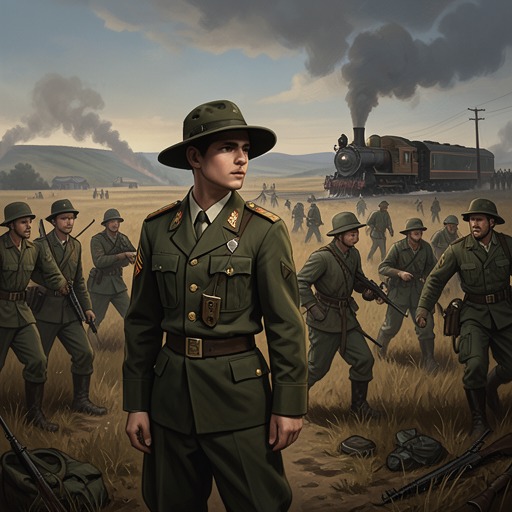
1919Norton-Harjes Ambulance Service is the volunteer ambulance organization through which the book connects wartime service to the experiences of both its author and the fictional Richard Ellsworth Savage. Dos Passos volunteered for the service in 1916 and served in France and Italy; within the novel, Richard’s decision to join it turns his pacifist convictions into a form of direct participation in the war, even as he remains unsure what awaits him overseas.
Dos Passos and wartime service
The book’s biographical account identifies Dos Passos as a volunteer driver for Norton-Harjes Ambulance Service, the same organization for which Ernest Hemingway and E. E. Cummings drove. He served in France and Italy. When the United States entered the conflict, he enlisted in the American Expeditionary Forces as well. The account presents these experiences as a firsthand encounter with modern war that furnished material for his portrayal of soldiers and their suffering in Three Soldiers.
That biographical frame makes the service more than a passing name: it marks a point where Dos Passos’s movement through European settings brought him into the war itself. The account does not detail his ambulance duties, but it explicitly connects his time with the organization and subsequent military enlistment to the war experience that informed his fiction.
Richard Ellsworth Savage’s decision to join
Richard’s route to Norton-Harjes begins in Cambridge, where his pacifism sets him apart from Ned, who talks of joining the Navy. After the Armed Ship Bill passes, Mr. Cooper offers to find Richard a job in Washington, arguing that a young man of his talent should not endanger his career by entering the Army. Richard says that helping the war in any way would violate his conscience. Yet as military drills and lectures become part of university life, his studies lose their meaning to him.
Richard wins a Literary Digest prize for a group of sonnets, revising their final sestet at the editors’ request to include a note of hope. He sends the hundred-dollar prize to his mother for a trip to Atlantic City. Then he discovers that war work would let him receive his degree that spring without taking examinations. Without telling anyone, he goes to Boston and signs up for the volunteer ambulance service. His choice is not presented as a simple conversion to enthusiasm for war: it follows his pacifist refusal to assist the conflict, but takes the form of volunteering for work connected to it.
Reporting in Paris
After sailing for France, Richard and his companions reach Paris too late to report at the Norton-Harjes office. They stay at the Hotel Mont Thabor, and the next morning hurry to the address they have been given, rue François Premier. There they are told where to obtain their uniforms, warned to keep away from wine and women, and instructed to return that afternoon. Instead of receiving their identity cards then, they are told to come back the next morning; the cards require another day of waiting.
The delay gives the first days of service an unsettled rhythm: the men have crossed the ocean to join the organization, but their immediate business is reporting, obtaining uniforms, and waiting for identification. During the interval, Richard, Ed Schuyler, and Fred Summers explore Paris, dine together, and walk the boulevards. Richard likes talking to the women they meet but finds the commercial character of the encounters distasteful. His unease and his companions’ differing responses to the city stand beside the administrative routine of joining up, before their departure for the front.
Significance in the book
Norton-Harjes Ambulance Service provides a concrete bridge between the book’s biographical material and its fictional account of wartime youth. Dos Passos’s service in France and Italy is linked retrospectively to the soldier-victims of his writing; Richard’s enrollment is shown prospectively, through his departure from university and the anxious, mundane preparations in Paris. In both strands, the organization marks entry into the war, but the novel’s account emphasizes how little that threshold initially resolves: Richard has chosen his work and reached France, yet the front remains an unknown future.