Industrial Workers of the World
1919The Industrial Workers of the World is portrayed as a labor organization whose call for industrial democracy reaches from factory strikes to the lumber camps of the Pacific Northwest. Its members seek not only better pay and working conditions but collective power over the industries that shape their lives. The novel follows that politics through organizing and solidarity, and through the arrests, violence, and wartime suspicion directed against them.
A labor politics of industrial democracy
The organization enters a world where labor disputes and political repression are already closely linked. Accounts of indictments, the Masses trial, and the trial of members of the Industrial Workers of the World place the organization among the targets of a widening campaign that sends dissenters to jail. Its politics also circulate beyond formal meetings: Don Stevens, a journalist who has taken part in disputes involving the organization, carries a red membership card and speaks at antiwar meetings. He describes the press as constrained and predicts that the conflict in Europe and the Russian Revolution may intensify working-class revolt. This is his political analysis, not a neutral account of what must follow; the novel presents its urgency alongside the uncertainty and risk of organizing in wartime.
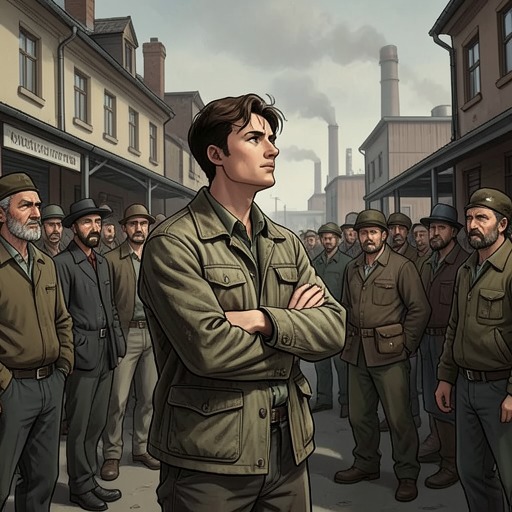
Joe Williams initially treats the organization’s politics as foreign to him. In a conversation with workers in a bar, they argue that he should join, carry a red card, and think of himself as a worker with common interests. Joe resists the idea that the movement could represent him, preferring the notion of a white workers’ party against bankers and profiteers. The disagreement exposes the racial and sectional divisions that impede solidarity. The barkeeper, himself a German immigrant and socialist, rebukes the group for turning on one another and refusing to recognize their shared position as workers. The scene does not resolve Joe’s hesitation; it shows how the organization’s appeal depends on challenging boundaries that workers themselves reproduce.
Organizing in the streets and at the mills
A New Jersey textile strike shows the practical work around collective action. Webb Cruthers and Anne Elizabeth Trent find a mill town guarded by police and special deputies, with strike headquarters crowded by workers, handbills, newspapers, and publicity work. Ben Compton urges Webb to speak, treating the labor dispute as part of a larger struggle over democracy in industry. The meeting cannot be held in the mill town, where the mills control access to a hall, so strikers and their families travel to a neighboring town. There, mounted police turn people away despite the hall’s limited attendance. Ben addresses the crowd from a lamppost, but police drag him away; as the crowd begins to disperse under pressure, Webb climbs onto a hydrant and protests the exclusion.
The organization’s commitment to solidarity is also shown through participation on the picket line. Before dawn, Anne Elizabeth joins Webb among workers whose clothing offers little protection from the cold. Strikers sing Solidarity Forever and call out against strikebreakers while police break up the head of the line. When Anne Elizabeth sees a fallen young woman struck by a policeman, she intervenes and is arrested. Her experience makes the costs of solidarity immediate: the picket line is not an abstract political emblem but a place where workers and their supporters face direct coercion. Elsewhere, a police search turns up packages of pamphlets in Yiddish, Russian, and English, as well as membership cards for the Industrial Workers of the World. The multilingual materials suggest an organizing effort that crosses linguistic communities; their discovery also makes the organization’s printed and membership records potential evidence against it.
Arrest, imprisonment, and wartime dissent
Ben Compton’s involvement develops from speechmaking into sustained commitment. After a strike, he is arrested repeatedly and sentenced to six months in jail. In court he speaks about surplus value, and the strikers in the audience cheer until the judge threatens to extend his sentence for contempt. In jail, Ben meets Bram Hicks, a young member of the Industrial Workers of the World who urges him to learn the labor movement by joining and traveling west. Their daily conversations in the prison yard become a source of support. The strike ends while they are imprisoned; on their release, the mills are running and the streets and meeting hall have returned to ordinary quiet. The contrast shows how quickly public conflict can disappear from view without settling the conditions that produced it.
Ben and Bram travel together through precarious work. After taking jobs in wheat harvesting and a fruit cannery, they read about the shingleweavers’ strike and free-speech fight in Everett and decide to go there. On arrival, members of the Industrial Workers of the World encounter armed deputies who arrest them as they leave the boat. Ben is beaten and later spends three weeks in hospital; Bram walks back toward Seattle with other members of the group. The organization’s defense committee then asks Ben to raise funds for seventy-four members held in the Everett jail on murder charges. A shipping-office sympathizer secures him work as supercargo on a freighter bound for New York City, but the passage does not end his trauma: he continues to wake from nightmares about the attack and the threat of being forced through a gauntlet. The defense work therefore extends the struggle beyond the dockside confrontation, even as the violence follows one of its survivors into private life.
The United States’ entry into the war further narrows the space for dissent. Ben registers for the draft as a conscientious objector and tells Morris Stein that he will agitate against the war, even if it costs him his job. After the government roundup of Industrial Workers of the World officials, Ben and Helen Mauer expect arrest but are initially passed over. Later, at a meeting in the Empire Casino in the Bronx to send greetings to Russia’s workers, federal agents take notes, police close the doors, and uniformed soldiers and sailors enter the gallery. Ben speaks against a war he considers beneficial to bankers and munitions makers; he and others are arrested. When Morris Stein and a government official offer to quash the charges if Ben promises to report for military training, he refuses to abandon his opposition. He is released on substantial bail under an assurance that he will not agitate before trial, leaving the organization’s political work suspended between continued resistance and state control.
The timber conflict and the organization’s legacy
In the Northwest, the novel gives the organization’s program its clearest statement through the figure of Paul Bunyan. Lumberjacks, loggers, shingleweavers, and sawmill workers are described as the laborers of a timber empire. Organizers argue for an eight-hour day, clean bunkhouses, wholesome food, dry clothes, and payment in real money rather than company scrip. Their broader demand is that the forests belong to the people who work and live from them. Paul Bunyan, returned from the war, joins a lumberjack local: the familiar giant of logging folklore becomes a figure through whom industrial democracy can be imagined as a change in ownership and everyday working conditions.
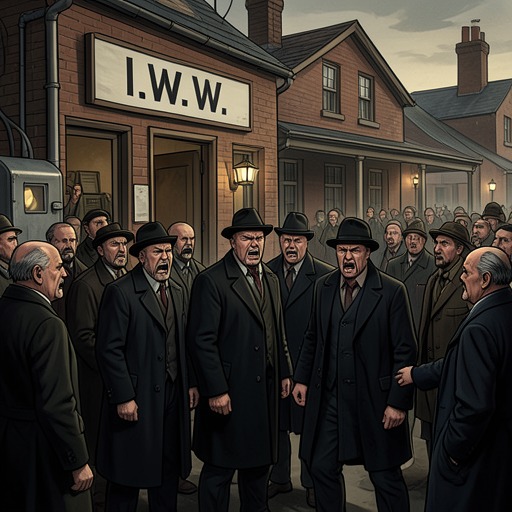
The employers’ response gives that organizing a violent political setting. As lumber prices rise sharply during the war, timber owners form the Employers Association and the Legion of Loyal Loggers, recruiting ex-soldiers to raid halls, assault organizers, and burn literature. On Memorial Day in 1918, American Legion members, accompanied by people from the Chamber of Commerce, wreck the Industrial Workers of the World hall in Centralia, Washington; they beat and jail those inside, remove others from the county, destroy papers and pamphlets, and sell the hall’s fittings for the Red Cross. The union hires another hall and continues to grow. The surviving desk in the Chamber of Commerce stands as an unsettling remainder of the raid: the organization’s presence has been displaced, not erased.
The novel’s recurring contrast is between the organization’s expansive promise of worker solidarity and the institutions that constrain it. Its members distribute multilingual pamphlets, speak at meetings, join picket lines, aid jailed comrades, and press demands grounded in the conditions of work. Employers and public authorities answer with surveillance, prosecution, exclusion, and force. In the lumber camps, the promise of a shared industrial future meets an organized effort to preserve private control; in wartime, antiwar organizing is treated as a threat to national loyalty. The Industrial Workers of the World thus links disparate lives and workplaces while revealing how difficult it is to sustain collective action when the costs of participation fall so heavily on workers and organizers.