League of Nations
1919The League of Nations is the defining promise of Woodrow Wilson’s postwar politics in the novel: an institution meant to carry peace beyond the end of fighting and make international cooperation answer to justice rather than force. Yet the League appears less as a functioning body than as a contested ideal. Wilson’s campaign for it collides with political repression at home, competing national and commercial interests abroad, and a public language of peace that can also serve as a cover for power.
The League as Wilson’s Promise
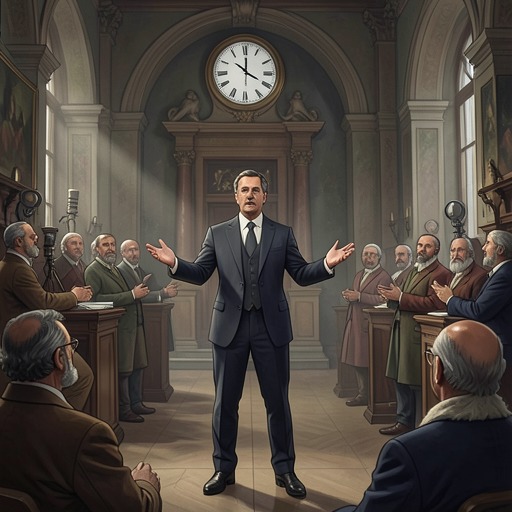
From the day Woodrow Wilson returns to the United States, he speaks to preserve his faith in words, the League of Nations, himself, and his father’s God. The sequence makes the League inseparable from his personal confidence: defending the institution also becomes a way of defending the belief that language and principle can still direct political action. Wilson commits the agencies of government under his control to this effort. In the novel’s account, however, disagreement is treated as evidence of disloyalty or radicalism, and there is no pardon for the imprisoned socialist leader Eugene V. Debs. The campaign for international peace therefore unfolds alongside the coercive politics of the wartime state, exposing a tension between the League’s promise and the means used in its defense.
The novel sets Wilson’s public appeal against divergent responses among the people he encounters. In Seattle, workers whose leaders have been imprisoned or killed stand silently as his car passes, in contrast to the patriotic applause along other parts of his route. In Pueblo, exhausted and visibly unwell, Wilson gives what proves to be his last speech. He insists that the American people will recognize justice, liberty, and peace and that these principles can guide both the country and the world. The League’s appeal rests on that confidence in a public capable of choosing a shared moral purpose, but the silent reception in Seattle shows that Wilson’s claim to speak for the nation is not universally accepted.
Peace, Mandates, and Competing Interests
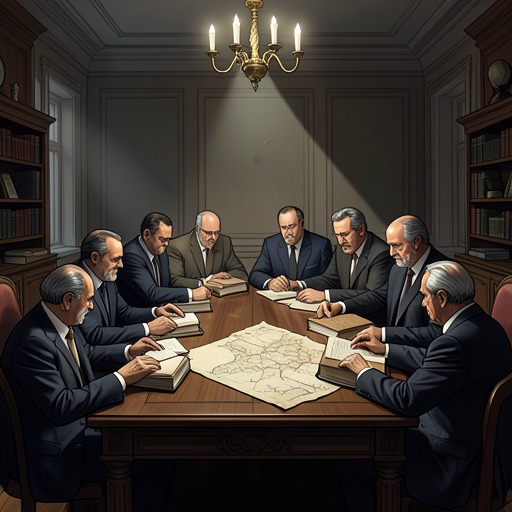
At the Paris Peace Conference, the League’s language of international cooperation encounters disputes over strategic resources and political authority. In a discussion after the opera at the Café de la Paix, Standard Oil engineer Mr. Rasmussen argues that Britain and Royal Dutch-Shell are gaining ground on the United States in the Near East. He links the question of mandates to control of oil and speaks of American influence as an interest that could be lost. Baku becomes a focal point: the possibility of a British presence there, the proposal that France might hold it, and the competing claims made in the name of self-determination all appear within the same conversation. Mr. Rasmussen doubts that a League dominated by Great Britain would serve American interests; his account presents the institution not as neutral ground but as a possible arena for the redistribution of advantage.
The novel also gives the mandate system a more elevated public formulation. A statement describes the welfare and development of colonial regions as a sacred trust of civilization, supervised by the League. That language presents international oversight as a duty toward people in dependent territories. Set beside arguments about oil, national primacy, and which power should control Baku, however, it leaves a pointed uncertainty: whether the language of trusteeship restrains imperial competition or gives it a more acceptable form. The evidence establishes the contrast, not a settled answer.
Private finance forms another part of the political landscape surrounding the peace project. The novel’s account of the Morgan interests traces their reach across banks, insurance companies, railroads, shipping, and other enterprises, then places the scale of Allied borrowing through the House of Morgan beside Wilson’s wartime appeal for democracy. By the end of the Peace Conference, the phrase J. P. Morgan suggests is associated with an immense financial power. The juxtaposition does not establish that the League is directed by financial institutions; rather, it places Wilson’s language of international principle in a world where concentrated private capital and national policy possess their own formidable reach.
Campaign and Public Reception
The League travels through the novel as a repeated political message. On a crowded train to Rome, G. H. Barrow speaks at length about Wilson’s diplomacy, a new European order, peace without annexations or indemnities, and an understanding between capital and labor. Richard Ellsworth Savage, too tired to engage, hears the argument as a stream of presidential claims and falls asleep. The scene turns the League’s public vocabulary into background noise: its phrases circulate with great insistence, yet reach a listener who is physically and emotionally removed from them.
During Wilson’s visit to Rome, the League’s broader moral ambition is joined to a ceremonial appeal to history. At the Roman Forum, Wilson calls the ruins symbols rather than mere stones and presents America’s defining pride as its love of humanity. The scene links the wartime past to an imagined international future, but its formal speeches and dignitaries also make the ideal a matter of public performance. Later, wounded Italian soldiers approach Wilson with a petition in favor of the League. Their appeal gives its cause support from people marked by the war, rather than only from diplomats or officials.
For G. H. Barrow, the League also carries intimate emotional weight. When he takes Anne Elizabeth Trent to lunch in Paris, he portrays Wilson’s struggle at the Peace Conference as a crusade against intrigue and for a better world. He says the president and his supporters are standing for decency and fair dealing, and recalls the signing of the Covenant of the League of Nations as one of his own moments of happiness. His fervor reveals how the promise can become a personal faith, even as Anne hears him at a distance and remains troubled by her own life. The League’s ideal inspires conviction, but the novel does not equate conviction with political success.
Fracture, Rebranding, and Aftermath
The League’s weakness is stated starkly in the news fragments: it lies in pieces on the floor of the Hôtel de Crillon, while the modest alliance that might usefully replace it remains only a vague sketch. The image reduces the distance between the language of a lasting peace and the unsettled negotiations in which that peace is supposed to take shape. Instead of presenting a completed settlement, the novel shows a broken promise and an alternative without firm definition.
Elsewhere, international cooperation is presented in language that blurs the difference between public peace and corporate agreement. At a press gathering, J. Ward Moorehouse avoids a question about disagreement between Wilson and Edward M. House. When reporters ask about oil, he describes an understanding between American producers and perhaps Royal Dutch-Shell as evidence of a new era of cooperation serving peace and democracy. He answers the question of the League by returning to that claim of a dawning new era. The scene makes the rhetoric of internationalism available to private business as well as to Wilson’s political program: cooperation can signify collective peace, but it can also describe the accommodation of powerful commercial interests.
Wilson’s final League campaign ends in physical collapse. After returning to the United States, he undertakes a speaking tour intended to rally the country behind the institution. On the train to Wichita he suffers a stroke and abandons the tour; afterward, he is left severely paralyzed and barely able to speak. The loss is both personal and political: the man who had devoted his public voice to sustaining faith in the League can no longer carry that argument across the country. In the novel, the League consequently remains suspended between an ideal that inspires Wilson, Barrow, and the wounded Italian petitioners, and a political order shaped by repression, strategic rivalry, and the bargaining power of capital. Its significance lies in that unresolved contradiction, not in a triumph it never achieves.