Council of Ten
1919The Council of Ten is the peace conference’s first attempt to move the work of dictating peace from a grand assembly into a smaller deliberative body. The novel presents its formation as a revealing procedural sequence: the Allied and associated powers gather in ceremonial splendor, retreat from the public assembly to the Gobelin Room, and then retreat again, this time to the Council of Four. The Council of Ten matters less here as a roster of individual statesmen than as one stage in an increasingly restricted process of making peace.
Formation at the Peace Conference
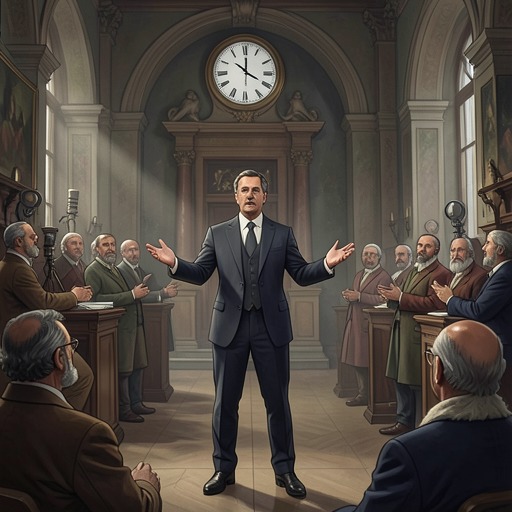
On January 18, 1919, the High Contracting Parties met in the Salon de l’Horloge at the quai d’Orsay. The scene is crowded with the visible insignia of official authority: uniforms, cocked hats, gold braid, decorations, epaulettes, orders of merit, and knighthoods. Against that display, the conference’s stated task is starkly practical: the powers have assembled “to dictate the peace.” The Council of Ten emerges from this gathering when the full assembly proves too public a place for the work.
The passage does not name the Council’s members, explain how the number ten was constituted, or specify its rules. Instead, it identifies the Council through its place in the sequence and the task assigned to it. The allied and associated powers first meet collectively; they then form the Council of Ten and continue their work in a different room. This sparse account leaves the body’s internal composition outside the frame while emphasizing the political procedure by which the conference narrows its circle.
From the Salon to the Gobelin Room
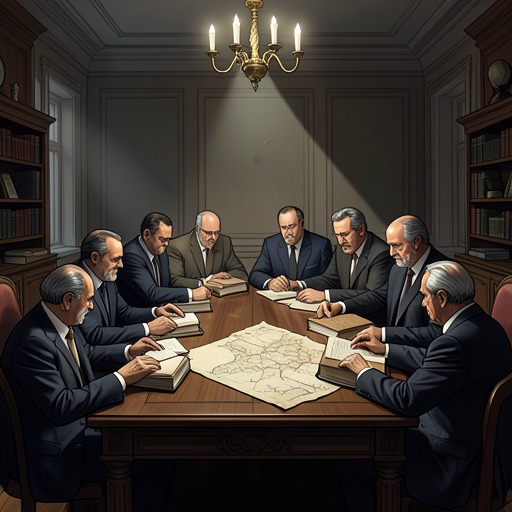
The first change of venue is presented as an answer to a problem of publicity. The grand assembly is “too public a place to make peace in,” so the High Contracting Parties form the Council of Ten and enter the Gobelin Room. The room is marked by the presence of Rubens’s History of Marie de Medici. The narrative names the painting and the setting, but supplies no account of debate or of the decisions reached there; the movement between rooms, rather than a record of deliberation, carries the episode.
In the Gobelin Room, the Council begins again to dictate the peace. Yet the effort to move the negotiations into a less public setting is not presented as a final solution. The next turn repeats the same judgment: the Council of Ten, too, is “too public a place to make peace in.” The repeated formulation makes procedure itself the scene’s subject. A change in the scale of the meeting has not produced a setting deemed sufficiently private for the task, and the Council of Ten gives way to another, still more restricted body.
Succession by the Council of Four
The Council of Four follows the Council of Ten in a two-step contraction: first from the full conference to ten, then from ten to four. The account does not describe the Council of Four’s membership or its subsequent decisions, so it does not establish what peace the successive bodies ultimately made. It does establish the direction of institutional change. Each relocation and reduction is prompted by the same stated difficulty—the setting is too public—and the Council of Ten is therefore represented as an intermediate arrangement rather than the conference’s final forum.
That sequence also sets a limit on what can be claimed about the Council. The passage records its formation, its move into the Gobelin Room, and its supersession; it offers no list of delegates, particular dispute, or agreement attributable to it. Its significance in this episode lies in that visible transition: a formally grand gathering becomes a smaller council, which in turn yields to a four-person body.
Place in the Novel’s Account of Peace
The conference scene appears within a wider narrative in which the end of war does not make political and economic competition disappear. Elsewhere, a discussion at the Café de la Paix after the opera turns to oil, mandates, and rivalry among powers in the Near East. That conversation is not presented as a meeting of the Council of Ten, and its claims are not assigned to the Council. Read alongside it, however, the procedural retreat from the full assembly to smaller councils belongs to a larger portrayal of peace as a contested political undertaking, not simply the quiet opposite of war.
The scene’s clipped repetitions give institutional form to that uncertainty. The conference convenes amid the emblems of rank and ceremony; the assembled powers withdraw to a council; the council is judged too public; and the account ends its sequence by naming the Council of Four. Rather than narrating a settled result, the passage makes the narrowing of participation its decisive fact. The Council of Ten stands at the point where the peace conference’s public spectacle turns into increasingly restricted negotiation.