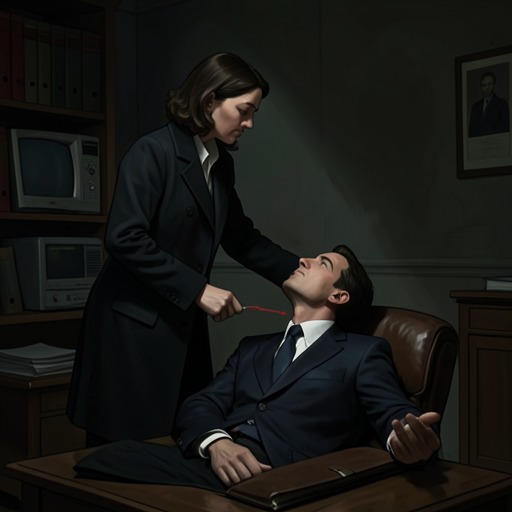
Aomamé kills the abusive oil executive
1Q84Aomamé kills the abusive oil executive in a Shibuya hotel, presenting his death as a heart attack. The killing ends his ability to harm his wife and bypasses the legal and financial burdens of divorce; its aftermath, however, remains deliberately quiet, as news reports omit the death and Tamaru describes it as an apparently ordinary medical event.
Background and Circumstances
The event is framed by the limited options available to a woman seeking divorce on grounds of domestic violence. Tamaru explains that proving abuse takes time and money, and that a capable lawyer for the husband can make the process especially difficult. Family courts are overburdened and short of judges; even when a wife wins damages and maintenance, former husbands often use evasions to avoid paying. In Tamaru’s account, imprisonment for nonpayment is rare, and the courts show leniency when a man demonstrates some willingness to pay. Aomamé’s action takes place against this institutional imbalance, though the evidence does not detail the killing itself.
The victim is identified in their later conversation as a violent husband, and Tamaru says he was just over forty. Aomamé connects the death to the steps taken against him, while Tamaru objects to calling those steps concrete measures. Their exchange makes the central reversal plain: a man whose wife would otherwise face a protracted and uncertain legal route has died, and the immediate danger he posed is over.
The Death and Its Concealment
After the killing, Aomamé watches a television bulletin for news of a body found in a Shibuya hotel. No such report appears. She switches off the television, leaving only the quiet presence of the elderly man sleeping beside her. The contrast between the possible public discovery of the death and the silence of the broadcast keeps the act from becoming a public incident in that moment.
Aomamé’s recollection of the dead man’s stillness is brief and controlled. She thinks of him as no longer able to wake or rise, then gets out of bed and gathers the clothes she had left on the floor. The restrained narration registers the finality of the killing without depicting its physical details. His death is later reported in conversation as an apparent heart attack, and Tamaru notes that newspapers have not covered it.
Tamaru’s Account of the Consequences
When Aomamé meets Tamaru, he mentions that a man has died in a Shibuya hotel and says the reported cause is a heart attack. Aomamé replies that she had not heard. Tamaru describes the deceased as a little over forty and remarks that the newspapers have omitted the story. The exchange confirms how the death is understood outside Aomamé’s immediate experience: as an unremarkable medical event, not as a killing.
Tamaru also sets out the practical consequence for the wife. Because the stated cause of death is not suspicious and no unusually large life-insurance policy is involved to draw attention, he expects the insurer not to raise questions. He says the wife should receive a reasonable sum with which to begin a new life. The death has also spared her the cost and time of divorce proceedings, their complicated formalities, and the psychological suffering those proceedings can entail. The evidence presents this as Tamaru’s assessment, not as a separately confirmed account of the wife’s later circumstances.
Moral Framing and Narrative Significance
Aomamé and Tamaru frame the outcome differently from the legal order that failed to offer a swift remedy. Aomamé points to the concrete steps that brought the violent husband down; Tamaru recasts the result as providence. He calls the apparent heart attack a resolution and says that the matter has ended well. Aomamé’s answer—that an ending may exist somewhere—holds open a doubt his neat conclusion cannot settle.
Tamaru extends that doubt through an image of a ladder: no final rung announces itself as the last one, and no sign warns against stepping beyond it. His reflection makes the event’s apparent closure unstable. The husband can no longer harm another victim, and his wife may be able to start again, but the conversation does not establish that the broader conditions Tamaru has described have changed. The killing therefore resolves an immediate danger while leaving the question of where an ending truly lies unanswered.