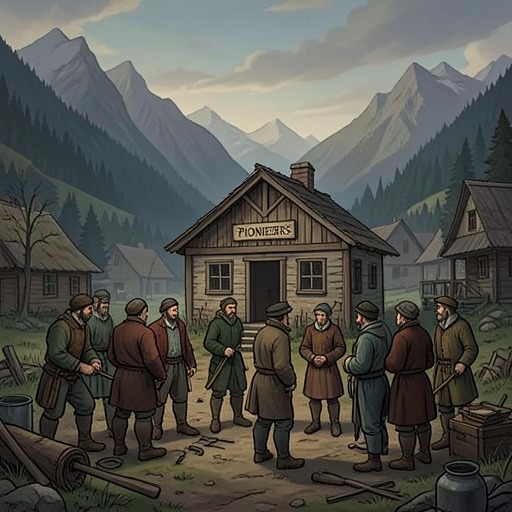
The split of the Pioneers and the formation of the Dawn
1Q84The split of the Pioneers and the formation of the Dawn transformed an initially flexible farming community into two increasingly estranged projects: one oriented toward communal life in nature, the other toward revolution and clandestine military preparation. The division was not simply a dispute over agricultural management. It exposed the distance between Fukada’s increasingly metaphorical conception of revolution and the literal, violent future his former students expected him to help bring about.
Causes and Competing Visions
Under Fukada’s leadership, the Pioneers’ farms were organized around a system of separate units, allowing a degree of communal life without abolishing personal property. The structure had been designed to remain flexible, but it also made it possible for sharply different political commitments to develop within the same community. Ordinary farm work could continue, yet disagreement over the movement’s larger direction repeatedly overwhelmed attempts at compromise.
The militant faction, centered on former “Red Guards” trained by Fukada, saw farming as a preparatory stage. Its members concealed their revolutionary purpose behind agricultural work and intended to take up arms when the time came. The moderate faction also opposed capitalism, but kept its distance from politics and sought instead to live communally and self-sufficiently amid nature. It had more adherents among the farming community. The two positions could coexist in routine labor but were, in the account, as incompatible as oil and water whenever the community had to choose a general course.
The conflict sharpened because Fukada’s idea of revolution had changed. He had come to doubt that an actual revolution could take place in 1970s Japan, and thought of revolutionary thinking chiefly as a possibility or metaphor: a healthy society, in his view, needed a destructive, anti-system current as a kind of corrective. The students he had once led wanted a real revolution, with real bloodshed. Fukada bore responsibility for that expectation: under pressure, he had told them stirring stories about revolution without making clear that he meant the term conceptually rather than literally. He was intelligent and capable, but prone to being carried away by his own eloquence and lacking deeper self-scrutiny. His later uncertainty therefore did not undo the militant movement he had helped inspire.
The 1976 Separation
The Pioneers divided in 1976. The moderate faction remained in the original village, while the militant faction relocated about five kilometers away and established a base for its revolutionary movement. Fukada’s family and the other families stayed with the Pioneers. At first, the separation was made on roughly friendly terms: Fukada apparently helped the departing group secure funds, and the two agricultural settlements continued to exchange essential provisions and route their produce through shared channels for economic reasons. Their continued dealings reflected practical interdependence, not agreement about what the communities were for.
That limited cooperation soon faded. The factions’ aims had grown too far apart, and movement between the original Pioneers and the dissidents effectively stopped. Exchanges continued chiefly between Fukada and the former extremist students he had organized. He felt responsible for them because he had led them into the Yamanashi mountains, and because his secret source of funding remained indispensable to their community. The material connection endured even as their political relationship became more strained.
Fukada Between the Communities
Fukada occupied an increasingly divided position after the schism. He remained the Pioneers’ leader while also advising the militant settlement, traveling between the two. Inwardly, he no longer believed in the possibility or romance of revolution as he once had, yet he could not wholly reject it. To do so would have meant repudiating the group’s past and admitting his own errors; pride made that reckoning difficult, and he may also have feared confusing the original Pioneers, over whom he still held some influence.
The militants’ course moved further from his own. Alongside their farm work, they underwent rigorous ideological education and trained in the use of weapons. Their political position became increasingly radical in comparison with Fukada’s. They organized in complete secrecy, admitted no outsiders, and remained under distant police surveillance; despite their declarations in favor of armed revolution, the police regarded them as relatively low-risk. The combination of routine agricultural life, ideological discipline, weapons training, and strict isolation shows how the break produced a community operating on two levels: visible farm work and a concealed revolutionary structure.
From the Dissidents to the Dawn
In 1977, the dissident faction took the new name Dawn. The renaming followed the 1976 division and marked the group’s separate identity, but it did not resolve the tensions inherited from the Pioneers or Fukada’s ambivalent role between them. Its members continued to live and work as a clandestine revolutionary community while Fukada maintained ties through counsel and funding, despite no longer sharing their certainty about the revolution they pursued.
The history reaches the reader through the Master’s account to Tengo, who recognizes the name Dawn but finds that his recollections of it are confused and fragmentary. That delayed recognition gives the schism significance beyond the internal history of a farming settlement: the movement’s name resurfaces in a later, uncertain present, while the account of its origins reveals how a flexible communal experiment became the ground for a concealed armed project. The split thus joins an ideological failure of communication to a lasting political consequence: Fukada’s revolutionary rhetoric outlived his belief in it, embodied by students who took literally what he had treated as metaphor.