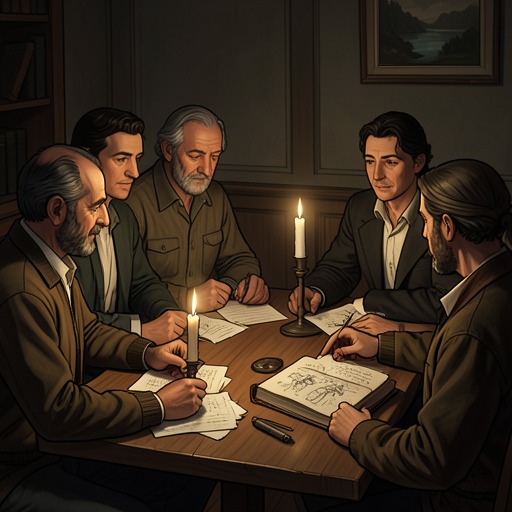
La réécriture de La Chrysalide de l’air par Tengo
1Q84Tengo’s rewrite of Air Chrysalis is the point at which an attempt to reshape Fukaeri’s story becomes an irreversible literary undertaking. The Master authorizes the work because Fukaeri trusts Tengo, and Komatsu later confirms that the revised manuscript has already gone to the printers and entered preparations for the Newcomer’s Prize. Their collaboration gives the story a public future, while its impossible image of two moons remains a precise, still-unfinished challenge for Tengo as a writer.
Authorization and Trust
Tengo seeks a clear answer from the Master: permission to rewrite Air Chrysalis. The question is not merely whether the manuscript can be improved. The Master has spent seven years trying to learn what happened to Fukaeri among the Pioneers and what became of the Fukadas, and he hopes the story may contain a key to those unresolved questions. He cannot promise that Tengo has the necessary ability, but recognizes that Tengo has valued the story and immersed himself in it. That attention, rather than credentials, supports his request.
The Master says yes and gives Tengo freedom over the work, while asking to read the revised version. His authorization rests in part on Fukaeri’s confidence: she trusts Tengo, the Master says, and trusts no one else apart from Azami and himself. The permission therefore carries a double weight. Tengo receives room to alter the story, but that freedom is entrusted to him by people for whom the manuscript is connected to a concealed past, not simply a literary exercise.
The decision is marked by a heavy silence. Fukaeri brings tea just as the conversation ends, as though she had waited for the men to finish. The scene gives the authorization a quiet finality: once the Master has agreed, Tengo returns alone, while Fukaeri is out walking the dog. The practical journey back toward Futamatao and the Chuo Line follows a decision that will soon prove difficult to reverse.
From Private Revision to Submission
When Tengo later meets Komatsu, the editor recognizes both the strain and the result. Tengo says that the ten days spent on the work left him unsure whether he was alive or dead; Komatsu replies that he has secured Fukaeri’s guardian’s consent and rewritten the novel successfully. He praises the achievement, admitting that he had underestimated Tengo, who had managed the task despite living apart from the literary world.
Komatsu’s praise is not the same as a declaration that the manuscript is finished in every respect. He calls the rewrite close to perfect and says it is already good enough for the Newcomer’s Prize. If it wins, Tengo can make further revisions before publication in the magazine. The distinction matters: the work has passed into the machinery of publication, yet a final opportunity to refine it remains.
That opportunity is narrow because the manuscript is already at the printers. Komatsu explains that proofs are being prepared and will then go to the editor-in-chief, the director of publications, and the four members of the jury. He rejects the idea of simply restoring the original manuscript: the text has already entered a process involving readers and decision-makers beyond the two collaborators. When Tengo sighs, Komatsu frames the situation as one in which time cannot be turned back. He takes responsibility for what follows and proposes keeping Fukaeri’s public appearances to a minimum if the novel wins, presenting her as an enigmatic young author who refuses to appear in public. His confidence in managing publicity contrasts with the more exposed position of the manuscript itself.
The Two Moons and the Craft of Description
Komatsu’s sole requested revision concerns the scene in which the Little People make an Air Chrysalis. In Tengo’s version, the little girl looks up and sees two moons. Komatsu does not object to the event; he objects to the amount of description it receives. Readers are accustomed to seeing one moon, he argues, and have never seen two. A familiar object can be left largely undescribed, but an image without a counterpart in the reader’s experience requires precise, detailed presentation.
Tengo accepts the reasoning and agrees to develop the passage. The exchange turns the doubled moon into more than an arresting detail in the plot: it becomes a formal problem the rewrite must solve. The image is strange enough to unsettle ordinary perception, but the prose cannot rely on strangeness alone. To make the scene legible, Tengo must give readers enough concrete description to imagine what the girl sees. The editor’s demand links the novel’s extraordinary occurrence to the ordinary discipline of writing.
Komatsu says that after this change the manuscript will be perfect and raises no other objection. His confidence makes the requested passage appear small in relation to the rewrite as a whole, but its significance is concentrated: a single unfamiliar sight tests whether the revised story can carry its readers beyond what they already know without leaving them unable to picture it.
Consequences and Significance
The rewrite brings together literary judgment, trust, and the practical consequences of publication. The Master’s permission enables Tengo to alter a story associated with Fukaeri’s past; the revised manuscript then moves beyond private hands, toward printers, prize jurors, and possible magazine publication. Komatsu can limit Fukaeri’s exposure and handle the public presentation, but he cannot retrieve the manuscript from the process already underway. The moment of consent has become a commitment with consequences neither editor nor writer can simply undo.
The episode also distinguishes two kinds of uncertainty. The Master hopes the story may illuminate the unresolved history of Fukaeri and the Fukadas, but the evidence here does not establish that the rewrite answers those questions. At the level of craft, however, Komatsu gives Tengo a definite problem and Tengo accepts it: the two moons need fuller description. The manuscript thus remains open to revision even as its route toward publication becomes fixed. Its central tension lies in that combination: the story may hold a key to a hidden past, while its most visibly impossible image must be made exact enough for readers to see.