Le récit de La Chrysalide de l’air par Éri
1Q84Eri’s account of Air Chrysalis is the story Eri tells Azami after coming to live with her and the Master. As Azami records and transcribes it, the tale of a blind goat, a child’s confinement, and the Little People becomes more than a mysterious narrative: its telling coincides with Eri’s partial recovery from emotional withdrawal, though neither the Master nor Tengo can establish whether its events are literal memories.
The account takes shape
After Eri arrived at the Master’s home, she spoke little and did not attend school. The Master did not press her to explain what had happened to her, and allowed her to spend long stretches alone with Azami, who had become her closest companion. Their private conversations remained their own; he suspected that, at some point, they began to center on the story Eri later called Air Chrysalis.
Azami wrote down or recorded Eri’s telling, then transcribed it on the word processor in the Master’s study. The account therefore passed from Eri’s speech through Azami’s recording and into a written text. The Master did not know exactly what the girls did in their room, and the narrative preserves that boundary: the story’s emergence is reconstructed from what he observed and inferred, not from direct access to their conversations.
A child, a goat, and a passage between worlds
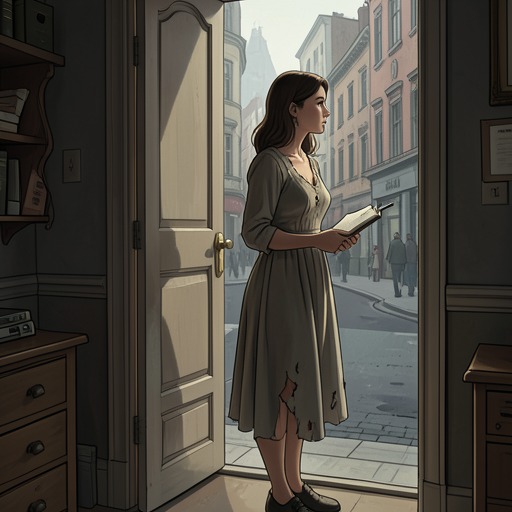
In the story, Eri is ten and lives in a mountain commune where every child has an assigned task. Her responsibility is to watch over an aged, blind goat that matters greatly to the community. She has repeatedly been told not to take her eyes off it. One day, through carelessness, she fails in that duty, and the goat dies.
The community punishes the child by shutting her in an old earthen storehouse with the goat’s corpse for ten days. She is isolated from everyone and forbidden to leave; no one is allowed to speak to her. The punishment turns her assigned act of care into a period of enforced confinement, placing the child alone with the dead animal on which the community’s beliefs depend.
The goat, Eri says, serves as a passage between this world and the world of the Little People. At night they travel through its corpse to enter this world, and at dawn they return to the other side. Eri can speak with them, though neither she nor Tengo can tell whether they are good or evil. They teach her how to make an Air Chrysalis, binding the child’s experience of isolation to an encounter that exceeds ordinary explanation.
Telling and partial recovery
The Master recalls that Eri had seemed emotionally indifferent when she first came to his home, though she adapted readily. He gave her time rather than demanding disclosure; she remained close to Azami, and, apart from her silence, their life together presented no particular difficulty. Eri’s account thus takes shape within a household that makes room for silence without knowing what lies behind it.
The Master observes a change as Eri begins telling the story. The emotional indifference that had seemed to surround her like a membrane recedes, expressions return to her face, and she becomes more like the Eri he had known before. When Tengo asks whether this marks the beginning of her recovery, the Master agrees, but qualifies the answer: she recovers only in part, and the connection between telling the story and that improvement remains his considered belief, not a complete explanation.
Text, experience, and uncertainty
Tengo, while rewriting the account, is struck by the precision with which it describes the blind goat’s habits and behavior. Those details give the whole text a vividness that makes him wonder whether Eri really cared for such a goat and lived in a mountain community like the one she describes. He allows that she may have done so; if not, the narrator would need exceptional talent to make the experience feel so exact.
That uncertainty is central to the account’s force. The Master can describe how the story was recorded and what changed in Eri, but cannot report what she and Azami said in private or verify the world the story depicts. The account reaches the reader through several distinct layers—Eri’s speech, Azami’s transcription, and Tengo’s scrutiny of the manuscript—while its possible basis in lived experience remains unresolved. Its imaginative world is also structured by passage and enclosure: the goat’s corpse connects two worlds, while the storehouse seals a child away from her community. The story’s telling opens a channel back toward feeling, without making the experience that produced it fully knowable.