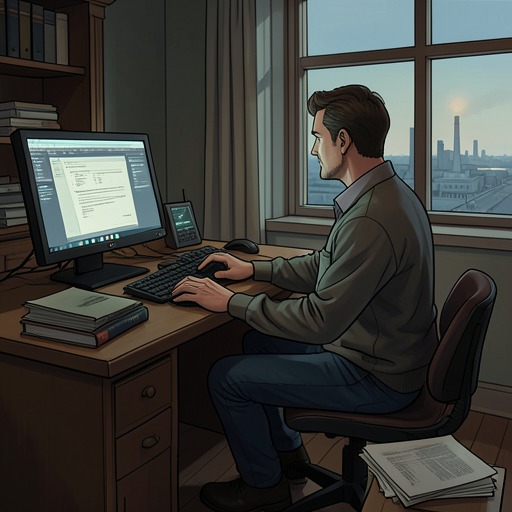
Tengo begins rewriting Air Chrysalis
1Q84Tengo begins rewriting Fukaéri’s La Chrysalide de l’air as a practical assignment that quickly becomes an absorbing act of interpretation. Asked by Komatsu to obtain a word processor and begin immediately, he works through the manuscript by expanding and cutting in turn. The revised story becomes clearer and more fluent, but the process exposes a persistent tension: making Fukaéri’s fiction legible risks weakening the very strangeness that gives it force.
Commission and Preparation
Komatsu tells Tengo to buy a word processor that day, choose the make and model himself, and start rewriting La Chrysalide de l’air as soon as possible. The price does not deter him: when Tengo points out that even the least expensive machines cost 250,000 yen, Komatsu replies that it makes no difference and promises to reimburse him. The request turns a proposed literary collaboration into an immediate undertaking, with Tengo responsible for both acquiring the equipment and doing the work.
At ten o’clock, Tengo goes to Shinjuku and buys the latest Fujitsu word processor, paying by card. He also buys spare ink ribbons and paper, brings the machine home, sets it on his desk, and plugs it in. Although lighter than the larger Fujitsu he uses at school, it has essentially the same functions. Once he has checked that he can operate it, he begins the rewrite. The new machine is therefore not simply a convenience: it marks the point at which the arrangement becomes sustained work at his own desk.
Establishing a Method
Tengo starts without a clear plan or settled principles. He is unsure whether a delicate, fantastical novel can be rewritten logically, and worries that radically changing its style might damage the original’s qualities and atmosphere. The problem is not merely how to correct awkward sentences, but how to give shape to a story without reducing what makes it distinctive. He nevertheless begins with a manageable unit: he types the opening pages, stopping at a natural break, and decides to revise that portion until satisfied.
His first approach is to preserve the content while reorganizing syntax and transforming the style. He likens the work to renovating an apartment: retain the sound structure and the fixed arrangements, but replace what can be changed—floors, ceilings, walls, and partitions. Without a blueprint, he relies on his experience and intuition. In practice, he clarifies difficult passages, smooths sentence flow, removes unnecessary material and repetitions, fills gaps, and occasionally changes the order of sentences or paragraphs. He generally respects the original’s scarcity of adjectives and adverbs, adding a qualifying word only when it seems necessary.
The qualities he has to handle are divided against themselves. Fukaéri’s style is broadly childlike, which makes some passages hard to understand, yet that same quality gives other passages a freshness that would be lost if they were simply corrected into conventional prose. Tengo removes obscurity where it obstructs reading while trying to retain the vividness that emerges from the original’s unusual expression. He understands the manuscript as a work of singular contradictions: it has original beauty and substantial flaws, while also containing a particular design. The rewrite thus requires discrimination, not uniform polishing.
Expansion and Reduction
The first major revision enlarges the text to two and a half times the length of the original manuscript. Tengo sees that the underdeveloped passages are more numerous than the superfluous ones; restoring coherence therefore makes the whole longer. The added material makes the sentences logical and sensible, clarifies the point of view, and eases the reading. Yet the gains carry a cost: the new opening feels heavy, and its increased logic has weakened the sharpness and edge of Fukaéri’s original.
Tengo answers that imbalance by cutting. He removes what he judges nonessential, stripping away excess until the revised text has been reduced by nearly seventy percent. Expansion and reduction become opposing but complementary stages of one method: he first develops the material as much as possible, then pares it back as far as he can. Repeatedly working between those extremes, he aims for a stable balance at which nothing more needs to be added or removed. The point is not maximal explanation or maximal brevity, but a version in which the ego’s indulgences and needless qualifiers have been cut away and the logic no longer dominates the surface.
This cycle suits Tengo’s strengths. He is described as a natural technician, able to follow the rules of the exercise patiently and persistently. Revision gives him a concrete way forward when his initial uncertainty might otherwise leave him stalled: he can test a passage, assess its effect, and adjust it again. The process is demanding—he works almost to the point of dizziness—but it also gives the task a rhythm and a standard of completion.
The First Day and Its Result
Tengo begins the actual rewriting at half past twelve. By nearly three in the afternoon he has worked intensely enough to realize he has not yet eaten; he pauses for coffee, biscuits with cheese, and an apple, then returns to the work. By close to five, as it grows dark, he has reached the limit of his concentration. The opening alone has taken almost a full day, longer than he expected. He knows it will need further adjustments after he has left it for a few days, but decides that the beginning is sufficient for now and plans to tackle another part the next day. He expects the work to move faster once he has laid the tracks and found a cruising rhythm.
The day’s effort leaves him with more than a mechanically improved text. Tengo feels that, through a kind of reaction within himself, he has grasped the essence of the world Fukaéri sought to describe—or record. Her scenes, initially drawn with a limited and unusual vocabulary, seem more vivid and clear in his careful rewrite; he believes a harmonious flow has emerged, and that the story now stands out more sharply. Though his changes have been technical, the result feels natural enough to him that it seems as if he could have written it in the first place.
That sense of closeness is paired with uncertainty about Fukaéri herself. Tengo imagines her reading the altered manuscript but cannot predict her response. He knows a few facts about her—she is seventeen, in her third year of high school, uninterested in university entrance examinations, speaks in a distinctive way, likes white wine, and is strikingly beautiful—but recognizes that he knows little about her as a person. He cannot even picture her smiling with pleasure or darkening with disappointment. His satisfaction lies instead in the work and in the possibility that he may not disappoint her, even as he doubts whether he can imagine what disappointment or approval would look like for her.
Significance of the Rewrite
The rewrite begins as Komatsu’s urgent commission, but its central difficulty is artistic rather than procedural: clarity can improve the story and at the same time blunt its force. Tengo’s renovation metaphor expresses his attempt to distinguish what can be altered from what must remain, while the repeated movement between expansion and drastic cutting gives that attempt a practical form. The manuscript’s growth to two and a half times its original length and subsequent reduction by nearly seventy percent make visible how far the work swings before it approaches balance.
For Tengo, the undertaking also becomes a source of intense concentration and happiness. Once away from the word processor, he wants to return to it; the technical labor has drawn him into the imaginative world behind Fukaéri’s words. Yet the result does not resolve the distance between the collaborators. He can make her recorded scenes clearer and more vivid, and can feel that he has caught their underlying world, while remaining unable to read the expressionless young woman whose story he is reshaping. The first day therefore establishes both the power and the limit of the collaboration: Tengo can transform the manuscript with conviction, but cannot yet know how its author will receive the transformation.