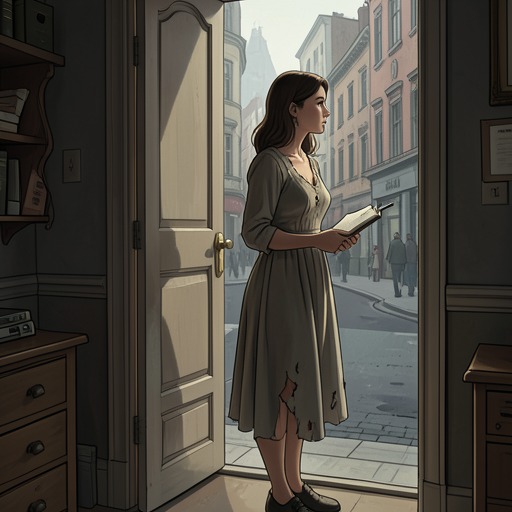
Fukaeri’s escape from the Pioneers
1Q84Fukaeri’s escape from the Pioneers in 1977 was a decisive break from the mountain community where she had grown up, and the beginning of her refuge in the Master’s household. Recalled years later, the departure is framed not as a simple rescue or a fully explained flight, but as a passage from one guarded environment into another life whose first defining feature was her silence.
Background and Departure
The Master tells Tengo that the Pioneers divided in 1976, and that Eri escaped from the group and came to take refuge with him the following year. At roughly ten years old, she left the community in the mountains where she had been assigned to care for an elderly blind goat, a task treated as important to the group. The sequence places her escape against a rupture already underway: the faction that broke away from the Pioneers adopted the name the Dawn around the time she fled.
Fukaeri’s account of the community gives the departure a disturbing background. When she neglected her assigned watch, the blind goat died; she was then locked with its corpse in an old earthen storehouse for ten days, isolated and forbidden to leave or speak with anyone. The goat was said to mediate passage between this world and the Little People, who entered through its body at night and departed at dawn. The girl could speak with them, and they taught her how to make an Air Chrysalis. The account describes both her unusual access to the community’s sacred world and the severity of its discipline, without establishing every detail as independently verified fact.
Refuge in the Master’s Household
The Master recalls that Fukaeri did not seem frightened, shocked, or anxious about separation from her parents when she arrived. Instead, she appeared entirely unresponsive, though she adapted to life in the household more easily than he had expected. He chose not to press her to open up or question her about what had happened, reasoning that she needed time; he treated her silence as something he could live alongside rather than force her to overcome.
Fukaeri spent much of her time with Azami. After school, the two girls would finish their meal, shut themselves in their room, and remain together privately. The Master did not know what they did there and did not intrude, allowing them to act as they pleased. They became inseparable. Because Fukaeri did not speak, she could not attend school, but the Master describes her as intelligent and attentive to what he told her. Her silence was therefore both a practical barrier to ordinary schooling and a condition the household accommodated without demanding an explanation.
The Community and the Story of Escape
The Pioneers publicly described their religious orientation in terms of spontaneous, individual awakening rather than a fixed doctrine or codified manual. Their representatives said that personal awakenings came first and that doctrine and rules emerged afterward; they presented practical exercises, spiritual development, and a simple, largely self-sufficient agricultural life as alternatives to materialism. This public account contrasts sharply with Fukaeri’s remembered punishment and with the community’s claim that the blind goat served as a passage between worlds. The contrast does not itself settle what happened, but it places her childhood narrative beside the group’s polished account of its beliefs and methods.
The Master’s chronology also links Fukaeri’s escape to the Pioneers’ political fracture. After the 1976 division, the breakaway faction took the name the Dawn, while Fukaeri sought shelter with him in 1977. Tengo recognizes the name but finds his recollections confused and fragmentary, so the escape also becomes a point where personal history intersects with a larger conflict whose implications he does not yet fully grasp.
Significance
The escape changes Fukaeri’s circumstances without immediately making her past legible. She is no longer living in the community that assigned her the blind goat and punished her after its death, yet she arrives at the Master’s home unable or unwilling to speak about her experience. His restraint, and her closeness with Azami, make refuge possible without turning it into a forced confession.
The event also establishes a tension between institutional explanations and private experience. The Pioneers’ public language of free, spontaneous awakening sits beside a child’s confinement and the mysterious account of the Little People. Fukaeri’s escape leaves those accounts unresolved: it marks a clear physical departure, but the silence surrounding her arrival preserves the uncertainty of what she endured and what, if anything, she carried out of the community.