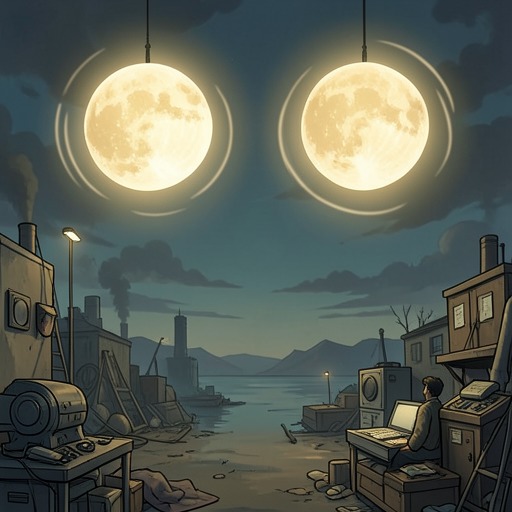
Aomame discovers two moons in the sky
1Q84Aomamé discovers two moons in the night sky while staying with Ayumi, and the sight becomes the clearest evidence yet that the reality she knows has shifted. The revelation begins as a small discrepancy, not a dramatic rupture: beside the familiar yellow moon hangs a second, smaller one, green and irregular. When the pair remains in the sky the next night, Aomamé can no longer dismiss the anomaly as a momentary visual mistake; she must reckon with the possibility that either the world or she herself has changed.
The First Sighting
After Ayumi has fallen completely asleep, Aomamé leaves the bed and settles on the small balcony. She drinks mineral water, sits in an aluminum chair, and looks out over the city on a peaceful spring night. The traffic murmurs in the distance like an artificial sea, while the neon lights have thinned after midnight. Against this quiet, ordinary scene, she senses that something in the night sky is different.
Her attention wanders through memories of Tamaki: the time they spent together, their exchanges, and their caresses. Then the difference in the sky registers. It is subtle but unmistakable, although she needs time both to identify it and to accept what she is seeing. Her consciousness can take in the changed view before it can make sense of it.
There are two moons: the large, nearly full yellow moon she has always known, and a smaller moon with an unusual, slightly distorted outline, colored a tender moss green. The new object does not replace the familiar moon; it hangs beside it. The pairing makes the change legible through contrast: the old celestial landmark remains recognizable, while its green companion makes the sky irreducibly unfamiliar.
Testing What She Sees
Aomamé narrows her eyes and studies the moons, then closes them, waits, breathes deeply, and looks again. She hopes the second moon will disappear and the sky will return to normal. It does not. The two lights remain side by side, one yellow and one green. She rules out a diffraction of light and a change in her eyesight, but the checks cannot explain the sight itself.
She considers waking Ayumi to ask whether she sees the same thing. Either answer seems to leave the central problem unresolved: if Ayumi sees two moons, Aomamé would still have to make sense of their presence; if Ayumi sees only one, she would have to question her own vision. Rather than transfer the uncertainty to her sleeping companion, Aomamé keeps watching alone.
With her chin in her hands, she concludes that something is happening. Her heart beats faster as the question opens in two directions: perhaps something has happened to the world, or perhaps it has happened to her. The sight changes the terms of her uncertainty. It is no longer simply an obscure unease about whether reality is different; it is a persistent fact before her eyes that demands an explanation.
The Second Night
The following evening, the two moons are still there. The large moon has an unusual whiteness, as though it has passed through a mountain of ash, yet otherwise remains the familiar moon. Aomamé’s thought reaches back to the summer of 1969, when Neil Armstrong took his first step on it. Beside that old point of reference, the little green moon appears deformed and almost sheepish, like a guilty child beside its larger companion.
The recurrence matters: the sight has survived the passage of a day and cannot be contained as a transient impression from one sleepless night. Aomamé reasons that if the moon had suddenly split in two, the tides and other aspects of life on Earth would have changed, and everyone would be talking about it. The absence of such public recognition does not settle the question. Instead, she considers a more disquieting alternative: perhaps information has somehow escaped her awareness.
Reality or Perception
Aomamé asks herself whether she is mad and whether she can be completely certain that she is not. Her doubt is not resolved by simply trusting her eyes: the sight persists, but its persistence does not explain why nobody else appears to have noticed a second moon. Nor can she easily assume that the whole world has changed when ordinary life gives no corresponding confirmation.
She has already noticed curious events and changes occurring without her knowledge. In that context, she imagines the world playing a game of “1, 2, 3, sun,” changing while her consciousness is asleep. The green moon may have appeared from somewhere in the universe and settled into Earth’s gravitational field during just such an interval. This is speculation, not an established account of the moon’s origin, but it gives form to her fear that the world can alter without warning and without her participation.
Significance
The discovery turns a visual anomaly into a crisis of orientation. The familiar moon anchors Aomamé’s memories and assumptions; the smaller green one sits beside it as an unmistakable breach in that familiar order. Her repeated tests establish that she is not casually mistaking a flash of light for a second body, while her reasoning about the tides and public attention shows why the evidence remains disturbing rather than reassuring.
The event’s force lies in its unresolved alternative: reality may have changed, or Aomamé’s relation to it may have changed. The next-night recurrence intensifies rather than answers the question. Two moons therefore become the concrete sign of a world whose alterations may precede awareness, and of a witness who cannot yet tell whether the rupture belongs to the sky or to herself.