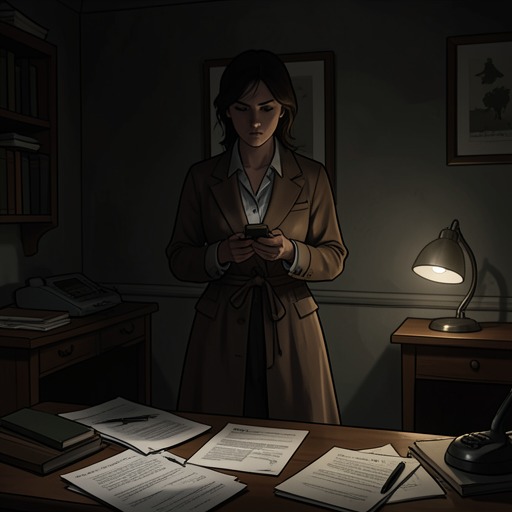
Aomamé Assassinates Miyama
1Q84Aomamé Assassinates Miyama is a carefully prepared killing carried out in a hotel room, where Aomamé uses a concealed, purpose-built instrument and then manages the scene so that the death is likely to be mistaken for a natural one. The episode turns on the contrast between the ordinary appearance of a hotel call and the precision of Aomamé’s actions: she enters unnoticed, approaches Miyama under a plausible pretext, and leaves without drawing attention.
Entry and Target
Aomamé rides the elevator to the third floor and goes directly to room 326. She takes from her bag a prepared shirt, holds it against her chest, and knocks softly. When there is no immediate response, she knocks again, harder. Miyama opens the door, looking irritated and tired. Aomamé’s professional appearance seems to fit the possibility that he has been expecting hotel staff to replenish the refrigerator, giving her a plausible reason to be at his door.
Aomamé knows that Miyama works in the oil industry, specializing in investments in Middle Eastern countries. She understands him as professionally successful and socially confident: he has an expensive new Jaguar, an education that included study abroad, and fluency in English and French. The outward polish is set against his treatment of others. He does not tolerate demands or criticism, especially from women, yet is comfortable making demands himself. He has seriously abused his wife, an act that does not trouble him. This background establishes the target of Aomamé’s intervention and the disparity between Miyama’s cultivated public standing and his private conduct.
Method and Execution
Before acting, Aomamé takes a deep breath, holds it, and identifies a precise point on Miyama’s neck. She first presses the spot lightly with her fingertip, checking its location by touch. The careful pause conveys the technical nature of the act: she wants to be certain of the placement, though the circumstances do not allow her more time.
Aomamé then takes a small, rigid plastic case from her bag. Inside is an instrument wrapped in thin cloth. It resembles a miniature ice pick, about ten centimeters long, with a solid wooden handle, but it was made by Aomamé for this purpose. Its fine point is protected by a specially treated piece of cork, which she removes and puts in her pocket before using the instrument. The concealed tool is thus both ordinary-looking and highly specialized; its construction makes the apparent simplicity of the act depend on exact preparation.
With the point positioned, Aomamé raises her right hand and brings it down onto the wooden handle, applying controlled force at the chosen angle. She avoids striking too hard, since the fine point could break, and instead lets the movement fall directly and lightly. The scene stresses restraint and accuracy rather than force: the success of the method depends on how carefully she directs the motion.
Death and Intended Appearance
The effect is gradual: Miyama’s body stiffens, and his energy ebbs. Aomamé keeps a finger on the selected point and shifts him forward onto the table, where his documents serve as a pillow. His open eyes register astonishment, but the narration describes no fear or pain. He seems to have encountered something inexplicable without being able to identify what happened. This quiet, puzzling end contrasts with the deliberateness of Aomamé’s preparation and leaves Miyama unaware of the cause of his death.
The method is designed to resemble a natural fatal illness. The account explains that a very fine puncture at a precise point below the brain would be read by a doctor as a heart attack; Miyama’s apparent collapse at his work could be attributed to stress and overwork. Nothing in the immediate circumstances would necessarily suggest an unnatural cause, and an autopsy would not be essential. Concealment is therefore built into the method itself: the killing is intended to pass as an ordinary death rather than provoke an investigation.
Concealment and Exit
After the killing, Aomamé replaces the cork tip on the instrument, wraps it in cloth, returns it to its case, and puts the case at the bottom of her bag. She then retrieves a towel from the bathroom and carefully wipes the prints she left in the room, noting that she had touched nothing else apart from the air-conditioning panel and the door handle. These practical steps extend the preparation beyond the act itself: the room is arranged to offer little immediate reason to suspect an intruder.
Aomamé leaves the coffee pot and cup on the tray in the corridor, so the staff member collecting them will not need to knock and delay discovery. She expects that, ideally, the room attendant will find Miyama the following day, after checkout time. The delayed discovery and the intended medical explanation work together: both are part of her effort to make the death appear unremarkable.
She checks the corridor before slipping out, takes the stairs instead of the elevator, and crosses the hotel reception without attracting notice. Her back is straight, her gaze fixed ahead, and her pace quick but measured. The scene closes on her assessment of herself as a professional close to perfection, followed by a wry acknowledgment that she must make do with what she has. That turn from meticulous composure to private self-deprecation gives the exit a controlled, character-specific ending without undoing the gravity of the killing.
Concealment and Exit
After the killing, Aomamé replaces the cork tip on the instrument, wraps it in cloth, returns it to its case, and puts the case at the bottom of her bag. She retrieves a towel from the bathroom and carefully wipes the prints she left in the room, having touched nothing else apart from the air-conditioning panel and the door handle. These practical steps extend the preparation beyond the act itself: she leaves as little evidence of an intruder as she can.
She places the coffee pot and cup on the tray in the corridor so that the staff member collecting them will not have to knock and delay discovery. Ideally, she expects the room attendant to find Miyama the following day, after checkout time. Delayed discovery and the intended medical explanation reinforce one another: both are part of her effort to make the death appear unremarkable.
After checking that the corridor is empty, Aomamé leaves the room, takes the stairs rather than the elevator, and crosses reception without drawing notice. Her back is straight, her gaze fixed ahead, and her pace quick but measured. The episode ends with her private assessment that she is a professional close to perfection, followed by a wry acknowledgment that she must make do with what she has. That shift from meticulous composure to self-deprecation gives the escape a character-specific close without diminishing the gravity of the event.