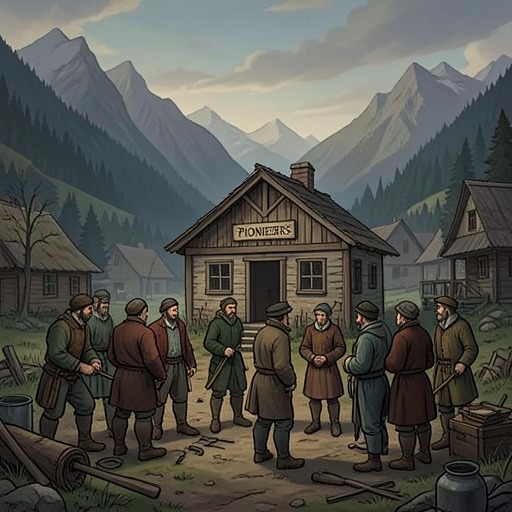
Les Précurseurs deviennent une association religieuse
1Q84The Pioneers’ registration as a religious corporation gave a secluded agricultural community a new institutional identity and practical protection. The change, approved by the Yamanashi prefecture in 1979, sharply limited the police’s ability to investigate the group’s private grounds and helped establish a religious organization whose public claims of openness and individual awakening coexist with secrecy, strict discipline, and concentrated authority.
From Agricultural Community to Religious Corporation
The Master explains that from 1979 it had become effectively impossible to investigate inside the Pioneers’ grounds. The land was private, and police could not enter without evidence that a crime had occurred there. He had approached the local police without disclosing Eri’s situation, saying only that friends might be held against their will and that his attempts to negotiate had failed. The police, he says, had no means to intervene.
The community’s official recognition changed the force of that limitation. The Pioneers received approval to constitute themselves as a religious corporation, and the prefecture’s decision made police entry increasingly vulnerable to being characterized as an infringement of constitutional religious freedom. The Master’s account stresses that the organization had capable lawyers and a strong defense, while the local police were not in a position to challenge them.
Legal Recognition and Its Consequences
The novel presents religious registration not merely as a change of name but as a shift in the organization’s relation to public authority. The Master describes the distinction between a genuine religion and a sect as difficult to define conclusively. Because the boundary depends on interpretation, he suggests, political influence or preferential treatment can help an organization clear administrative obstacles. Once recognized, a religious corporation receives favorable tax treatment and substantial legal protection.
Those protections have a direct consequence for people seeking information or intervention. The Pioneers’ status makes the privacy of their grounds harder for the police to penetrate, even when concerns have been raised about people inside. The official recognition therefore supplies a legal shield around a community whose internal life remains difficult for outsiders to examine.
Public Doctrine and Hidden Authority
The Pioneers publicly describe themselves as lacking a fixed, codified doctrine. Their account emphasizes the study of early Buddhism, practical exercises, and individual awakenings that arise spontaneously before rules or doctrine take shape. This self-description presents the group as distinct from established religions and places lived spiritual practice above formal dogma.
Other descriptions in the novel complicate that account. The community is associated with demanding work and training, secret practices, and strong solidarity directed toward the outside world. Its founder, known as the Leader, is said to possess extraordinary abilities, although the claims are treated as appearances rather than established fact. He remains unseen publicly and unidentified by name or age; a nominal president represents the organization at official events, while the Leader appears to be its real center of authority. The group thus combines collective administration in form with an obscure, charismatic figure at its core.
Hierarchy Behind the Claim of Spontaneity
The Pioneers’ professed rejection of worldly values also sits uneasily beside an internal hierarchy. Ayumi reports that members who leave are generally low-ranking, while the organization separates leaders and subordinates more sharply than ordinary society. Education or specialist status helps determine who can rise into the leadership, approach the center, meet the Leader, and receive his instructions. Most members remain distant from that center, contributing money, training, and labor on the farms.
The contrast matters to the significance of the registration. Legal recognition gives an organization founded on spiritual practice the standing and protections of a religious corporation, but it does not make its internal arrangements transparent. The Pioneers’ official identity can shield its private domain even as the evidence describes unequal access, controlled information, and authority organized around a leader whom outsiders cannot identify. Registration secures public legitimacy; the novel’s accounts reveal how little that legitimacy, by itself, says about life inside the community.