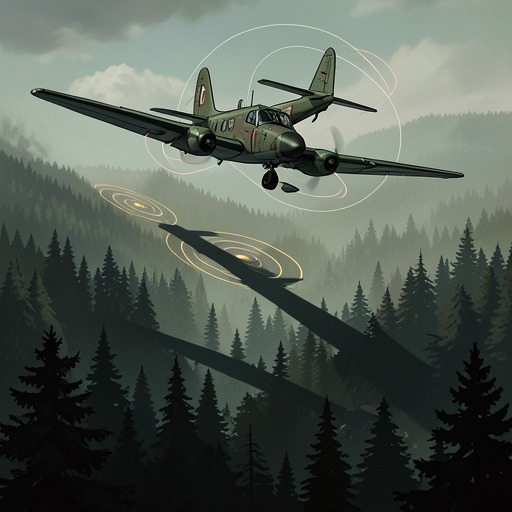
Downing of the UN Black Hawk
AfterburnThe Downing of the UN Black Hawk was an October 31 friendly-fire incident in Georgia in which a Navy Tomcat mistook a U.S. Army helicopter on a UN mission for a hostile gunship and fired an AIM-9 Sidewinder. The missile struck a rotor blade rather than an engine, and the helicopter came down in flames. The crew’s escape did not undo the larger failure: Army helicopters had entered the no-fly zone without the codes that would let Navy aircraft recognize them as friendly, while the aircrew’s target identification and command procedures failed to catch the mistake before a weapon was launched.
Background and Identification
The incident unfolded amid the complicated military arrangements around the UN operation in Georgia. The carrier group had entered the area to add its air wing to the UN presence, while debate continued over whether American forces should operate under UN commanders. The shootdown made that abstract question of command and coordination immediate: the aircraft involved belonged to different U.S. services, yet were working in the same operational space.
The immediate encounter took place in a canyon. The Tomcat pilot had only a brief, difficult-angle view of a helicopter approaching from behind, near the aircraft’s seven-o’clock position. Dixie identified the contact as a Hind gunship. The visual impression seemed consistent with a hostile target, but the later review established that the crew had not correctly identified what they were seeing. The helicopter was being painted by a Gun Dish signal from the ground, probably from a ZSU, and the report from one aviator helped shape the decision to engage.
The flight had been told that it was weapons free, but also to mark its targets. That combination left room for a critical distinction between permission to fire and confidence about what had been identified. Afterward, the pilot acknowledged that he could have ordered a second check. In the canyon, with a fleeting sighting and a ground signal adding to the picture, the decision passed from uncertain contact to attack before that check occurred.
The Attack and Escape
Once the helicopter was identified as a Hind, the Tomcat moved into open sky. The pilot’s AIM-9 Sidewinder acquired the helicopter’s heat and was fired with the alert Fox two. Traveling at about 660 miles per hour, the missile came down from above and behind, homing on the hot exhaust from the helicopter’s engines. It struck the tip of a whirling rotor blade instead of the engine. The impact was still shattering, but the account notes that an engine hit could have been more deadly.
The helicopter was engulfed in fire. Marty Cole and Palmer helped Paul Dombrowski out from between the cockpit seats, moved him aft through the smoky darkness, and carried him through the right-side door. They reached muddy ground and kept moving. Cole looked back and saw the aircraft being consumed by flames; its tail remained recognizable, with UNITED STATES ARMY stenciled in yellow on the olive-drab paint. Nearby, a Russian-made Hip Mi-8 settled to the ground as figures appeared. The scene thus made the misidentification plain in a stark physical detail: the burning aircraft itself bore the words that should have distinguished it from an enemy helicopter.
Investigation and Responsibility
The shootdown was not treated as an inexplicable accident. The carrier’s intelligence department laid out photographs and reviewed the distinguishing features of a Hind, including its five-bladed rotor, shoulder-mounted stub wings, and separate, stepped pilot’s and gunner’s cockpits. The examination turned the error into a question of what the aircrew had seen, what it had inferred, and what further verification was available. The pilot, identified in the exchange by the callsign Batman, accepted responsibility; the carrier air group commander, Matthew Magruder, insisted that accepting responsibility was not itself an explanation.
The missing information about the Army helicopters was another part of the inquiry. The Black Hawks had been sent into Georgia to work with the UN team, but the Navy aviators had not been told that they were there. Nor had the helicopters received the computer codes that would allow radar systems to recognize them as friendly. The failure therefore ran through more than one point in the chain: the Army aircraft and the Navy air wing shared a mission area without adequate notice, and the identification systems lacked the data that might have prevented a hostile classification. The later review also exposed a decision point inside the cockpit, where a second check could have tested the initial identification before the missile was fired.
Consequences and Significance
Two days after the incident, Secretary Samantha Reed addressed the shootdown in a meeting with senior officials. She described it as a Navy jet bringing down an Army helicopter flying a UN mission and emphasized that the Army aircraft were operating in the no-fly zone without the codes needed for friendly recognition. The incident had already become public knowledge through cable news, giving the operational mistake an immediate political life beyond the flight and the crash site.
Its significance was sharpened by the carrier group’s other recent error: the day before the Black Hawk shootdown, the same group had accidentally sunk a Russian submarine, killing at least fifteen Russian nationals. Together, the two incidents made the group’s record difficult to separate from the wider debate over intervention and command. In the immediate investigation, attention narrowed to the Hind identification, the ground signal, the absent IFF codes, and the failure to double-check. At the political level, those details raised a broader question about how forces assigned to a shared mission could act on incomplete, incompatible pictures of the same battlefield. The shootdown stands as a chain of preventable errors whose consequences reached from a burning Army helicopter to the credibility of the operation itself.