Battle of Kerch
AfterburnThe Battle of Kerch was the climactic engagement in which the American battle group and Marine Expeditionary Unit 25 defeated the forces opposing General Boychenko near Arsincevo and evacuated his defenders from the ridge. The victory resolved an immediate ground crisis, but it did so under a larger strategic pressure: the Thomas Jefferson battle group was operating inside the Black Sea with limited aviation fuel and the possibility that the Bosporus Strait might close behind it. The battle’s ending therefore joined a local reversal on the ridge to the question of whether American forces could remain supplied and leave the sea at all.
Strategic Setting and Constraints
The fighting took place against the continuing dispute between Kiev and Moscow over the ownership of Crimea and the Black Sea Fleet. Ukraine had long been uneasy with its position in the former Union, and the account emphasizes that ethnic Ukrainians were not Russians. Crimea was geographically associated with Ukraine, while the Russian Federation bordered the peninsula to the east. With Russia consumed by civil war, Ukraine appeared poised to settle the old dispute; in a political discussion, Admiral Scott described the region as coming apart, while the Secretary of State argued that Ukraine had not yet attacked. These tensions formed the political background to the battle, rather than a simple contest between two settled national positions.
The American force also faced a severe logistical limit. A modern carrier such as the Thomas Jefferson required replenishment of expendables at sea every two to three weeks. Although nuclear-powered and therefore not dependent on fuel for its own propulsion, the carrier’s aircraft consumed aviation fuel rapidly. Its available supply would last no more than ten days, and less under a heavy flight schedule or a prolonged battle. The battle group depended on replenishment tankers following it at sea; if access or resupply failed, the force could be pinned in the Black Sea.
That danger sharpened as the operation continued. With round-the-clock flying, the Jefferson’s remaining leeway could fall to only two to four days. If the Bosporus Strait closed, the carrier and its escorts would be trapped in the Black Sea with little operational value. The scale of the fuel problem became concrete when the force prepared to pump nearly three million gallons, about nine thousand tons, of aviation fuel aboard. Flight-deck operations were suspended during the transfer. The ridge battle thus unfolded alongside a race to preserve the aircraft’s ability to fight and the carrier group’s ability to move.
Air Attacks and the Fight for the Ridge
American air attacks formed part of the wider pressure on opposing forces. A-6 Intruder aircraft from VA-84 and VA-89 flew repeated low-level missions from the Jefferson. Their purpose was not to eliminate every enemy position: planners recognized that there were too many targets for a clean sweep. The air campaign instead contributed to a sequence of attacks and opportunities on the ground, where the outcome depended on whether Boychenko’s position could hold long enough for evacuation.
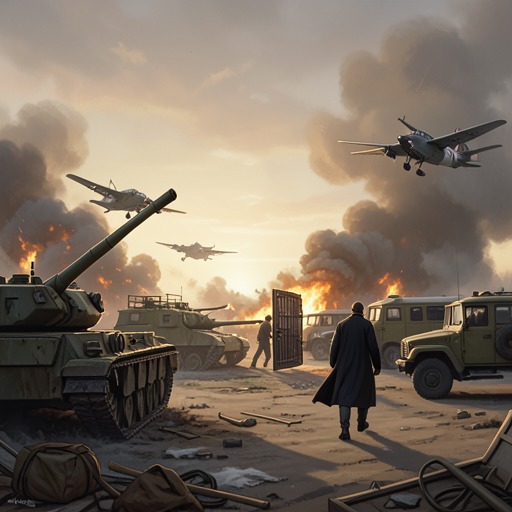
At Arsincevo ridge, Boychenko’s Spetsnaz faced repeated charges by Russian naval infantry. The lead elements of Boychenko’s column had been skirmishing with them for several minutes; the gunfire came from over the ridge, and the column could not force a way through. One charge came close to sweeping over the defenders. The position was therefore not secure simply because Boychenko’s men held it: each assault threatened to overwhelm the line and close the route needed to bring the defenders out.
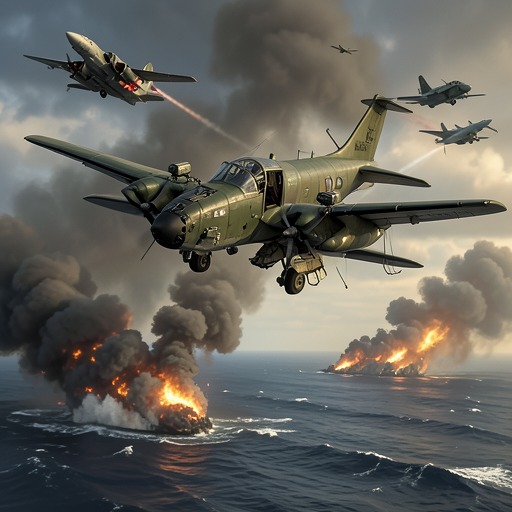
The crisis turned when Joyce “Tomboy” Flynn made an improvised strafing run against the attacking naval infantry. Flynn and Bruce “Hacker” Kosinski were operating a large aircraft in a ground-attack role outside its normal purpose and outside Flynn’s usual work. The attack was credited with breaking up the assault on Boychenko’s position. The Krasilnikov forces fled moments later, changing the immediate balance on the ridge and opening the way for evacuation helicopters from USS Guadalcanal.
Evacuation and Outcome
The helicopters landed on the ridge above Arsincevo minutes after Flynn’s strafing run. Their arrival converted a temporary break in the attack into an opportunity to remove Boychenko’s forces. Matt “Tombstone” Magruder returned to the Jefferson only ten minutes before Flynn and Kosinski, who were themselves picked up after the ridge operation. The sequence made the evacuation dependent on a narrow interval: the attack had to be disrupted, the route opened, and the helicopters brought in before the defenders were overrun again.
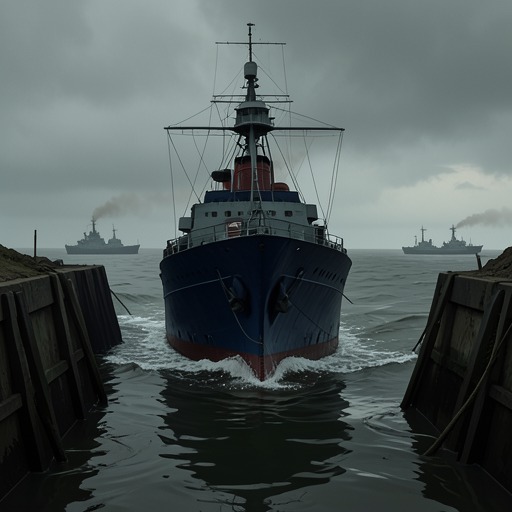
The battle group’s wider position remained precarious even as the land fighting turned in its favor. Fuel was being transferred in enormous quantities, flight operations had been halted during the pumping, and the carrier’s projected endurance under sustained operations was measured in days. The conflict was not over merely because one assault had broken; the force still needed a navigable way out of the enclosed sea. Engineers and Navy Seabees eventually reported the Bosporus Strait clear for navigation, removing the immediate obstacle to passage.
The Battle of Kerch was then recognized as a clear victory for the American battle group and Marine Expeditionary Unit 25. Its decisive local moment was not a comprehensive destruction of every opposing target, but the disruption of the charge that threatened Boychenko’s ridge position. That opening enabled the helicopters to reach the defenders, while the clearance of the Bosporus addressed the separate strategic danger facing the fleet. The battle’s outcome thus depended on two forms of access: a route off the ridge for Boychenko’s forces and a route through the strait for the American ships.