Russian Attack on the Bosphorus Strait Bridge
AfterburnThe Russian Attack on the Bosphorus Strait Bridge is a missile strike whose consequences extend beyond the bridge itself: its collapsing span scatters debris into the narrow shipping channel and threatens to close passage until a major clearance effort can be completed. The attack makes the region’s widening conflict tangible in the infrastructure of Istanbul, where a crossing designed to bear heavy loads and withstand severe weather proves vulnerable to a concentrated assault.
Strategic Setting
The bridge stands over the Bosporus, in a city that occupies both Europe and the Asian mainland. Earlier, the city’s afternoon soundscape—muezzins calling from minarets, horns, and crowded-street traffic—establishes a densely inhabited urban setting around the straits. The bridge is therefore not presented as an isolated military object: it belongs to a working city and a waterway whose importance becomes sharply visible when the crossing falls into it.
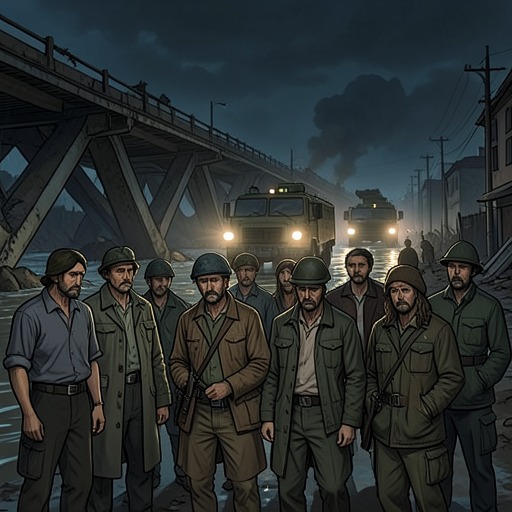
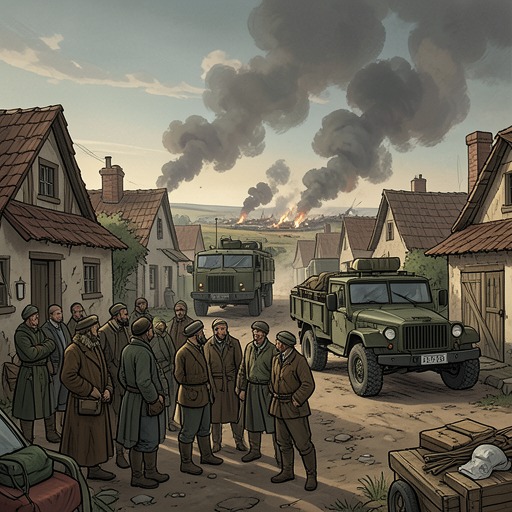
The attack occurs amid a broader effort by the United Nations to establish a strong military presence in the area and defuse regional problems. Turkey had repeatedly threatened to invade former Soviet Armenia to suppress unrest there, while the crisis around the Black Sea was becoming more dangerous day by day. The prospect that the northern half of the sea, from Odessa to Gagra, might become a war zone placed both civilian and military movement under growing pressure. The bridge strike belongs to this increasingly unstable setting, although the evidence does not identify a specific political or operational motive for the attack.
The political debate also exposes how contested the language of peace has become. When Secretary Reed argues that intervention is needed to maintain peace, Scott challenges the premise, insisting that the area is already tearing itself apart. Reed counters that Ukraine has not yet attacked. Their disagreement gives the surrounding crisis a precarious quality: peace is invoked as a goal, but it is also a claim about a situation already being reshaped by violence.
The Missile Strike
The bridge’s suspension span between its two towers is just over a thousand meters. The first Kedge missile travels south over the Bosporus, only feet above its dark, oily surface, and strikes the base of the western tower. Its warhead detonates there, raising a large cascade of white spray and throwing concrete fragments far across the water. The low flight and the impact at the tower’s base bring the attack directly to the structure on which the suspended crossing depends.
Three seconds later, a second missile hits the tower. The bridge had been engineered to carry tremendous weight and withstand hurricane-force winds, but those specifications cannot save it from repeated strikes against its supports. The short interval between impacts leaves little time for the first damage to settle before the next blow compounds it; the account follows the structure’s failure as a sequence, not as a single instantaneous collapse.
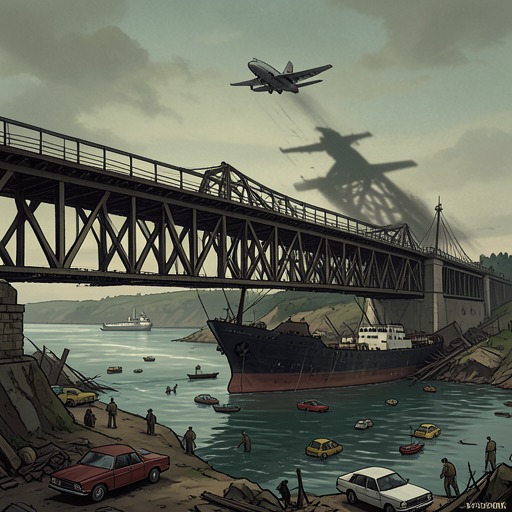
The northern part of the suspension rig fails first and its collapse accelerates. Vehicles and people are carried into the gulf below as the southern half begins to give way. The eastern tower then sags heavily toward the north amid falling, splintering concrete. As the structure’s oscillations build, the main cables snap and sections of the deck drop into the strait. The bridge’s designed strength and the violence of its destruction stand in direct contrast: a structure built to endure weight and storms gives way under missile attack, with its own mass becoming part of the danger.
A Waterway Blocked by Wreckage
The channel at the center of the Bosporus is only a few hundred yards wide at most. Once the smoke and spray clear, observers aboard nearby vessels can see that the fallen bridge has almost completely obstructed it. The strike thus changes the strait’s condition as well as the bridge’s: broken spans and other wreckage lie in a navigable passage, where debris below the surface forms a danger to ships.
Removing the tangled wreckage will require a major engineering operation, not a quick clearing of the route. The estimate is weeks, possibly months. That interval makes the attack’s consequence durable. Even after the missiles have struck and the collapse has ended, the waterway remains constrained by the material remains of the crossing; the immediate destruction becomes a continuing problem for anyone seeking passage through the strait.
Significance in the Wider Crisis
The sequence gives the conflict a concrete scale. Regional instability and arguments over intervention can be expressed in speeches and assessments, but the bridge’s collapse turns those abstractions into damaged supports, falling traffic, and a channel nearly choked with wreckage. The narrative moves from the missiles’ near-surface flight to the cables snapping, then outward to the vessels that must contend with the obstruction. That movement links a precise act of destruction to a prolonged strategic consequence without supplying a casualty total or a full account of how the attack was planned.
The bridge’s failure also sharpens the tension between infrastructure’s ordinary purpose and its exposure in war. Its engineering is described in terms of loads and hurricane-force winds, measures of stresses a bridge is expected to withstand. Missile strikes test it against a different kind of force, and the result is not merely a broken crossing but a physical hazard extending beneath the water. In the expanding crisis around the Black Sea, the attack demonstrates how violence against a single structure can disrupt movement well beyond the point of impact.