Operation Ranger
AfterburnOperation Ranger is the attempt to get Matthew Magruder and the other Americans ashore out of hostile territory. It is not simply a helicopter pickup: the plan couples an extraction with continuing air cover and attacks supporting forces already fighting ashore. Its urgency is captured in the moment of execution, when the helicopters approach and Matthew Magruder recognizes that the entire operation could fail there. The rescue thus becomes a test of coordination under fire, set within a campaign whose political stakes and logistical limits extend well beyond the shore party.
Purpose and setting
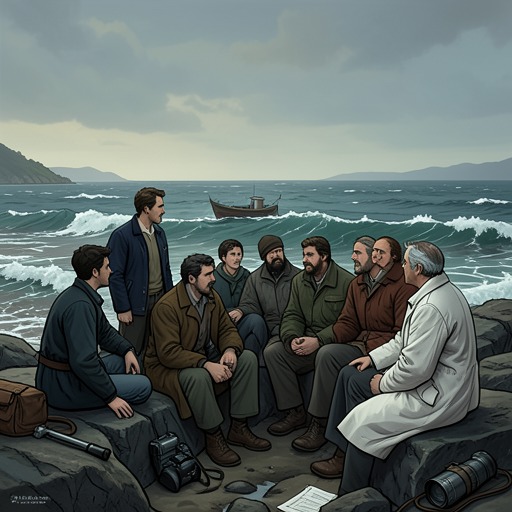
Operation Ranger is described as an operation aimed at getting Captain Magruder and the rest of the Americans ashore out of hostile territory. The party is stranded around Yalta, where the danger is not abstract: the operation is being mounted in the middle of armed conflict, and the rescue depends on reaching personnel who cannot simply return to safety on their own. The immediate objective is extraction, but achieving it requires air units to protect the approach and support the fighting on the ground.
The setting also carries a political weight that distinguishes this mission from an uncomplicated recovery of personnel. Crimea is the contested ground at the heart of the wider conflict. The dispute between Kiev and Moscow over ownership persists, while the assertion that Crimea is the Crimean people’s homeland places the territory’s competing claims in human as well as strategic terms. Operation Ranger is therefore a rescue conducted inside a struggle over who controls the peninsula, not an action outside that struggle.
The plan is named for John Paul Jones’s ship. That choice gives the operation a naval identity, but the mission itself reaches across several forms of military activity: fixed-wing aircraft maintain cover and strike, electronic-warfare aircraft contribute to the air effort, and helicopters carry the people who must be brought out. The name is concise; the operation it labels is necessarily composite.
Air cover and assault coordination
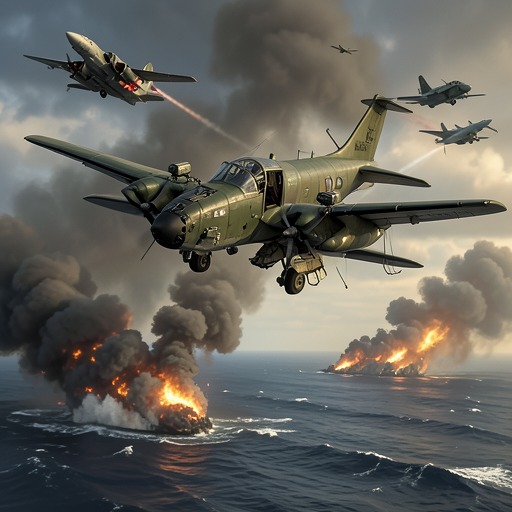
The command plan calls for two flights of Tomcats, designated Air Hammer One and Air Hammer Two. Their inclusion gives the rescue an explicit fighter-cover component rather than leaving the helicopter formation to reach the shore without an organized air screen. Two separate flights of EA-6B Prowlers are also reported as having departed. Their presence adds electronic-warfare aircraft to the operational picture, alongside the fighters and attack aircraft; the account identifies their departure but does not specify the precise effect of their work during the extraction.
The carrier’s Tomcat squadrons serve as FORCECAP while Hornets join the air action over the ground fight. The distinction matters: the rescue is not only a matter of protecting the aircraft carrying the shore party away. The wider plan also addresses the forces locked in combat with Dmitriev’s naval infantry. Hornets come into that struggle as the American ground forces remain under pressure, linking the extraction effort to the effort to sustain them on the battlefield.
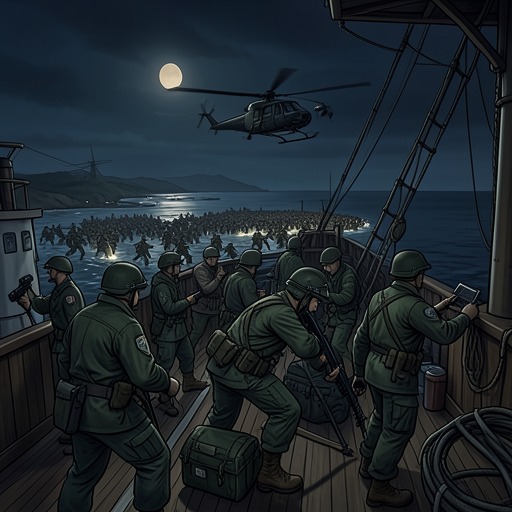
The helicopter lift is supplied by USS Guadalcanal. As the action develops, five large, gray CH-53 Sea Stallions from the ship are heard approaching. Their arrival gives the plan its decisive physical means: aircraft must reach the exposed shore party, take the Americans aboard, and carry them away while the surrounding operation is still in progress. The scale of the lift is concrete, but it does not make the result automatic. Matthew Magruder watches with icy apprehension because, at that point, the operation could still fail.
Execution under pressure
The account emphasizes the difference between a plan on the command net and an extraction taking place in hostile territory. Full combat air patrol coverage is maintained, and the operation continues despite the danger to the Americans ashore. The rescue is consequently not a pause in the battle. It has to be fitted into it: fighter cover remains active, aircraft are directed toward the ground struggle, and the helicopters arrive while the operation’s success is still in doubt.
Radio calls help mark the coordination among units. Dixie calls over the radio using Jefferson’s callsign, and another voice identifies itself as Top Hat before addressing Air Hammer. These brief exchanges locate the mission within a larger command network rather than presenting the rescue as an isolated act by the helicopter crews. The operation depends on aircraft and personnel acting under shared callsigns and an evolving plan, even as the immediate danger is concentrated on the shore party and the incoming lift.
The narrative gives the rescue a sharp point of vulnerability: the helicopters’ approach. For Matthew Magruder, this is the instant when the whole operation could fail. The apprehension does not cancel the careful preparation represented by the CAP, Prowlers, Tomcat flights, and Hornets; it shows what those preparations cannot guarantee. The rescue’s tension comes from the gap between assembling sufficient forces and bringing the people out safely.
Campaign constraints and significance
Operation Ranger unfolds while the American carrier group faces constraints of its own. A modern carrier such as Jefferson requires at-sea replenishment, and the book’s broader account underscores the narrowness of available resupply in the surrounding campaign. Later, the operation’s world is measured in fuel as well as aircraft and fighting strength: nearly three million gallons must be pumped. Those details do not establish that a particular fuel shortage dictated the rescue plan, but they show why sustained air cover and repeated operations cannot be treated as limitless. The carrier group’s combat power depends on keeping it supplied as well as assigning aircraft to the mission.
The operation also sits within a conflict where tactical success and political resolution are not the same thing. Admiral Scott challenges the language of peace by pointing to the continuing violence across the area. That wider instability surrounds the rescue: removing the Americans from danger can meet the immediate objective without settling the contest over Crimea or ending the fighting. The campaign ultimately reaches the Battle of Kerch, which is described as ending in a clear victory, but that larger outcome should not be mistaken for a simple measure of what the rescue itself accomplishes.
As a narrative event, Operation Ranger brings several strands of the campaign into one exposed undertaking: the stranded Americans, the aircraft protecting them, the Marines fighting ashore, and the carrier group sustaining operations in a confined and contested theater. Its defining significance lies in that convergence. The mission is named and organized as a rescue, yet its execution depends on air superiority efforts and combat on the ground—and remains uncertain until the helicopters can reach the people they were sent to recover.