First U.S.-Russian Air Battle over the Black Sea
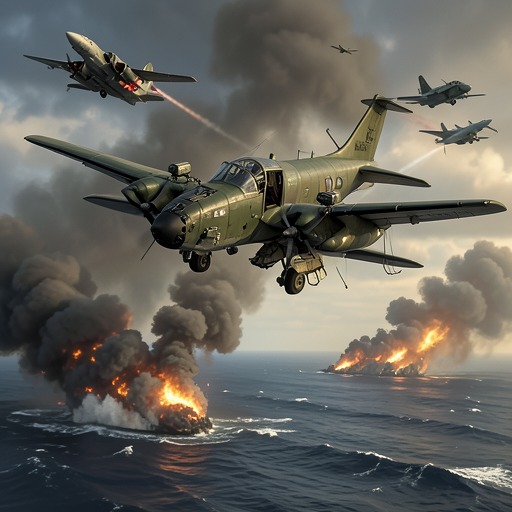
AfterburnThe First U.S.-Russian Air Battle over the Black Sea is a sudden encounter in which electronic interference and battlefield confusion turn a flight near the Jefferson into a direct fight between U.S. aircraft and Russian MiG-29s. The engagement’s defining movement is from obscured approach to immediate personal danger: the bandits appear between Dixie and the distant carrier, a missile warning sounds, and an explosion strikes Dixie’s Tomcat, leaving him to report back through a cockpit that is losing pressure.
Strategic and Operational Setting
The fight unfolds amid an unsettled conflict involving Russia, Ukraine, Crimea, and the Black Sea Fleet. The book describes Ukraine as a distinct national community, not simply another name for Russia, and presents Crimea as a longstanding point of contention: geographically connected to Ukraine yet bordered by the Russian Federation to the east. As Russia is consumed by civil war, the dispute over Crimea and the fleet remains unresolved, while Ukrainian moves in the peninsula are treated by U.S. officials as a possible attempt to settle the question. This context establishes why the Black Sea is politically charged, though the evidence does not assign a specific political motive to the aircraft that enter the engagement.
The immediate circumstances are less legible than that larger dispute. The hostile aircraft come in between Dixie and the now-distant Jefferson, their approach masked by jamming and the confusion of the moment. The encounter is therefore not presented as a cleanly arranged challenge with a clearly visible opponent. The pilots must interpret an unfolding threat while separated from the carrier and operating amid disrupted electronic conditions.
The Encounter
The action is dated Thursday, November 5, at 1010 hours, Zulu plus three, and centers on Tomcat 218. Badger warns Dixie to break left and announces a Fox Two launch, the call for a heat-seeking AIM-9 Sidewinder. Dixie hauls the aircraft around in a hard turn to port, the abrupt maneuver placing both crew members under heavy physical strain. The battle moves from detection to evasive action in seconds; there is little space between recognizing the danger and having to answer it with the aircraft.
The opposing fighter is identified as a MiG-29 Fulcrum, a type Dixie had studied through silhouettes, films, and photographs during flight training. That recognition gives the threat a concrete form, but not a safe solution. The account characterizes the MiG-29 as a deadly aircraft with exceptional speed and climbing and turning performance. In the close, contested airspace, technical knowledge helps Dixie identify what he faces without removing the disadvantage of the situation.
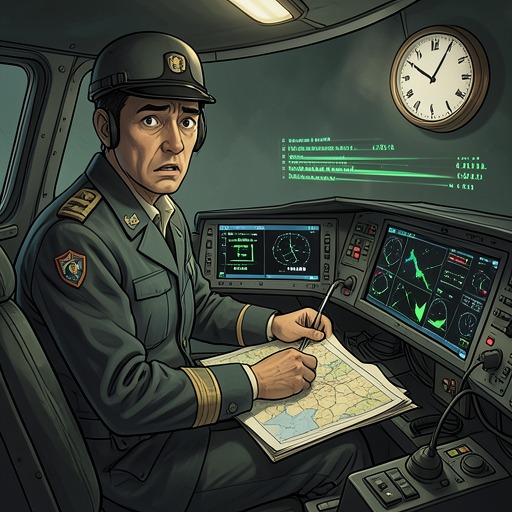
The warning system then signals that Dixie’s aircraft has been painted by radar. The alert makes the unseen contest unmistakable: an opposing aircraft has acquired him, even though the jamming and confusion have already complicated the pilots’ view of events. The danger is conveyed not through a distant operational report but through the warning in the cockpit and the crew’s immediate need to react.
Damage and Immediate Consequences
An explosion jolts Dixie’s aircraft from aft and left. The controls briefly go soft, and the cockpit begins to lose pressure, a condition marked by the piercing sound of air escaping. The sequence establishes that the engagement has moved beyond a radar threat and a maneuvering fight: Dixie’s aircraft has been hit or damaged by an explosion, and its ability to remain safely pressurized is compromised. The evidence does not specify the weapon responsible or establish the eventual fate of the aircraft, so the moment’s consequence is the immediate emergency rather than a confirmed loss.
Badger calls to ask whether Dixie can hear him. Dixie answers that he can. The reply is small but consequential: amid the sudden damage, the crew remains in communication, and Dixie is still able to respond. The battle passage ends on that limited confirmation, not on a declared victory or a complete account of what follows.
Significance
The scene’s tension comes from the collision of visibility and uncertainty. Dixie can recognize the MiG-29, and the radar warning tells him that he has been detected, but those pieces of information arrive inside an engagement already shaped by jamming and confusion. The aircraft’s technical capabilities and the pilots’ training matter, yet neither makes the situation orderly or predictable. The explosion turns an abstract warning into physical damage before the narrative provides any broader accounting of the encounter.
The book has already shown how failures of coordination can make aircraft dangerous even when the combatants are not enemies: a U.S. Navy jet shot down a U.S. Army helicopter flying a United Nations mission after the Navy pilots had not been told that Army helicopters had entered Georgia. That earlier incident, and the comparison drawn to a 1994 friendly-fire disaster, provides a revealing contrast to this air battle. Here the opposition is identified as Russian, but the same pressure of incomplete information and rapid decision-making remains. The encounter thus belongs to a conflict in which recognizing an aircraft, understanding the situation, and surviving its immediate consequences are separate problems.