Arsincevo Landing
AfterburnThe Arsincevo Landing was a dawn amphibious assault in which U.S. Marines secured an initially undefended beachhead south of Kerch and moved inland to take the Arsincevo refinery complex. Its immediate success was measured not only in the ground gained: the refinery offered a potential source of aviation fuel to a carrier group whose operations in the Black Sea were increasingly constrained by dwindling supplies and a closing maritime passage.
Background and Stakes
A modern nuclear-powered carrier does not need fuel for its own propulsion, but its aircraft consume aviation fuel and its operations depend on regular replenishment. The carrier group normally relied on tankers accompanying it at sea; the wider campaign had made that supply chain vulnerable. Sustained flight operations could sharply shorten the group’s already limited fuel margin, while closure of the Bosporus Strait threatened to leave the ships trapped in the Black Sea without their usual route for resupply.
That strategic pressure gives the landing’s choice of objective particular weight. Arsincevo was not simply a point on the coast: its refinery and fuel-storage facilities represented a possible local source of the fuel the carrier’s aircraft required. The landing therefore connected an amphibious operation ashore with the continuing ability of the naval force offshore to fly and fight. The evidence establishes the stakes, though it does not describe the landing itself as a complete solution to the carrier group’s supply problem.
Approach to the Beach
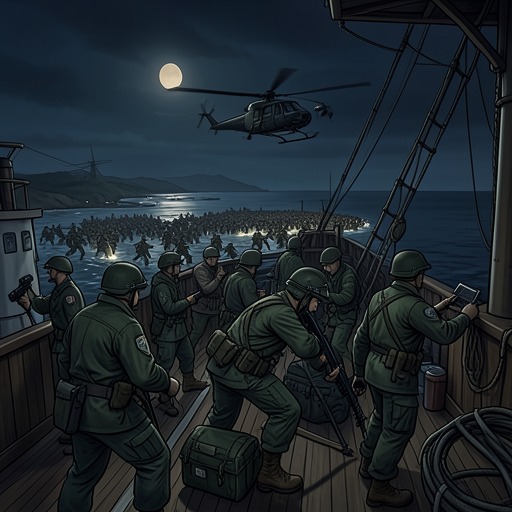
The assault was underway by the early morning of Saturday, 7 November. At 0750, twenty minutes after sunrise, the first LVTP-7 amphibious vehicles reached the shore. Dozens of these tracked vehicles crossed the light surf at nine knots, each carrying twenty Marines. As their tracks met sand, the vehicles climbed out of the water and continued inland, turning the sea crossing into the first movement of the ground advance.
The landing used more than one kind of transport. Landing Craft Air Cushion craft sped across the surf after dawn, then settled onto their rubber skirts as they reached the beach shelf. Their bow and stern ramps could release twenty-four troops or as many as four vehicles, allowing the craft to disgorge their loads directly onto the shore. The mix of amtracks and hovercraft gave the assault several ways to move personnel and vehicles from ship to land; the account specifies their capacities and arrival but does not give a complete order of landing or a full inventory of the force.
Securing the Beachhead and Refinery
The landing place was a public beach south of Kerch designated Red Beach. By 0830, U.S. Marines were firmly ashore and moving onto and across it by several means. Their advance followed a carefully planned double envelopment, securing both the undefended beachhead and the refinery complex at Arsincevo. The pairing matters: the beach provided the foothold, while the refinery was the inland objective that could make the foothold valuable to the larger campaign.
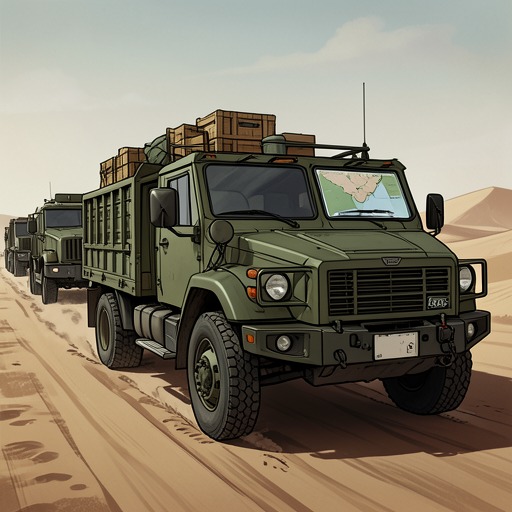
Marine helicopters carried strike teams inland to key points around the tank farm and naval base. Overhead, Marine Harrier jets and Cobra gunships joined the airborne activity as the operation spread beyond the shoreline. The account presents an assault organized across surf, beach, and inland objectives: tracked vehicles and landing craft delivered troops, helicopters moved teams toward important facilities, and aircraft formed part of the force above them. It does not describe a prolonged fight for the beach; the beachhead is explicitly characterized as undefended.
Fuel and Operational Consequences
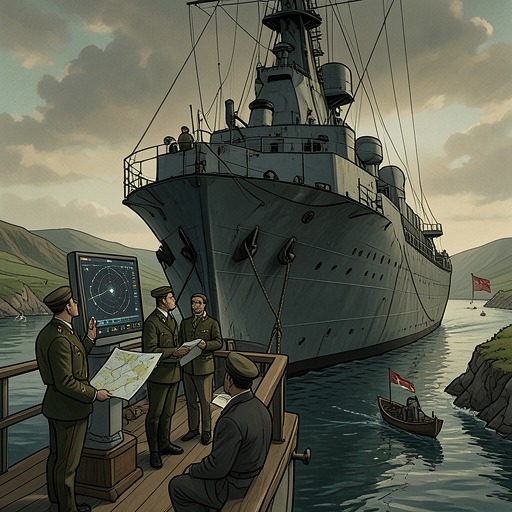
The refinery’s significance became concrete in the subsequent effort to supply the carrier. Fuel from the Arsincevo facility had been judged suitable for the carrier’s demanding standards, but bringing it aboard required pumping nearly three million gallons, approximately nine thousand tons. Flight-deck operations had been suspended during the transfer. The quantity makes plain both the promise and the scale of the undertaking: capturing access to fuel was only the beginning; transferring it to the ship was itself a major logistical operation.
That requirement contrasts with the fragile position described for the carrier group. The carrier was nuclear-powered, yet its aircraft could exhaust their fuel margin much faster than the ship’s reactor could sustain the aircraft’s operations. Under a heavy flying schedule, the available leeway could fall to two to four days, and the closure of the Bosporus Strait threatened to isolate the group in the Black Sea. The Arsincevo Landing thus joined a successful shore operation to a larger test of endurance. Its immediate result was a secured beachhead and access to the refinery; the fuel still had to be tested, pumped, and brought aboard before that access could help sustain flight operations.