Sinking of the Pobedonosnyy Rodina
AfterburnThe Sinking of the Pobedonosnyy Rodina ends the Russian carrier force’s attempt to trap the opposing battle group with a sudden, one-sided attack from an unseen submarine. The carrier is sunk in minutes, before an air strike can be ordered; the escorts turn back even before the ship capsizes. The episode’s decisive reversal is that the threat is detected not by the aircraft preparing to attack, but by a submarine already lying in wait beneath the carrier’s route.
Causes and Strategic Context
Dmitriev’s small, ill-prepared carrier force is steaming around the southwestern tip of Crimea, apparently hoping to trap the battle group. Its position and purpose make the encounter a contest over who will catch whom: the Russian force is maneuvering to spring a trap, but the danger has already found it. By the time the confrontation reaches its brief climax, Dmitriev has only a handful of aircraft left, and the huge Pobedonosnyy Rodina is described as a sitting duck.
The danger to the opposing battle group is also framed by the difficulty of sustaining a carrier at sea. The Jefferson is nuclear-powered and does not need fuel for its own propulsion, but its aircraft consume aviation fuel, and its other expendables require replenishment every two to three weeks. Aircraft fuel could last no more than ten days, and less under a heavy flight schedule or during an extended battle. The battle group depends on UNREP tankers following it across the sea; if an enemy can pin or isolate the force, that supply line becomes a vulnerability. This logistical pressure gives the carrier encounter a wider significance than the fate of one ship: control of the battle group’s freedom of action also depends on keeping it supplied.
The Submarine Strike
The sea battle is described as almost a total anticlimax. It is resolved in minutes, before Coyote can order an air strike by A-7s and Hornets. The suddenness is not simply a matter of speed; the opposing force’s decisive weapon has been in place before the air crews can act. The expected spectacle of aircraft attacking a carrier gives way to a submerged ambush that has already settled the outcome.
The USS Orlando, a Los Angeles-class attack submarine, has been lurking unseen and unheard in the deep water south of Sevastopol. It detects the approaching rumble of the Pobedonosnyy Rodina’s screws almost as soon as the carrier leaves port. More than one hundred miles away, the submarine launches four Tomahawk Land Attack Missiles from its vertical launch tubes. Their rocket motors drive them up through the water; the missiles then travel at altitudes of only a few feet, at Mach 7, toward the distant carrier. The account emphasizes a chain of precise advantages: the submarine is concealed, it detects the carrier early, and its weapons arrive before a conventional air strike can be ordered.
The Carrier’s Destruction
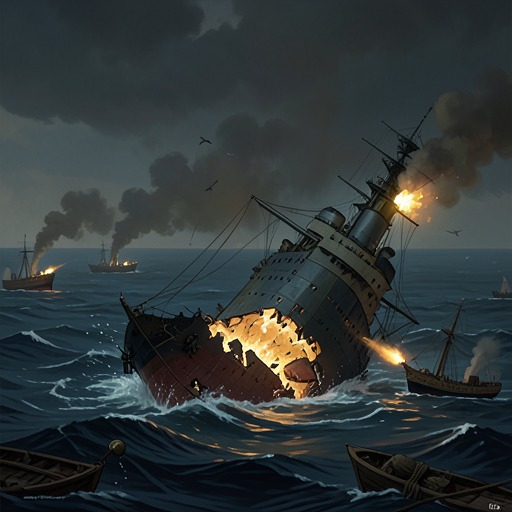
The Pobedonosnyy Rodina never has a chance to answer the attack. The escorts turn back before the huge vessel capsizes beneath a funeral pall of roiling black smoke. The sequence is stark: missiles close the distance, the carrier is lost, and the ships accompanying it withdraw before the sinking is complete. The text does not describe a prolonged exchange or a final air assault. Instead, the carrier’s size and visibility become liabilities against a weapon launched from a submarine it has neither seen nor heard.
That compressed ending also reverses the Russian force’s apparent plan. The carrier group has been moving in hopes of trapping the battle group; instead, its own flagship is caught and destroyed. The contrast between the massive carrier and the hidden submarine makes the reversal legible without a drawn-out battle: the vessel that dominates the surface is powerless against the threat below it, while the force expecting to set the terms of the encounter loses its central ship in minutes.
Consequences and Narrative Significance
The sinking removes the Pobedonosnyy Rodina from the conflict and leaves Dmitriev’s already diminished carrier force without its huge flagship. Its escorts have turned away, and the battle is over before the planned A-7 and Hornet strike can begin. The outcome therefore belongs to the submarine attack, not to the air operation that was about to be ordered.
The episode’s military logic rests on concealment, detection, and timing. The USS Orlando’s presence south of Sevastopol is unknown to the carrier, but its crew picks up the sound of the carrier’s screws soon after it leaves port. That quiet discovery makes the later violence appear almost abrupt: the four missiles cover more than one hundred miles, and the surface battle ends before it can become a sustained engagement. The narration calls the result an anticlimax, yet the phrase sharpens the reversal rather than diminishing it. A major carrier is destroyed without the air battle that seemed poised to define the encounter. The sinking demonstrates how quickly a force’s apparent strength can be undone when an unseen opponent has already found its position.