Operation John Paul Jones
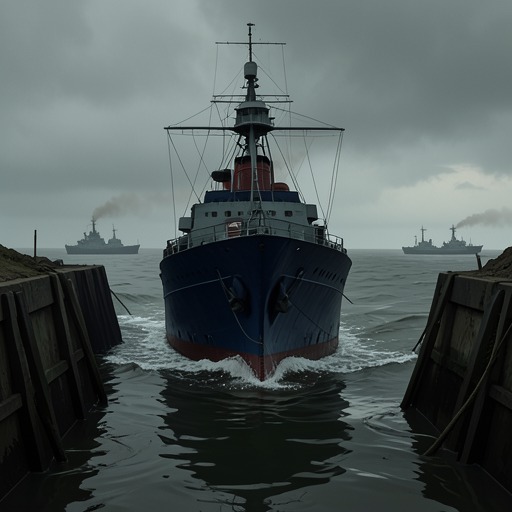
AfterburnOperation John Paul Jones is the designation for the U.S. carrier battle group’s redeployment to the Crimean theater under United Nations operational authority. Conceived as a show of force in support of a possible surrender agreement, it was neither simply a naval deployment nor an announced combat assault: its immediate purpose was to give the UN leverage while placing American forces within a command structure that no longer ran solely through their own commanders. The operation’s limited, conditional mission would unfold against an old territorial dispute and the practical vulnerability of a carrier group operating inside a sea whose exits could be closed.
Background and Political Stakes
The deployment addressed a dispute sharpened by Russia’s civil war. Ukraine had been one of the Union’s largest and most productive republics, but its people were not simply Russians, despite what outsiders might assume. Crimea, meanwhile, had long been considered part of Ukraine geographically: the peninsula extended from the Ukrainian mainland, while the Russian Federation bordered it to the east. The question of Crimea’s ownership—and of the Black Sea Fleet—therefore remained unresolved between Kiev and Moscow as Russia was consumed by internal conflict and Ukraine appeared poised to settle the issue.
The crisis was framed not as a settled war between Ukraine and Russia but as a danger that might still be contained. In a Washington discussion, Admiral Scott challenged the argument that intervention would preserve peace by pointing to the region’s disintegration; the reply was that Ukraine had not yet attacked. Herb Waring likewise treated the risk of a nuclear escalation as a reason to consider any measure capable of defusing the situation. He decided to recommend that the U.S. battle group in the Black Sea be placed under UN command and cooperate in receiving Crimea’s surrender. The proposal made the carrier group an instrument of diplomacy as well as military power, before any surrender agreement had been signed.
Orders and Command
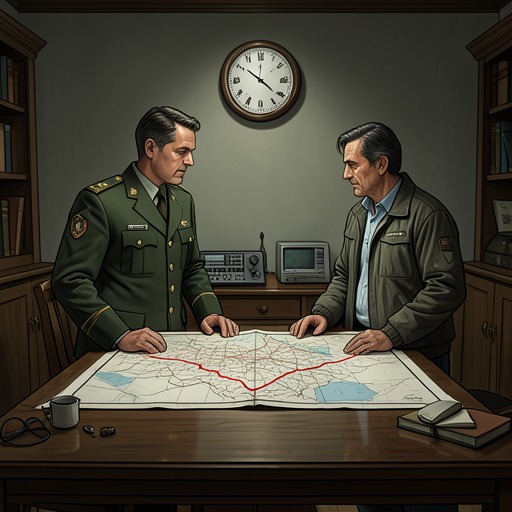
When Admiral Tarrant briefed the assembled officers, he announced new orders from Washington and a redeployment that would extend the group’s operational area northward. The humanitarian effort in Georgia was not canceled, but it was explicitly downgraded: a British peacekeeping unit was expected to take over in about two weeks, and ongoing Georgia operations would henceforth take lower priority than the new orders. The shift thus changed the hierarchy of the mission without formally ending the earlier commitment.
The most consequential order concerned who could direct American forces. Washington had granted the United Nations operational authority over U.S. forces in the Crimean Peacekeeping Operational Zone. Tarrant told the officers that his immediate superior for the mission would be the UN Special Envoy in Sevastopol, who would decide how, when, and where the Americans were used in support of other UN personnel entering the region. The announcement provoked immediate protest in the briefing room. Tarrant nevertheless stated that the battle group would operate under UN command until the President said otherwise, and instructed his officers to maintain military decorum. The command change was not presented as voluntary enthusiasm: it was an order accepted through the existing chain of command, despite the anger it caused among some of those who would carry it out.
Force Posture and Mission
Tarrant named the operation John Paul Jones. He explained the historical reference through the American naval officer who, after the American Revolution, accepted a commission as a rear admiral in Russian service. The historical parallel was political as well as naval: Jones had faced adverse politics alongside maritime enemies. The name therefore attached the new mission to a precedent in which service under a foreign sovereign and political difficulty were part of the same story.
The initial force plan called for Marine Expeditionary Unit 25 to reembark its Marines and join the carrier group at a position designated Victor Station. Tarrant described the group’s immediate role as mostly passive. It was to demonstrate to General Boychenko and the Ukrainians that the United Nations had a carrier battle group available to back a surrender agreement if one was signed. That conditional phrasing defined the operation’s uncertainty: the force was present to support an agreement whose conclusion was not assured, and Tarrant acknowledged that what would follow remained unknown. The deployment projected military capacity while leaving its eventual use unresolved.
Sustainment and Strategic Vulnerability
The operation’s political reach depended on a demanding logistical system. A modern carrier such as the Jefferson needed replenishment of expendable supplies at sea every two to three weeks. Nuclear power meant the ship itself did not require fuel, but its aircraft consumed aviation fuel; their endurance could fall below ten days, and heavy flying or a major strike could reduce it further. The group relied on UNREP tankers that followed it across the sea, making resupply an operational necessity rather than a background convenience.
That dependence became more acute because the group operated inside the Black Sea. If the Bosporus Strait were closed, the carrier and its escorts could be trapped, cut off from the route out. Later calculations put the group’s remaining leeway at two to four days under round-the-clock flight operations, rather than the ten-day margin that might otherwise have been available. The pressure was concrete: at one point the force faced the task of pumping nearly three million gallons—about nine thousand tons—of aviation fuel aboard, after the fuel had been tested and judged suitable for the Jefferson’s requirements. These figures reveal the material limits behind the operation’s show of force. A battle group could signal support for a political settlement, but the duration and effectiveness of that support rested on access, fuel, and a replenishment system vulnerable to interruption.