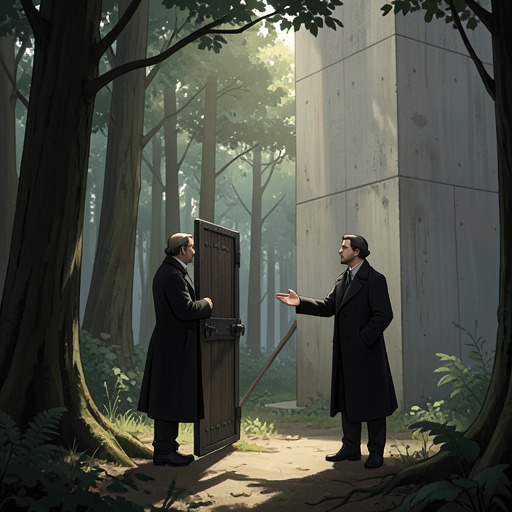
Breitsprecher logging concern
BarkskinsThe Breitsprecher logging concern is an established timber enterprise whose value to Lavinia Duke lies in more than its acreage: it is known for dealing fairly with loggers and dealers, and for an honesty that can distinguish it from Duke Logging’s reputation for ruthlessness and deviousness. Its eventual incorporation into the Duke business brings those contrasting commercial reputations together. Under Dieter Breitsprecher’s arrangement, however, the merger does not absorb every part of his forestry work: he retains cutover land for reforestation and assumes responsibility for a separate land-management division, introducing a long time horizon into the combined company’s plans.
Identity and Reputation
The concern is described as substantially more valuable than the small independent cutters who clear limited acreage and retire. Its standing rests in part on its record of fair treatment toward loggers and dealers. The narrative also makes its ethical reputation a business asset: honesty may constrain a company in the pursuit of immediate advantage, but it can attract trust and lend credibility to a firm regarded by other timbermen as ruthless and devious. For Lavinia, the Breitsprecher name and record therefore offer a way to add luster to Duke Logging, not simply to expand its operations.
The enterprise’s past success was associated with Dieter’s father, Armenius Breitsprecher. By the time Lavinia considers a partnership, Armenius has been dead for two years, and the circumstances of his death remain rumor-tainted. Dieter’s presence thus carries both the company’s inherited reputation and unresolved family history, although Lavinia’s interest in learning more about Armenius does not determine the business terms she proposes.
Lavinia Duke’s Approach
After Duke’s board proposes a buyout, Lavinia judges that a partnership may be more diplomatic and more useful than a straightforward purchase. Dieter’s request to attend Duke Logging’s inventors’ exhibit gives her an opening to approach him. She invites him to dinner, where they discuss their respective businesses and the repeated fires at their mills. Dieter reports the second fire at Robin’s Nest Mill and says he will not again hire a pipe smoker; the sawyer responsible for the fire died in it. The exchange establishes that fire has affected both concerns, but their conversation also moves toward the different ways each owner thinks about land and the future.
Lavinia asks whether Dieter has bought cutover land. He confirms that he has acquired a good deal of it because such acreage can be obtained cheaply, and that he takes pleasure in replanting it and making it valuable forest again. Lavinia points out the long delay before replanted land can be cut or yield value. His answer reveals a different measure of usefulness from immediate timber returns: forest recovery itself is a purpose, even when its commercial reward lies years away.
At the Hotel Great Lakes, Dieter presents his offer through his lawyer and accountant, and Lavinia accepts it provisionally. She proposes that Breitsprecher close its logging operations, perhaps selling them directly to Duke, while Dieter keeps the cutover land he still owns so that he can continue his reforestation projects. Her acceptance is not an unconditional transfer of every asset or purpose. It joins the operating businesses while preserving a distinct tract of land and a continuing role for Dieter in its renewal.
Merger and Management
The integration is worked out by Lawyer Flense and Mr. Pye with Dieter’s business manager, Maurice Mossbean. Mossbean suggests that the company name become Duke and Breitsprecher, while the many detailed obligations are left to board meetings. Dieter is notably relieved to turn over the business end of forestry to Duke Logging. This division of responsibilities allows the combined company to draw the Breitsprecher enterprise into its operations while giving Dieter time to concentrate on management plans, his pine nursery, and the study of abundant, little-known hardwoods, including maple trees.
The merger changes the scale on which the company is asked to think. Dieter had requested that the company not sell its cutover pinelands to speculators, but instead sequester and manage them through a separate division, Maintenance Timberland, which he will oversee and replant. This arrangement supplements the acreage he holds back from the merger. It places reforestation within the structure of the business rather than treating cutover land as disposable property, while leaving Duke and Breitsprecher’s ordinary logging operations under the larger company’s control.
Dieter argues to the board that timber may become scarce and more valuable than current projections suggest. He links the case for retaining forestland both to future lumber and to the emerging paper market, and asks directors to judge the investment across decades rather than months or a few years. The planted trees on older Breitsprecher lands make that future less abstract: land Dieter began replanting twenty years earlier already carries sturdy growth that will become valuable timber in another three or four decades. The company’s outlook is thus reframed from rapid turnover toward an interval longer than an individual manager’s working life.
Markets, Transport, and Environmental Costs
The concern’s history belongs to a wider timber economy in which the location of forests, the cost of moving logs, and access to markets determine what can be profitably cut. James Duke is told that timber profits depend almost entirely on transportation costs, and that steamboats could alter how logs move. Edward Duke sees steam engines and a possible railway into dryland pineries as a way to reach timber where rivers do not flow. The discussion places the company’s prospects within an infrastructure system: forests may be abundant, but their commercial value depends on waterways, mills, and prospective rail access.
The novel sets that commercial logic beside the work and environmental damage it entails. At a lumber camp, men rise before daylight, work with axes in extreme cold, and return to crowded quarters where they sleep on a dirt floor. Spring river driving is especially dangerous. Managers assign the water work to Indigenous laborers on the assumption that they are suited to violent rivers; a camp boss dismisses their risk by saying they drown just as white men do. The river itself is made to carry immense quantities of colliding logs, changing the watercourse in which salmon once rested. These details do not describe the Breitsprecher concern’s individual camps, but they show the labor system and ecological transformation surrounding the timber industry into which the company is drawn.
The later account of the Sel family’s generations in the woods traces a broader technological shift: poll axes give way to double-bitted axes, crosscut saws, circular saws, and long band saws; oxen give way to horses, then to donkey engines and geared locomotives; and roads and trucks replace river drives. The changes increase the reach and scale of logging while leaving workers exposed to dangerous machinery and accelerating the cutting of ancient forests. Against this record, Maintenance Timberland and Dieter’s nursery offer a real but bounded countercurrent: they make regeneration part of the company’s organization, without undoing the extensive extraction on which its commercial expansion depends.
Development and Significance
The concern’s transformation is expressed through both corporate structure and the fate of forests after cutting. Its integration offers Duke Logging access to a respected timber business and a partner who can manage reforestation, while Dieter relinquishes day-to-day control of logging in order to pursue longer-term forest work. The compromise does not erase the difference between conservation and exploitation. The combined company can retain cutover land for future growth and continue to seek new timber supplies at the same time.
That tension becomes especially clear when the combined company sends its first shipload of its best pine to Sydney, Australia. Lawyer Flense meets the buyer, Harry Blustt, who seeks a decade-long supply contract and also expresses interest in kauri from New Zealand. He wants a logging partner able to establish efficient camps there. The conversation extends the company’s commercial horizon overseas: timber is not only a local resource or a domestic transport problem, but a commodity pursued through contracts and new logging territories. The concern’s legacy in the narrative is therefore double. Its reputation for fairness helps make partnership possible, and its management structure gives reforestation a place; yet the joined enterprise remains oriented toward expanding markets and supplies whose extraction carries costs in labor and forest loss.