Breitsprecher-Duke
BarkskinsBreitsprecher-Duke is a timber company whose rise and decline trace the changing scale of the forest business: from the belief that timber could provide permanent wealth, through mechanized and international expansion, to a sale that leaves only company papers, portraits, and a separate seedling concern. Its history links commercial ambition to the labor and infrastructure that move logs, while showing how the promise of renewable forests can become a rationale for exhausting them.
Origins in the forest economy
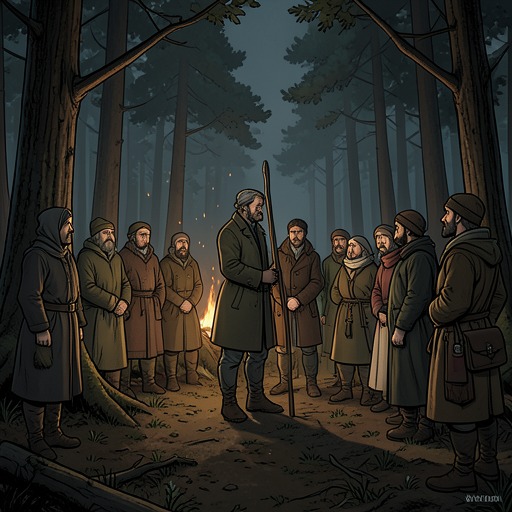
The company’s underlying commercial logic appears in Charles Duquet’s early search for a resource more dependable than fur. Overproduction, scarcity, disease, and uncertain animal populations convinced him that the fur trade could not guarantee wealth across generations. He settled instead on timber: forests seemed vast and self-renewing, while wood had uses in ships, houses, and heating. His plan was to accumulate capital in furs, then move into timber when prepared. He invited Toussaint Trépagny and Fernand Trépagny to join that future venture, but they offered no immediate enthusiasm. The contrast established a durable tension in the company’s later history: the forest could be imagined as a permanent inheritance even as commercial methods made it vulnerable to depletion.
The timber trade also depended on the movement of goods across long distances. Observing a three-cornered route in which Captain Verdwijnen exchanged cargo in India, Duquet considered how such a network might serve a lumber merchant. The scene places timber within a wider trading imagination: access to markets and transport, not merely possession of trees, would determine profit. Much later, a shipment of the company’s best pine to Sydney, Australia, brought a proposed decade-long supply contract and interest in New Zealand kauri. The exchange shows how the enterprise’s search for timber supplies could extend from regional forests to overseas markets.
Labor, transport, and technological change
The company’s larger history belongs to a timber economy sustained by dangerous work and difficult transport. Logging camps drew a varied labor force, while the work itself demanded long days, harsh living conditions, and physical risk. River driving was especially dangerous, yet employers assigned it to Indigenous workers on the assumption that they were suited to violent water. A camp boss defended the expense of river work by pointing to its essential role: water moved logs and powered mills, and there was no other way to get the logs to the sawmill. The statement makes the river both a productive infrastructure and a site where risk was unequally distributed.
Over three generations, the Sel family witnessed tools and transport systems change around the work. The poll ax gave way to the double-bitted ax, then the crosscut saw; older gang saws were replaced by circular and band saws. Oxen gave way to horses, then to donkey engines and Shay-geared locomotives. As roads penetrated forests distant from waterways, trucks and roads displaced river drives, and workers increasingly tended machinery. These changes expanded the reach and speed of logging, but did not make the labor safe: the profession remained one in which workers had to be watchful and fortunate to survive for long. The narrative’s sequence of tools and machines registers technological progress as a transformation in the scale and organization of extraction, not as a simple escape from its costs.
The company’s business thinking likewise centered on transport costs. James Duke was told that timber profits depended heavily on moving logs, and that steamboats could change the calculation. The discussion extended to steam engines and the possibility of railways reaching dryland pineries where rivers could not carry timber. The imagined railway promised access to new stands, but also made clear that the company’s expansion depended on infrastructure capable of overcoming the limits of geography.
International expansion and forest loss
Breitsprecher-Duke’s overseas ambitions became explicit when it sent its first shipload of best pine to Sydney. A prospective buyer sought both a long-term Michigan pine supply and a partner to establish efficient logging camps in New Zealand, where kauri grew. The company welcomed the prospect of new timber sources and treated efficiency as a business principle. In the wider narrative, that language of efficiency marks not a neutral improvement but an expansion of the company’s ability to take timber from more places and move it into distant markets.
The New Zealand shore stations illustrate the environmental consequences of this model. Logging camps and trading posts dealt in flax, spars, and lumber, while warehouses, sawmills, and small shipyards drew Europeans into coastal districts. Operators removed the most valuable timber and shifted camps onward, leaving burned stumps and deep waste. The assault moved from kahikatea to kauri; felled trees could carpet the ground for days of walking, before the mass was burned along with the surrounding forest life and vegetation. The newcomers’ limited interest in the country beyond profitable materials is condensed in the assumption that the forest was simply there for them. The episode gives the company’s wider expansion a landscape-level consequence: commercial supply chains separated the profits of timber from the extensive damage left at the source.
The company’s later participation in global extraction is stated directly through its alliance with banks and industries dealing in mining and agricultural commodities. As Breitsprecher-Duke joined this network, it became part of a new colonialism and moved into the assault on tropical forests. Charley Breitsprecher’s notebooks, full of information about tropical trees, passed to his nephew Conrad with the seedling nursery business. The company then used Charley’s forest knowledge to plunder the very forests he had studied. In this reversal, knowledge that could serve observation and cultivation becomes an instrument of extraction.
Decline, sale, and remainder
After the Second World War, the company experimented with hardboard siding, including a trial made with seaweed and corn-husk pulp, but moisture problems led it to abandon the product. It concentrated instead on Brite-Ply, made from culls and timber salvaged after forest fires. A postwar building boom offered some business, but larger competitors supplied by cheaper Canadian wood pushed the company into decline. Its public image of vigorous activity—its leaders photographed before log piles or machinery—persisted even as the underlying business weakened; the photographs, like the plywood itself, presented a polished surface over inferior material.
The next generation had little interest in the plywood company, while Sophia Hannah Breitsprecher Harkiss pressed for a place in it and objected to being excluded from a business run by her brother and husband. Her appeal recalled the precedent of Lavinia Duke, who had controlled the lumber business from a young age. The episode reveals that the company’s succession was also a struggle over who could hold authority within a family enterprise, even as the enterprise itself was losing strength.
The company’s ending is figured as a tide going out. International Paper entered as the old concern fell, leaving only boxes of papers and several portraits, alongside the separate Breitsprecher Seedlings entity. The remainder preserves an uneven legacy: corporate records and family images survive, but the timber company that once pursued seemingly inexhaustible forests no longer does. Its rise and fall expose the distance between the promise of lasting wealth and the physical and human costs of continually widening extraction.