Duke Logging and Lumber
BarkskinsDuke Logging and Lumber is the timber enterprise built around the ambition to turn forests into a lasting source of wealth. Its history follows a chain of connected operations—from choosing timber as a more dependable commodity than fur, through logging and river transport, milling and overseas sales, to land acquisition, corporate consolidation, and renewed efforts at forest management. That chain also exposes the company’s central contradiction: the same business that depends on forests repeatedly treats them as an inexhaustible supply, while the costs of extraction fall on landscapes and workers beyond the boardroom.
From Fur to Timber
The company’s guiding idea precedes its mature operations. Watching the fur trade swing between abundance and scarcity, Charles Duquet dismisses the promise of permanent wealth from beaver pelts: animal resources could vanish, markets could become saturated, and fortunes tied to them seemed too uncertain to establish a lasting family name. He instead sees forests as an enduring commodity that Europe lacks and imagines timber serving ships, houses, and fuel. He plans to accumulate capital in the fur trade before shifting to wood, and briefly invites the Trépagny brothers to remain partners in that future venture. Their guarded response foreshadows that his commercial vision will not necessarily be shared by those around him.
The forest-to-market idea later becomes a transatlantic business. A trading route through India, where Captain Verdwijnen exchanges goods for produce, spices, and medicinal opium, prompts Duquet to consider whether a similar circuit could work for a lumber merchant. The episode places timber within a broader system of shipping and international exchange rather than treating a forest as a resource valuable only at the point of cutting. Much later, Duke & Breitsprecher sends its first shipload of best pine to Sydney, Australia. An English buyer, Harry Blustt, seeks a decade-long supply arrangement and raises the possibility of a New Zealand logging partnership, extending the company’s search for timber beyond North America.
Work, Transport, and Production
The company’s fortunes depend on the infrastructure that moves wood. James Duke’s business partner Lennart Vogel explains that timber profits rest heavily on transportation costs and that steamboats might transform log movement. The prospect of steam locomotives reaching dryland pineries is likewise presented as a potential break with reliance on rivers: until such routes exist, the company’s returns remain tied to water transport. Technology promises access to new stands and lower constraints on movement, but it also makes more extensive extraction possible.
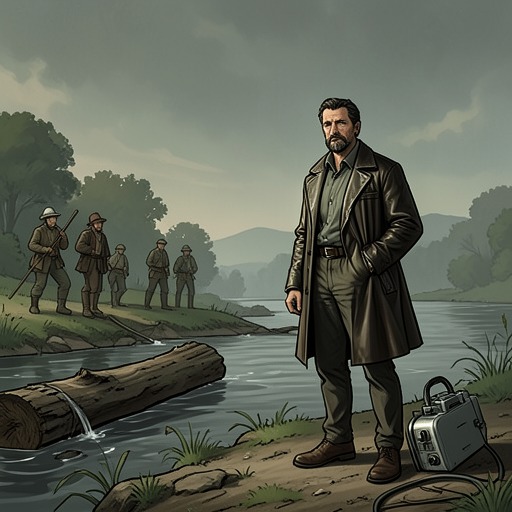
Logging is shown not as an abstract input to commerce but as arduous, hazardous work. At a camp run by Marchand, men rise before daylight, carry their axes to the cut, and return to crowded quarters after long days; after the spring drive, many spend their wages and wait for another contractor to hire them. Jinot works through chopping and river driving, briefly tries the sawmill, and returns to camp. River work is especially dangerous, and the account describes a racialized division in which the boss assigns water work to Indigenous workers because he regards them as expendable. Logs must be guided through the river by men using long pike poles and tools for shifting hung-up timber; the work keeps them in cold water and exposes them to injury. This labor underwrites the lumber economy, while the workers’ limited alternatives help make the danger seem routine to those directing it.
The bottleneck moves from forest to mill as production expands. On a Michigan mill inspection, James explains to Lavinia that the existing mill, bought from Joe Push, can process about three thousand board feet a day, while the shanty workers cut trees faster than the mill can handle them. Circular saws are on order to replace the older gang rig, and James considers turbines for additional power, portable mills close to logging camps, and finishing capacity for smooth boards and shaped woodwork. These plans show the company attempting to coordinate cutting, milling, and transport as one production system. The proposed improvements are framed as ways to increase capacity and flexibility, not as limits on the amount of forest harvested.
Expansion and Corporate Methods
During the Civil War era, the expanding national economy and rail infrastructure enlarge the market for the company’s lumber. Duke’s shipments quadruple as the Union Army builds forts and prison camps; the narrative also records the company’s willingness to supply warped and knotty lumber at the price of clear. In a period of rapid growth, business opportunity and compromised standards appear together.
The company’s land acquisitions depend on the federal preemption and homestead systems. Lawyer Flense argues that the government cannot prove claims were not made in good faith. Duke sends landlookers to select desirable timber tracts, uses nominal settlers to obtain deeds, and buys large blocks of land before cutting the timber and relinquishing the homestead rights. The methods described include makeshift shacks and portable structures presented as dwellings. Small loggers also sell to Duke after facing threats, sawmill fires, and extensive log theft. The company’s expansion is therefore not simply a matter of locating forests: it relies on legal openings, intermediaries, coercive conditions around smaller operators, and the rapid conversion of acquired land into cut timber.
The company also diversifies its commercial structure. After an inventors’ gathering, Duke Logging Corporation creates the Prairie Home Division to manage the packaged-house business, including transportation to the prairies and the supply of milled lumber and architectural components. Parker Brace, Hudson Van Dipp, and Charles Munster Weed are to direct construction as salaried employees, rather than as full partners; the Board rejects Weed’s preferred partnership arrangement. The episode shows the company extending its reach from raw lumber into a finished product while retaining control over the venture’s organization and returns.
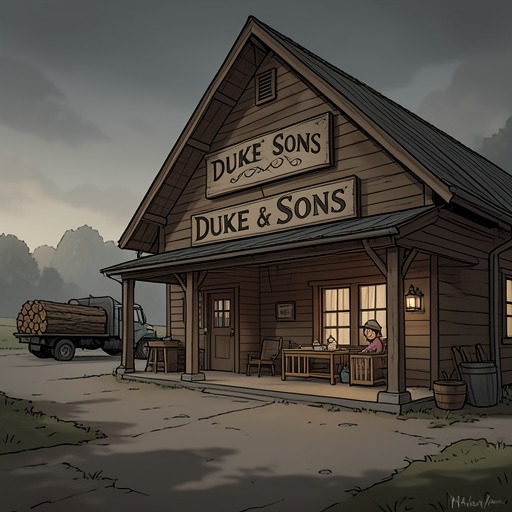
Dieter Breitsprecher’s marriage to Lavinia gives their enterprises a further corporate connection. Dieter becomes the company figurehead while Lavinia continues to manage and control it. In negotiations with Dieter’s business manager, Maurice Mossbean, Lawyer Flense and Mr. Pye work out how to fold the Breitsprecher enterprise into Duke Logging and Lumber; the proposed name is Duke and Breitsprecher. Dieter is relieved to leave business administration to Duke, so that he can concentrate on management plans, his pine nursery, and the study of hardwoods. The merger thus joins an expanding timber business to a different interest in forestry, although it does not erase the tension between commercial control and long-term stewardship.
Markets, Forest Costs, and Conservation
The overseas market makes that tension visible at a larger scale. In New Zealand, shore stations combine logging camps with trading posts, warehouses, sawmills, and small shipyards. The operations take valuable timber and then move on, leaving extensive waste; the account describes forests cleared first for kahikatea and then kauri, with felled material burned to clear land. These stations are not identical to the company, but they establish the extractive model that Duke & Breitsprecher enters when it seeks overseas timber. Its interest in New Zealand is expressly tied to finding new wood supplies and efficient logging operations.
Dieter presses the company to treat cutover land as an asset with a future, not merely as ground to sell after cutting. He asks that logged pine lands be held in a separate Maintenance Timberland division under his supervision, replanted and managed; this measure accompanies acreage he keeps outside the merger. His argument to the Board is temporal as well as financial: future scarcity could make timber more valuable, and previously planted Breitsprecher lands already show that managed stands may become valuable timber decades later. The proposal forces the Board to consider a horizon of decades rather than months, and gives the company’s reputation an initial association with conservation.
That policy remains vulnerable to the company’s demands for recovery and profit. After Flense’s fraud leaves the business weakened, Lavinia points to the remaining plywood and paper mills as sources of income and orders every kauri cut, despite the earlier promise to the Ovals not to clear-cut and abandon the land. Her decision begins to rebuild the fortune, but reverses the restraint that Dieter had sought. The company’s persistence is therefore inseparable from a repeated moral and ecological compromise: conservation is recognized as a future need, yet can be overridden when immediate financial recovery takes priority.
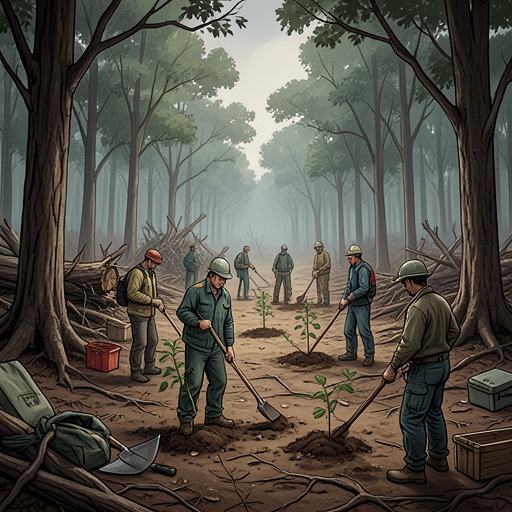
A later attempt to reshape forestry moves from managing cutover land toward improving regeneration itself. Conrad concludes that merely leaving scattered wild trees to seed logged areas produces poor results, and that site preparation is essential if planted seedlings are to survive. After enrolling in forestry school, he decides that Breitsprecher should offer site preparation as a service, persuading timber companies that their future supply depends on planting among the stumps. He also considers research into seedlings grown in paper cylinders, whose performance appears better than bare-root stock on the same site, while weighing nursery capacity, species, labor, planting conditions, and cost. The new approach makes restoration part of the business proposition, but it also recognizes that forest renewal requires practical knowledge and investment rather than an assumption that nature will refill every cut unaided.
Fraud, Retrenchment, and Legacy
The company’s reliance on delegated authority and personal trust eventually becomes a point of collapse. Auditors discover that Flense had broad powers to acquire and sell property on Duke Logging’s behalf, despite being an employee rather than a partner or stockholder. He secretly sells company woodlands, lumber barges, and warehouse contents. Lavinia says that she trusted him personally and relied on a gentleman’s agreement; the accountants tell her that he defrauded the company. The loss is not only financial: assets accumulated across land, transport, and storage have been exposed to the discretion of one trusted agent.
The national downturn compounds the fraud. Falling stock and land values, labor unrest, and strikes leave the company with a skeleton staff and a lean future. Seeking to sever the business from the arrangements associated with Flense, Lavinia votes with the remaining Board to surrender the incorporation charter. She argues that incorporation had helped when the company needed capital for logging railroads, barges, steamboats, and roads, but that it no longer suits the business’s reduced circumstances. Duke & Breitsprecher returns to sole proprietorship, operating on a shoestring. Retrenchment alters the company’s legal form without resolving the underlying problem of how to balance commercial survival with responsible use of forests.
Lavinia nevertheless keeps the enterprise operating by returning to sources of revenue and technical development: the kauri is cut, while the plywood and paper mills remain in business. She also insists that the annual inventors’ exposition continue after the Hotel Great Lakes burns, proposing a company-property venue that would connect machinery innovation with the company’s own small forest. Across its successive forms, Duke Logging and Lumber is thus defined by expansion and adaptation—new markets, mills, products, and legal structures—but also by the recurring limits of those strategies. Its history makes visible the distance between seeing the forest as permanent wealth and accepting the long labor, restraint, and stewardship needed to sustain it.