Royal Navy
BarkskinsThe Royal Navy appears not as a single onstage institution but as a powerful market whose demand for masts, ship timber, and other naval stores helps organize the novel’s expanding timber economy. Its needs connect forests in New France and the colonies to overseas shipbuilding, while regulations meant to secure those supplies become a source of colonial resentment and commercial maneuvering.
Naval demand and Duquet’s timber strategy
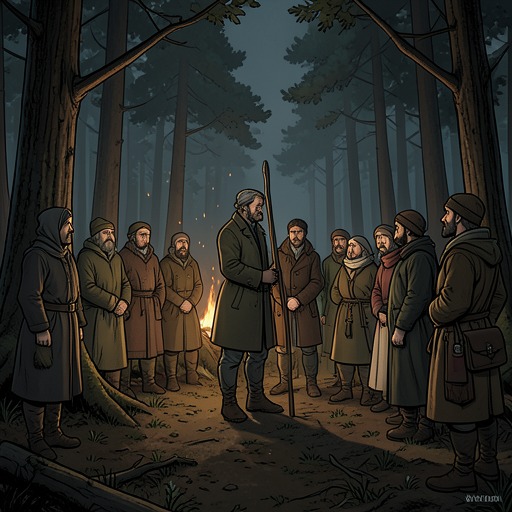
Charles Duquet’s turn toward timber begins with his distrust of the fur trade’s instability. Beaver could disappear through overtrapping, disease, or uncertain causes, and its market swung between scarcity and surplus. He therefore searches for a resource he believes can sustain wealth for generations and settles on the forest, reasoning that Europe needs timber and that it can supply ships, houses, and fuel. The example of English colonists cutting pines for the Royal Navy’s masts makes the opportunity visible to him: a forest commodity could support a durable fortune where fur could not.
Duquet first intends to accumulate money through furs, then move into timber when prepared. Later, he takes the risk of supplying English and Scottish interests, working through Benton Dred-Peacock and a shipbuilding yard on the Clyde. The trade is secret, complex, costly, and dangerous, but the profits rise year by year. The scale of naval construction gives the enterprise a material measure: the novel notes that building one seventy-four-gun warship required fifty acres of oak. Hardwood forests along New France’s rivers consequently begin to fall to Duquet’s ambitions, even as he regards distance from Kébec to the world’s financial centers as a business constraint.
Regulation, colonial grievance, and land claims
The Royal Navy’s supply needs are linked to the Royal Board of Trade’s stringent rules governing the cutting of dense forests and the provision of masts, bowsprits, yards, pitch, and tar. In conversation with Duquet, Dred-Peacock describes these controls, together with the Acts of Trade and Navigation, as restrictions that colonial merchants resent. The rules frame timber not merely as a profitable product but as a strategically managed resource: the Crown seeks naval stores, while colonial traders object to limits on how and where they may produce and sell them.
The legal dispute over mast pines in Maine shows the tension between royal claims and later private title. A five-year procurement license granted in 1730 authorized Ralph Gulston to cut mast pines on lands belonging to the Crown in 1691. Gulston hired William Leighton, who cut and removed the trees during the winter of 1733–34. By then, however, the land had passed to John Frost, whose title the Royal Surveyor General ignored. Frost sued Leighton for trespass in spring 1734, and the court found for Frost. The case exposes the collision between the Crown’s naval procurement arrangements and an owner’s claim based on subsequent title.
From forest resource to global commodity
The timber economy represented by the Royal Navy’s demand expands beyond the Atlantic. In India, Captain Verdwijnen trades ceramics and silks for food and spices and takes on Patna opium for medicinal trade in Amsterdam; Duquet notices the possibility of adapting such a triangular route to lumber. The episode connects forest products to shipping networks already carrying diverse goods, although the discussion turns as well to the growing Chinese market for opium.
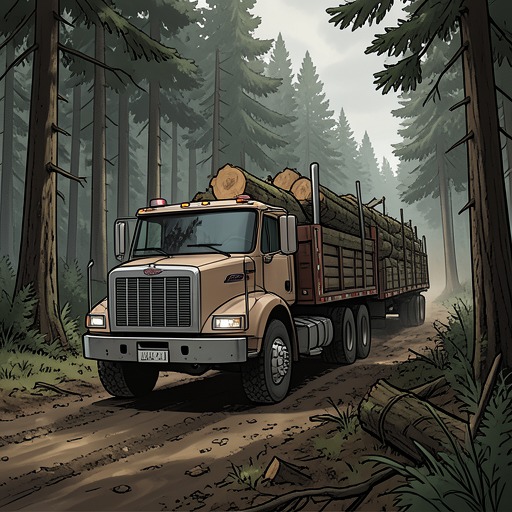
Later, Duke & Breitsprecher sends its first shipload of best pine to Sydney, Australia, and Lawyer Flense meets a buyer seeking a decade-long supply contract as well as a logging partner for New Zealand. This later development is not described as a Royal Navy transaction; rather, it shows how the timber trade’s commercial reach has grown beyond the naval market that helped make the forest’s value legible to Duquet. The same extractive logic recurs in New Zealand, where logging camps and trading stations strip coastal forests and move on, leaving burned and wasted timber behind.
Significance
The Royal Navy’s role reveals how military demand can make forests legible as long-term commercial assets. Duquet treats the forest as more dependable than animals or furs and initially imagines its supply as effectively enduring; the costs of that conviction appear in the falling hardwood stands and, later, in the large-scale depletion of forests elsewhere. The Navy’s procurement rules also show that access to timber is shaped by law and political authority, not simply by the existence of trees. Across the novel, naval demand is therefore both an incentive for the timber business and part of a larger system in which regulation, private profit, transport, and ecological loss are inseparable.