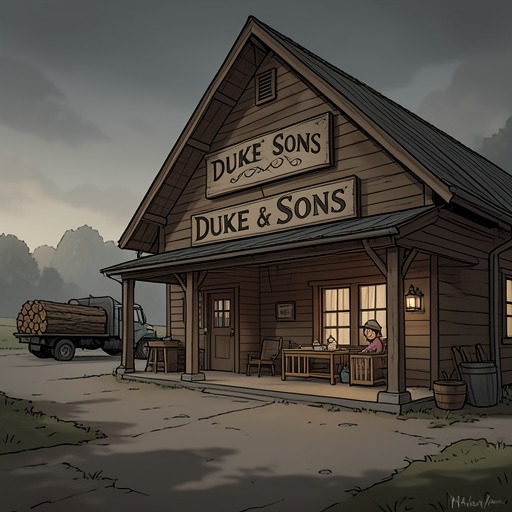
RBB Timber Company
BarkskinsRBB Timber Company is the timber concern formed by the Breitsprecher brothers with their cousin, Count Ernst-August von Rotstein. Its purchase of a quarter million acres of Michigan pine, enough to bring its holdings close to those of the Duke family, makes it a formidable competitor and begins a rivalry that reshapes the companies’ place in the forest economy. The novel presents that contest against a larger pattern: timber wealth depends not only on who owns the trees, but on the transport, labor, machinery, and markets that make forests commercially accessible.
Formation and Michigan Acquisition
RBB’s name identifies its partners: Rotstein, Breitsprecher, and Breitsprecher. The company’s appearance in the land records surprises the Duke family. The old landlooker, once associated with their own operations, has become part of a new enterprise backed by the considerable wealth of Count von Rotstein. The company has already bought a quarter million acres of Michigan pine, and its holdings nearly equal those of the Dukes.
The revelation reaches James Duke through his daughter Lavinia, who overhears the news before Cyrus Hempstead can bring it to the house. She warns James that the Breitsprechers and their wealthy associate have become enemies. The acquisition thus functions as more than an expansion of timber acreage: it makes competition between the two business interests explicit and gives the novel’s corporate rivalry a concrete scale in land and forest.
A Wider Timber Economy
RBB’s rise belongs to a trade built around the challenge of turning standing timber into a profitable commodity. The novel had already shown Charles Duquet rejecting fur as an unstable basis for lasting wealth: beaver populations and prices could fluctuate, while he imagined forests as a resource that could supply ships, houses, and fuel. Timber’s apparent abundance encourages long-range commercial ambition, even as later episodes expose the ecological damage and human costs hidden by that assumption.
The timber chain connects forest lots to distant buyers through camps, rivers, mills, and shipping. In New Zealand, logging stations combine camps and trading posts with warehouses, sawmills, and small shipyards; operators cut valuable trees, abandon waste, and move on. Elsewhere, the Duke business’s first shipload of premium pine reaches Sydney, Australia, and a buyer there seeks a decade-long supply contract while also expressing interest in New Zealand kauri. These episodes show the global market into which timber companies seek entry, though the evidence does not identify RBB as the company responsible for those particular operations.
Transport, Machinery, and Production
Transportation costs shape the industry’s prospects. Lennart Vogel tells James Duke that timber profits depend heavily on moving logs, and he sees steamboats as a possible means of changing that calculation. Edward Duke likewise considers steam engines and the possibility of railways reaching dryland pineries that rivers cannot serve. The discussion makes infrastructure a condition of commercial growth: forests become valuable at scale only when a company can move their output.
Production technology also changes the relationship between cutting and milling. James describes an existing Michigan mill limited to about three thousand board feet per day, while the lumber crews cut faster than the mill can process the trees. Circular saws are on order to replace the older gang rig, and he considers turbines, portable mills at cutting sites, and facilities for finishing lumber. These plans belong to the Duke operation, not directly to RBB, but they clarify the industrial setting in which the rival company’s land purchases matter: ownership of vast forests is only one part of the contest for timber wealth.
Labor and the Costs of Extraction
The novel depicts logging as arduous, precarious work. In Marchand’s camp, men rise before daylight, eat sparse meals, work in severe cold, and sleep on a damp, crowded floor. Their labor includes cutting trees and driving logs downstream; the latter is especially dangerous, with wooden crosses along the banks marking deaths. A foreman explains that Indigenous workers are assigned river work because they drown as readily as white men, exposing how dangerous tasks are distributed even as the camp’s workforce is described as a brotherhood of axe-men.
River driving requires men to guide and shift logs with long pike poles and specialized tools, moving among unstable timber in fast water. The logs make forests available to mills and markets, but the work carries continual risk and injury. RBB’s acquisition therefore belongs to an industry whose apparent wealth rests on laborers facing hazards far removed from the company’s land transactions and commercial decisions.
Rivalry and Significance
The novel marks the start of the Duke–RBB rivalry through the sudden disclosure of a purchase rather than through a detailed account of RBB’s internal organization. What is established is the company’s partnership, its wealthy backing, its large Michigan holdings, and the Duke family’s recognition that a former associate has become a serious competitor. The company’s significance lies in that shift: the forest is not simply a vast resource waiting to be claimed, but contested land whose commercial value depends on capital, access, labor, and transport.
Set beside the novel’s depictions of wasteful extraction and the dangers of logging, RBB’s rapid acquisition also sharpens the tension between short-term expansion and the forest’s long regeneration. The company represents the growing scale of timber enterprise, while the surrounding narrative asks what such scale costs: who performs the dangerous work, what is left after the valuable trees are removed, and whether the industry can plan beyond the next cut.