British government
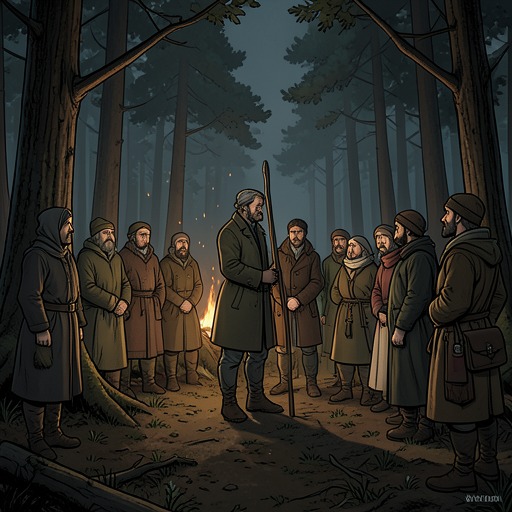
BarkskinsThe British government is a distant imperial power whose authority reaches the novel’s forests through land claims, colonial administration, timber regulation, and territorial expansion. Its rule is repeatedly presented as both a source of legal power and a contested system: colonial settlers resent decisions made in London, while Mi’kmaq people reject the premise that a European monarch can give away their homeland. The distance between imperial authority and local consequence makes government a force that can reshape land and lives without understanding either.
Imperial Authority and Colonial Grievance
The novel connects colonial resentment to the British government’s effort to restrain self-government. George Duke recalls that in 1686 the government, fearing the colonies were becoming too independent and prosperous, sent Governor Andros and revoked the colonial charter. Nicolaus Duke argues that two generations of colonial self-government had made this intervention a grave mistake, and that removing Andros did not repair the damage. The episode presents imperial policy as an attempt to recover control over societies that had acquired local political experience and expectations of autonomy.
George’s broader indictment is that English officials wield power over colonial affairs without knowing the colonies or having experience of them. In his account, they issue rules out of ignorance and self-interest, seeking to extract wealth for their own strongboxes. Bernard Duke recognizes a parallel with the relationship between France and New France, suggesting that the abuse is not confined to one empire: colonial distance allows metropolitan authorities to govern places they scarcely understand. The British government’s authority is therefore opposed not only by Indigenous claims but also by colonial political dissatisfaction.
Timber, Property, and the Reach of the Crown
Imperial power also appears in the management of forests. In 1730 the Crown granted Ralph Gulston a five-year license to procure mast pines from Maine lands that had belonged to the Crown in 1691. Gulston later hired William Leighton to cut the trees. By the winter of 1733–34, however, the land had passed into the ownership of John Frost, who sued Leighton for trespass when the cutting continued. The case turns on the conflict between an old Crown claim and a later private title: the Royal Surveyor General disregards Frost’s ownership, but the court finds for Frost. The episode exposes the unstable boundary between imperial authority and colonial property rights, and shows how the extraction of timber makes that legal conflict materially consequential.
A separate account of colonial commerce shows how regulation can provoke evasion rather than compliance. Benton Dred-Peacock complains that trade restrictions bind colonial enterprise, and explains that merchants pursue large white-pine tracts by buying old township grants and cultivating relationships with politically influential men. He describes the King’s Surveyor as an obstacle who scrutinizes lumbermen’s licenses and permits, while Duquet seeks details about acquiring townships. The resulting network of ships, operating under British flags between Portsmouth, Boston, and the Clyde shipyards, makes timber commerce a business negotiated through both imperial rules and circumvention of them.
Territorial Transfer and Mi’kmaq Sovereignty
The novel places British expansion within a longer history of territorial dispossession. On the Sel family’s return to Mi’kmaw country, Sosep warns that the French king has given their land to the British. Theotiste answers that the land was not the French king’s to give: it belongs to the people who live there. Her response directly contests the European premise that imperial rulers can transfer Indigenous territory as property. The change of colonial power does not resolve that conflict; it makes the settlers’ claims more pressing.
Sosep describes the consequences in lived terms. Acadian settlement has turned woodland edges into fields of maize and turnips, drained salt marshes for hay, and driven large game inland. Beaver numbers have fallen under the fur trade, and the animal’s role in Mi’kmaq burial custom has diminished as its skin becomes a form of white man’s money. Later, Sosep warns that settlers’ livestock damage food sources, their boats and nets take fish, and introduced plants displace local ones. He urges the Mi’kmaq to maintain their own understanding of a world in which plants, animals, birds, and people are persons who help one another. The British transfer of sovereignty thus belongs to an accumulating material transformation, not merely a change of flag.
Settlement, Law, and Unequal Claims
Settler law repeatedly gives formal force to claims that exclude Mi’kmaq people. When Renardette and Démon Meillard arrive to assert ownership of René Sel’s former property, they rely on his notarized title and his bequest to his adopted daughter. Démon presents Renardette as the rightful owner and denies the Sel children’s claim to be René’s descendants; he insists that the sale will be entered in Captain Bouchard’s ledger and made legally binding. The scene’s confidence in documentation contrasts with the family’s appeal to René’s marriage to Mari under white law and the recorded history of the house. Legal form does not settle the moral or familial dispute; it determines whose account can be enforced.
The novel also shows the uneven consequences of forest settlement through René Sel’s life. He begins by asking why settlers cut forest rather than build on existing clearings. Monsieur Trépagny defends the practice as a project of subduing wilderness and explains the river-to-forest strips as a way to combine fertile soil, flood-safe ground, and timber. As more settlers arrive and Crown corvée gangs widen a trail into a road, trees fall, farms spread, and animals retreat. René, the woodcutter, becomes both agent and witness of the change, feeling that his blows are negligible against the seemingly endless forest even as the work consumes his life. Government-backed settlement and labor thus join private occupation in altering the landscape.
Power, Distance, and Consequence
Across these episodes, the British government is not represented through a single continuous administrative presence. It is encountered through remembered constitutional intervention, the Crown’s timber license, the surveyor’s authority, imperial territorial transfer, and the settlement enabled by colonial expansion. These instruments produce different conflicts: colonial subjects resist distant control, property holders challenge Crown claims, merchants negotiate restrictive rules, and Mi’kmaq people reject the right of foreign monarchs to dispose of their land.
The contrast between official legality and lived consequence gives the government’s role its central significance. Licenses and titles can determine who cuts trees or claims a house, while the transformations they authorize reach beyond paper: forests are cleared, animal populations decline, and Indigenous communities face pressure on their food, territory, and cultural practices. The novel’s account does not treat imperial rule as an abstract structure separate from the woods. It shows authority operating through the changing landscape, while the people most affected by its decisions dispute both its legitimacy and its account of ownership.