Kuntaw’s band
BarkskinsKuntaw’s band is a Mi’kmaw community shaped by kinship, shared responsibilities, and a persistent effort to remain connected to its homeland as settler rule narrows the space in which its people can live. Centered on the Sel family and led by Kuntaw, the band’s story moves between attempted return, practical adaptation, and losses that cannot be repaired by adaptation alone. Its members’ histories reveal how the pressures of land seizure and wage labor extend beyond individual lives, reorganizing family and community across generations.
Community and Leadership
Kuntaw is the Sel clan’s elder and sagmaw, and the band offers a place of belonging to descendants whose ties to Mi’kmaw life have been weakened by separation. When Aaron Sel arrives in Mi’kma’ki after his father Jinot Sel leaves for New Zealand, he expects ceremonial welcome and a ready sense of home. Instead, he discovers that he cannot repair an eel weir, identify plants, or hunt the animals he imagines finding; beaver and caribou are no longer available. His frustration makes the distance between descent and lived knowledge painfully concrete. Kuntaw tells him that he must learn to give rather than take, a rebuke that frames belonging as participation and responsibility rather than a claim to instant acceptance.
After two unsettled years, Aaron leaves for Boston, and his eventual return is met not with a test but with an embrace. Kuntaw calls the community together, asks his wife Maudi to prepare a celebration, and welcomes him as a Mi’kmaw son who has come home. The gathering includes fish brought by Etienne, Peter, and Alik, and women from nearby wikuoms who help make the feast. Aaron tries to explain that he has changed, but Kuntaw answers through an image of water and mackerel oil: mixed together by stirring, the oil nevertheless rises to the surface. He uses the separation to describe his own history of trying to become white and the persistence of Mi’kmaw identity within him. The image does not promise an untouched return to the past; it imagines a changed Canada in which the two peoples influence one another without erasing Mi’kmaw presence.
Belonging, Livelihood, and Community Debate
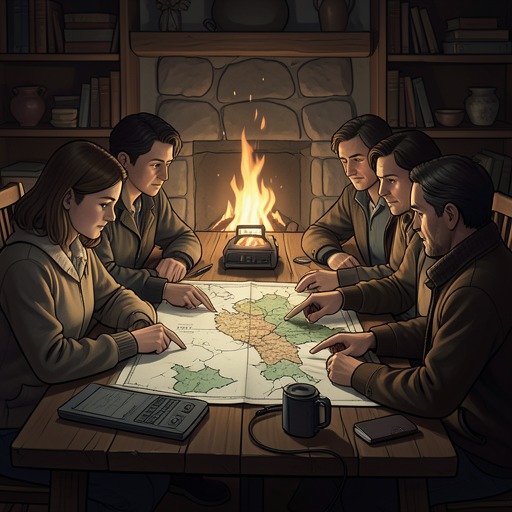
The band’s collective deliberations make clear that cultural continuity depends on material conditions as well as memory. During a discussion held with the traditional talking stick, members name food shortages, lost territory, discriminatory laws, and the loss of skilled canoe makers. Maudi interrupts the men’s discussion to identify another urgent problem: the community needs women. Kuntaw and Etienne agree that women have not come because they have not heard that they would be welcomed. Kuntaw recalls an older Mi’kmaw understanding of women as decision-makers and people of equal value, contrasting it with the influence of settler gender norms on Mi’kmaw men.
The conversation turns to a starving couple, Louis and Sarah Paul, whom Aaron has encountered in a village wikuom. Two days later, Aaron, Etienne, Peter, and Alik go to find them and bring them to K’taqmkuk. They discover that settlers have cleared and burned the site, and a settler fires a shotgun toward them. Etienne identifies the men as land-takers who clear trees in order to sell the land, not simply as settlers making homes. The failed search gives the band’s discussion of territory an immediate human consequence: even a place of refuge can be destroyed before the community can reach the people in need.
The band also seeks income through skilled work rather than relying only on access to forests controlled by others. Etienne describes a cooperage equipped with a workshop, forge, oak planks, steamer, and plane, where Mi’kmaw workers make barrels, tubs, casks, and kegs for white buyers. Julian Cooko, who had worked in a cooper’s shop in Halifax, taught the trade and came to live with the community. This enterprise demonstrates both the band’s practical knowledge and the limited terms on which that knowledge can earn money: the products are sold into a settler economy even as that economy continues to take land and timber.
Dispossession and the Two-World Condition
The band’s return to Sipekne’katik, now called Shubenacadie, is driven by a search for community, not by the quality of the land made available to it. The place had been an old Mi’kmaw village before it was designated a reserve in 1820. Those who return face crowding, racist jeering, restrictive government rules, and land settlers regard as worthless. They carry remembered places and practices with them, but the material landscape has changed: wikuoms can no longer be made, sawmills have proliferated along rivers, and the best eel grounds have been damaged. The contrast between remembered homeland and altered present makes displacement more than a change of address; it is a disruption of the ecological and social conditions that support community life.
The scale of population loss compounds the pressure. The narrative describes fewer than fifteen hundred Mi’kmaq remaining where more than one hundred thousand had lived before settlers arrived. After a St. Anne’s Day celebration, some people attempting to paddle back across the water to Kuntaw’s former place die when a storm catches their canoes. Meanwhile, settlers predict that the Mi’kmaq will disappear. The band persists despite that prediction, but its members must continually search for food, shelter, and places where some part of their former life can be sustained.
At a community discussion about land and law, members confront the mismatch between Mi’kmaw relationships to land and settler systems of ownership. Papers, repeated payments, taxes, and English-language legal knowledge determine whether land is recognized as secured. One speaker argues that children must learn to read and write English if they are to survive within that order. Another rejects money as a sufficient remedy, noting that the reserve exists precisely because wealth does not grant the Mi’kmaq equal control over land. The debate records a painful strategic choice: adapting to settler institutions may be necessary, but it cannot undo the underlying dispossession.
Wage Labor and Cultural Change
As traditional livelihoods become less available, forestry work emerges as one of the few forms of paid employment open to Mi’kmaw men. Kuntaw’s people drift back to Sipekne’katik in search of kinship and women, but the surrounding forests are increasingly organized around sawmills and commercial extraction. Etienne argues that women can continue making baskets while men must find wages to buy food; guiding white visitors to fish is insufficient, and woods work is among the remaining options. The band’s choices are thus made within an economy whose growth has already damaged eel habitat and taken control of the land.
The talking-stick gathering ends when someone throws the stick into the fire. The narrator identifies it as the last talking stick any Sel will hold: the practice belongs to an older way. Soon nine younger men leave for lumber camps in Nova Scotia, New Brunswick, and Maine. Camp work is easier for them in one respect, because it values men according to the labor they can perform, but that measure also signals the community’s forced accommodation to the timber economy. Édouard-Outger takes a young wife, Maddil, and has six children; Lobert Sel, born in 1877, is the oldest. The family continues, but under conditions in which wage labor and commercial logging increasingly shape what choices are possible.
Lobert later brings his family to Shubenacadie and works for a timber company in exchange for logs, which he uses to build a three-room house. He does not want his sons to work in the forests or his daughters to clean settlers’ homes. Nevertheless, he signs a residential-school consent form after being told that his children will otherwise be taken by welfare authorities. He believes school will give his son Edgar-Jim, known as Egga, literacy and better work than tree-cutting. The gap between that hope and the institution’s reality shows how the demand to adapt can be imposed through coercive choices rather than freely chosen opportunity.
Intergenerational Continuity
The band’s history registers the unequal burdens carried by families as community members pursue survival. When Lobert and Nanty visit Egga at school, they bring smoked eel, Nanty’s bread, sardines, and yellow cake, sustaining their son through care and food while believing he is receiving an education. In fact, he is made to work in the furnace room and suffers abuse; he cannot tell his parents the truth. Their visits and his silence expose the limits of family protection when institutions control children and present themselves as benevolent.
Other forms of intergenerational care appear in the next generation. Bren insists that her daughters should attend university and works the night shift at a fish plant, putting nearly all her pay into an education account. Her wish to study linguistics and perhaps help revive Wôpanâak, a language she does not speak, is itself shaped by the lack of educational opportunity in her family. This later effort echoes the band’s earlier recognition that literacy and education may be needed to survive, while giving that strategy a different purpose: not simply access to settler work, but the possibility of carrying endangered knowledge forward.
Across these episodes, Kuntaw’s band is neither an unchanging refuge nor a community that simply disappears into colonial society. Its members negotiate return, work, education, family life, and cultural memory under severe constraints. The water-and-oil image, the burned wikuoms, the lost talking stick, and the successive moves to reserve and lumber camp mark different stages of that negotiation. The band’s continuing presence rests on acts of welcome and care, but the narrative also insists that resilience does not erase the losses produced by dispossession.